Estimated reading time: 7 minutes
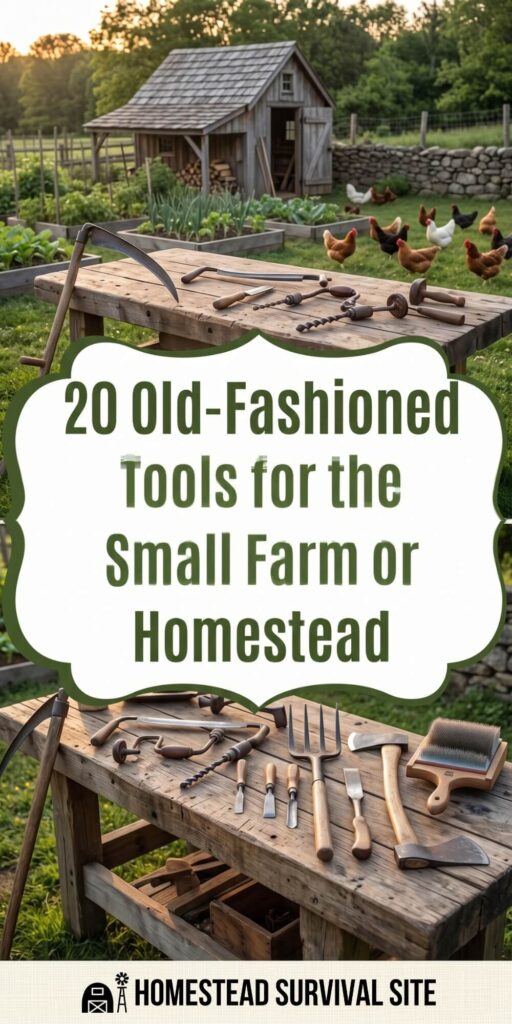
Living on a small farm or homestead means depending on yourself, and that means depending on your tools. Long before power equipment took over the barn, generations of farmers built their lives around a core set of hand tools. Nothing fancy. Just honest iron and wood designed to be repaired, resharpened, and handed down.
Whether you're fencing a pasture, tending a garden, splitting firewood, or doing rough carpentry, the right traditional tools will last longer than any battery-powered alternative. If you're serious about homestead life, stocking your shed with time-tested hand tools is a wise move.
The following list of 20 old-fashioned tools comes from the YouTube channel Farm Hand's Companion. You can watch the video and read the list below.
Want to save this post for later? Click Here to Pin It On Pinterest!
1. Crosscut Saw
The crosscut saw, whether the two-man version worked with a partner or the one-man variety used solo, is at the top of the list for good reason. It can fell trees, buck logs into firewood, and cut timbers to length without a single drop of gasoline.
Keeping it sharp and properly set is its own skill, but a well-tuned crosscut saw is one of the most capable and enduring tools ever made for working the land.
2. Scythe
Before the lawnmower and the brush hog, the scythe kept fields, pastures, and roadsides in check. A properly hung and sharpened scythe can mow grass, cut hay, and clear brush with a fluid, almost meditative rhythm that no powered tool quite matches.
It takes some practice, but once you find your swing, there's no quieter or more satisfying way to manage overgrown ground.
3. Mattock
Part axe, part hoe, all business, the mattock is your go-to when the ground fights back. Use the chisel end to cut through roots, the pick end to break up rocky or compacted soil, or the broad end to chop and scrape your way through whatever the earth throws at you.
It's one of those tools you reach for when nothing else quite fits the job.
4. Hatchets and Axes
Every homesteader should own several: a hatchet for splitting kindling and light camp work, a felling axe for dropping trees, and a broad axe for hewing and shaping timber.
Together they handle everything from firewood to framing, and a well-maintained axe edge will outperform a dull chainsaw on many smaller jobs.
5. Post Hole Diggers
Fencing is foundational to any homestead, and post hole diggers are how you set a fence line one post at a time without a tractor-mounted auger. The clamshell design lets you bite into the earth, pull up the soil, and work your way down to proper depth.
Simple, reliable, and still the fastest non-powered way to dig a clean post hole.
6. Block and Tackle
When the job in front of you weighs more than you do, the block and tackle is how your ancestors solved the problem without heavy equipment.
A simple arrangement of pulleys and rope gives you a mechanical advantage that lets one person lift, drag, or hoist objects that would otherwise require a crew. Things like logs, equipment, hay bales, and more.
7. Wash Pot
A cast iron wash pot is almost a homestead unto itself. Traditionally used for boiling laundry over an open fire, it's equally at home rendering lard, making soap, cooking down sorghum molasses, or scalding a freshly butchered hog.
Heavy? Yes. But there's almost no task that calls for a big pot over a fire that this won't handle.
8. Cottonseed Fork
Though cotton farming isn't what it once was, the cottonseed fork lives on as one of the most useful forks on the homestead. Its many light tines make it perfect for turning compost, pitching manure, moving leaves, and handling loose garden material, jobs where a heavier pitchfork would be awkward and a shovel would be too slow.
9. Shovels
Not just one shovel: you want a collection. The round-point for general digging, the square-point for scooping and moving material, the Sharpshooter (or tile spade) for cutting narrow trenches, and the big scoop for moving grain, manure, or snow. Having the right shovel for the job saves your back and your time.
10. Buck Saw
The buck saw is the old-fashioned workhorse for cutting firewood to length, and it handles rough carpentry, dimensional lumber, and even butchering tasks in a pinch. Its large frame keeps the blade taut and lets the teeth do the work efficiently without much muscle, a well-set, sharp buck saw can outpace an axe on many jobs.
11. Barn Lantern
A kerosene barn lantern means chores don't stop when the sun goes down, and that's a bigger deal on a working homestead than it sounds. Sturdy, wind-resistant, and requiring nothing more than coal oil to run, a good barn lantern is reliable in ways that battery-powered lights simply aren't when it's cold and dark and something needs doing.
12. Wedges
Iron wedges and wooden gluts (traditionally made from tough dogwood) are the muscle behind splitting large rounds of firewood. Drive them into the end grain with a maul to split logs in halves or quarters, and use multiple wedges to walk a stubborn piece apart. No splitting maul alone can do what a good set of wedges can.
13. Brace and Bit / Auger
Before cordless drills, the brace and bit was how you bored clean, precise holes in wood, and it still works just as well today. For larger holes, a T-handle auger steps in, especially useful for drilling into posts or timbers where a brace can't get the leverage. Between the two, you can drill just about any size hole you need.
14. Push Plow
One of the most versatile and satisfying tools in the garden shed, the push plow, whether single wheel, double wheel, or big wheel, can cultivate between rows, open seed furrows, side-dress with fertilizer, and hill up soil around plants. Push plows do the work of a rototiller on a garden scale without the noise or the fuel.
15. Draw Knife
A large two-handled blade that you pull toward yourself, the draw knife is the go-to tool for shaping green or rough wood. Paired with a shaving horse to hold your work, it's ideal for crafting tool handles, chair legs, fence rails, or any piece that needs to be rounded and smoothed by hand.
16. Froe
This long metal blade, driven with a wooden mallet, is the traditional tool for splitting wood bolts into kindling, shingles, or shakes. It follows the grain of the wood rather than cutting across it, which means clean, strong splits, just remember never to strike it with a metal hammer, only a wooden mallet.
17. Garden Hoe
The answer to the age-old question of how you keep weeds from strangling your crops is simply the hoe. A good hoe, or a few different styles for different row widths, makes quick, satisfying work of weeds between plants and is one of the most-reached-for tools during the growing season.
18. Rakes
A well-stocked tool shed keeps several kinds: the iron yard rake for moving leaves and debris, the four-tine rake for stirring compost or tending a fire, and the big bull rake for gathering cut hay. Each does a job the others can't, and together they cover the full sweep of farm tidying and harvest work.
19. Buckets
Every size, every shape, and yes, even the ones with a hole in them still have a use. Buckets are the most unassuming workhorses on the homestead, pressed into service for hauling water, carrying feed, collecting eggs, mixing concrete, or a hundred other tasks you'll think of the moment you don't have one handy.
20. Tamp Bar
A heavy iron rod that might look simple, but it earns its place fast the moment you hit a buried rock while digging a post hole. Use the pointed end to break up rocks and roots at the bottom of a hole, then flip it around to pack dirt firmly around a set post, a properly tamped post will outlast a sloppily set one by years.
Like this post? Don't Forget to Pin It On Pinterest!
You May Also Like:
The post 20 Old-Fashioned Tools for the Small Farm or Homestead appeared first on Homestead Survival Site.
from Homestead Survival Site https://ift.tt/DnAKjZw
No comments:
Post a Comment