Submissions     Contact     Advertise     Donate     BlogRoll     Subscribe                         

Monday, November 2, 2026

How to Water Bath Meat

Estimated reading time: 10 minutes
How to Water Bath Meat

If you’ve ever canned food before, you’ve probably heard the rule that meat should always go in the pressure canner. Period. And there’s a good reason for that. Meat is a low-acid food, and low-acid foods are where botulism likes to hide. A pressure canner gets the inside of your jars hotter than boiling water ever can, which is why the USDA says it’s the only safe way to can meat at home.

But here’s the thing: people were canning meat long before pressure canners were invented. In fact, the Amish still water bath their meat to this day. And in a lot of countries, pressure canners are either impossible to find or way too expensive, so water bathing is the only option. It’s sometimes called “heritage canning” or “rebel canning,” and while it’s not the officially recommended method, it can be done if you’re careful.

If the grid ever goes down and you’ve got a freezer full of meat that’s about to thaw, knowing how to do this could save you a lot of food. If you want to try it, there's a great video from the YouTuber Survival HT that explains exactly how to water bath meat as safely as possible. You can watch the video and read the steps blow.

Want to save this post for later? Click Here to Pin It On Pinterest!

A Quick Word Before You Start

Survival HT is upfront about this: if you own a pressure canner and can use it, use it. Water bathing meat is something she shares for educational purposes, for folks in other countries who don’t have another option, and as a backup skill for emergencies. That’s the right way to think about it.

It’s also worth knowing that boiling water doesn’t kill botulism spores the way pressure canning does. That’s why the long processing time and the “reheat before eating” step (more on that below) are so important. Don’t skip either one.

Step 1: Thaw Your Meat First

Don’t put frozen meat straight into jars. Heating up frozen jars is asking for trouble, since sudden temperature swings can stress the glass and crack it. Let your meat defrost completely before you start.
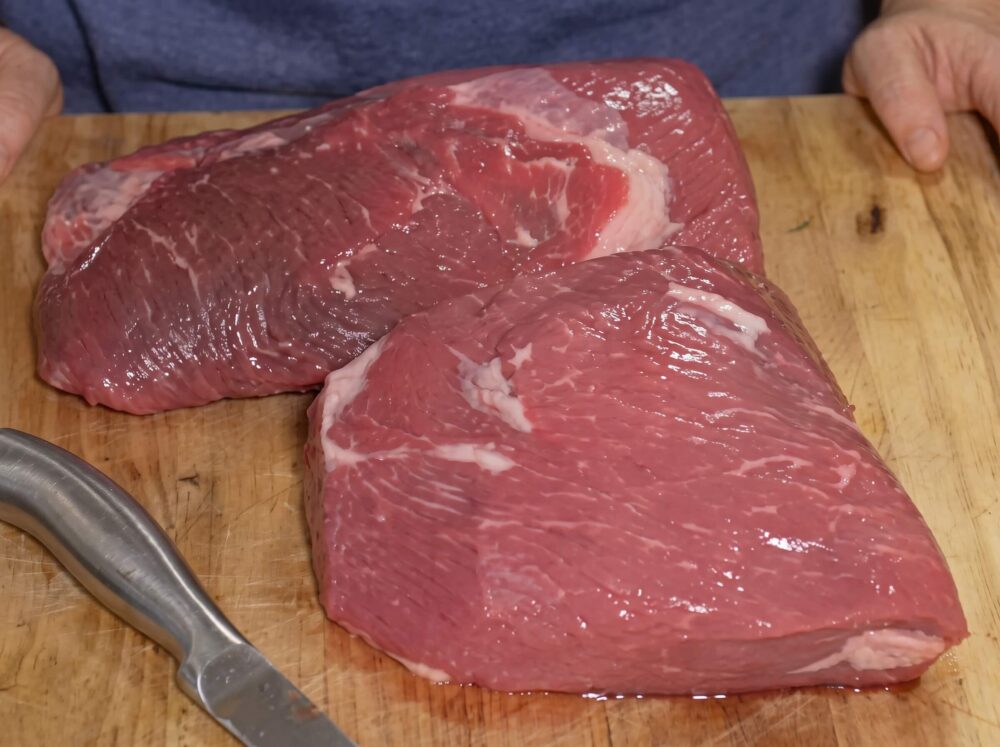
Thawed Meat

Step 2: Cut It Into 1- to 2-Inch Chunks

Cube your meat into pieces roughly 1 to 2 inches across. In the video, she used two beef roasts and cut them into about 1-inch cubes, since roast is a tougher cut. If you’re working with a more tender cut, you can go up to 2 inches.
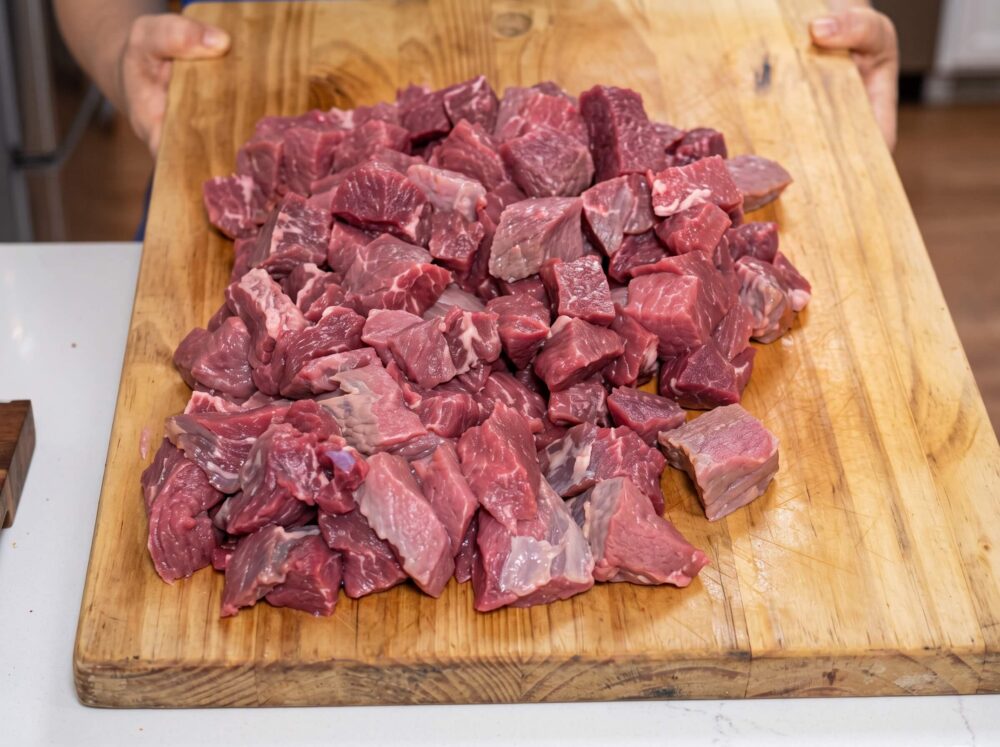
Chopped Meat

Step 3: Decide Whether to Add Liquid

If you’re raw packing (putting the meat in the jar uncooked), you technically don’t need to add any liquid. The meat releases plenty of juice as it cooks.

That said, she usually adds about an inch of water or broth anyway. Sometimes the meat doesn’t give off enough juice to stay covered, and any pieces sticking up out of the liquid can come out a little tough. It won’t make them unsafe, just less pleasant to eat.

If you cook your meat before packing it, you’ll definitely want to add broth or water.
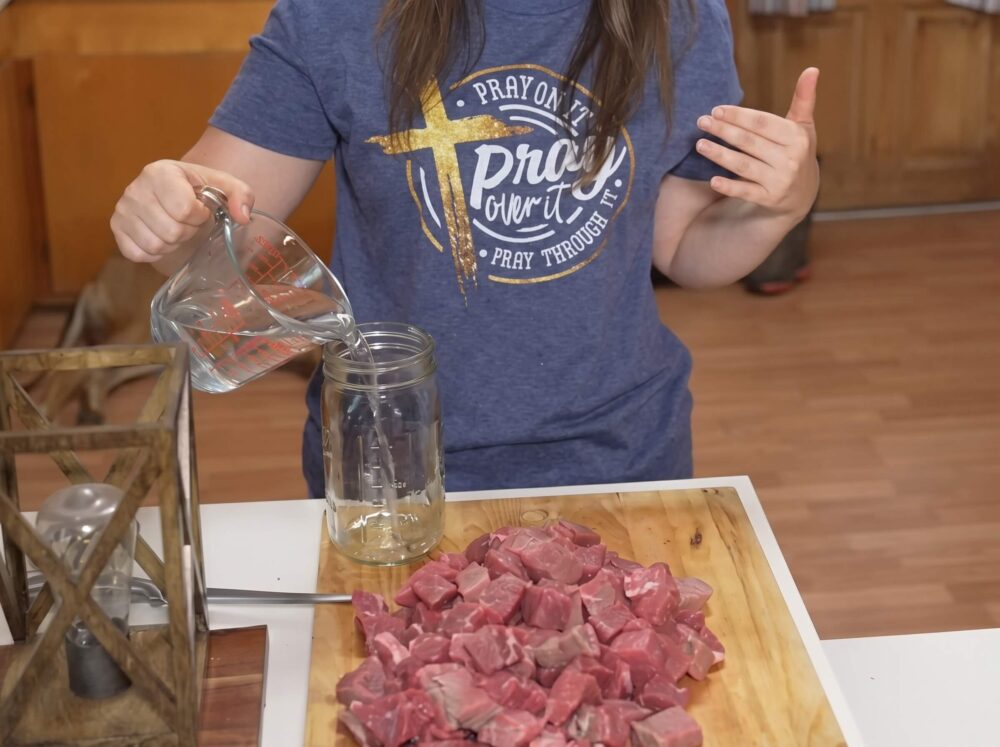
Adding Water

Step 4: Season It (Salt Is Optional but Helpful)

Salt isn’t required, but it’s a preservative, so it can help with shelf life. Most people add anywhere from half a teaspoon to half a tablespoon per jar.

She seasons everything, and her reasoning makes a lot of sense for preppers: if you’re storing food for an emergency, you don’t know what you’ll have on hand when you open it, so you might as well season it now. She keeps the salt to about half a teaspoon because her other seasonings already contain some.
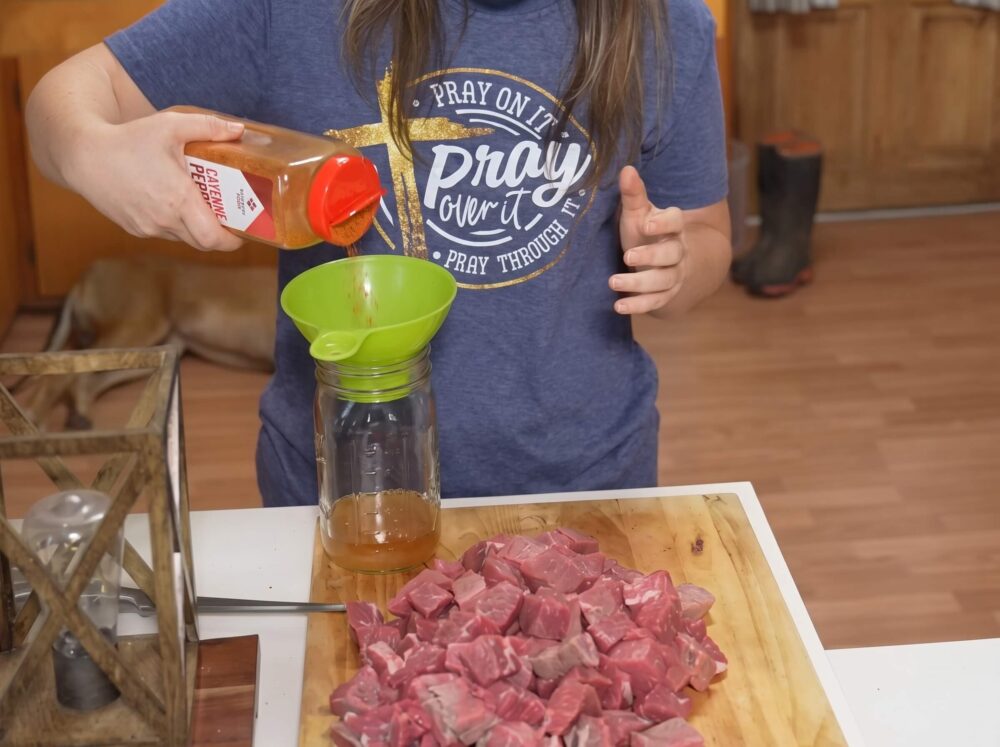
Adding Seasonings

Step 5: Pack the Jars

Wide-mouth jars are your friend here, since they make it a lot easier to get the meat back out later. Stuff as much meat into each jar as you can, leaving about an inch of headspace. It doesn’t have to be perfect.

You’ll be surprised how much meat fits. Those two beef roasts filled three quart jars.
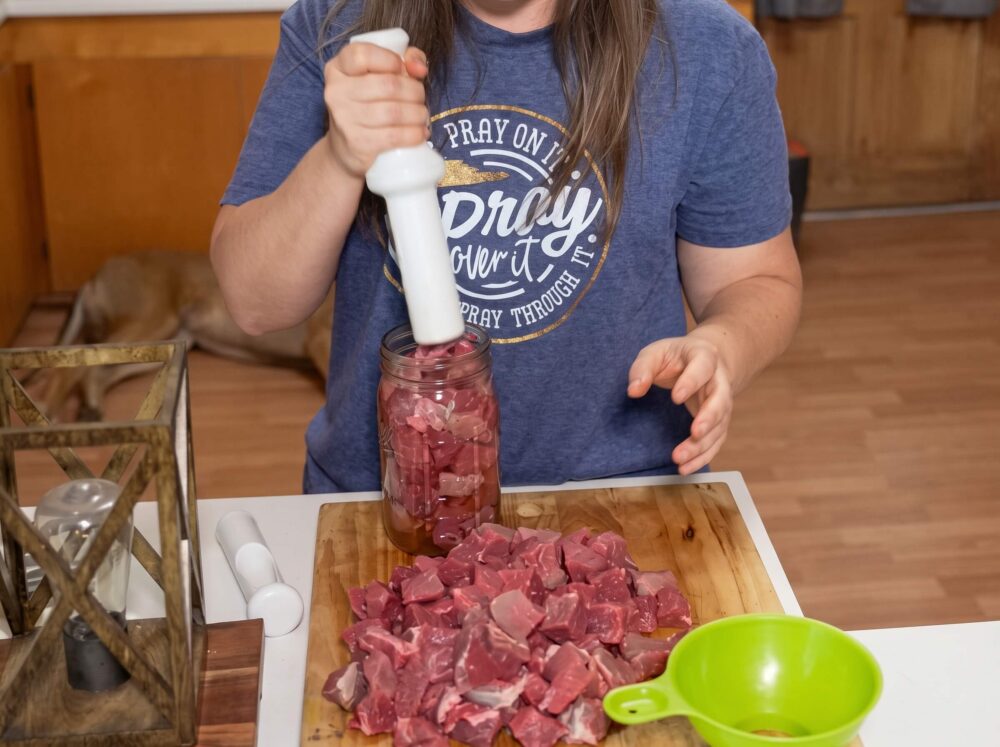
Packing the Jars

Step 6: Wipe the Rims

Before the lids go on, wipe each rim with a clean rag dipped in hot water or vinegar. Vinegar works especially well with meat because it cuts through the grease. You don’t want anything sitting between the rim and the lid, or you won’t get a good seal.
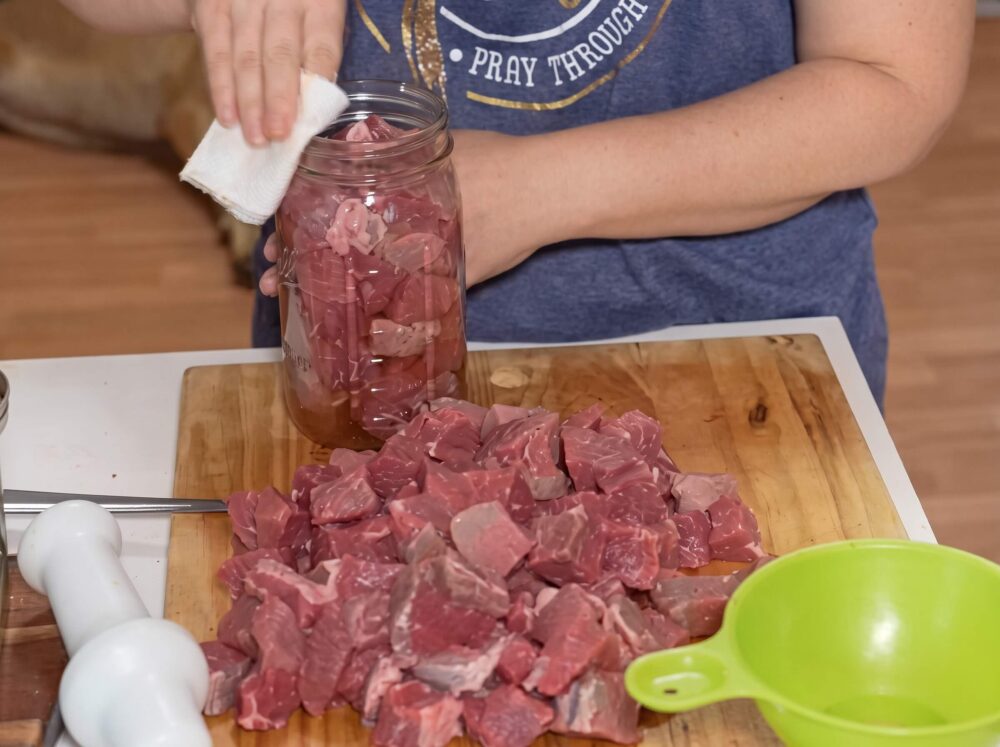
Wiping the Rims

Step 7: Put the Lids On Fingertip Tight

Screw the rings on just fingertip tight. Don’t crank them down.

Here’s why: as the jars heat up, the contents expand and push air out through the lid. Then as everything cools, a vacuum forms and seals the lid down. If the ring is too tight, the air can’t escape. You want it just snug enough to keep water out.
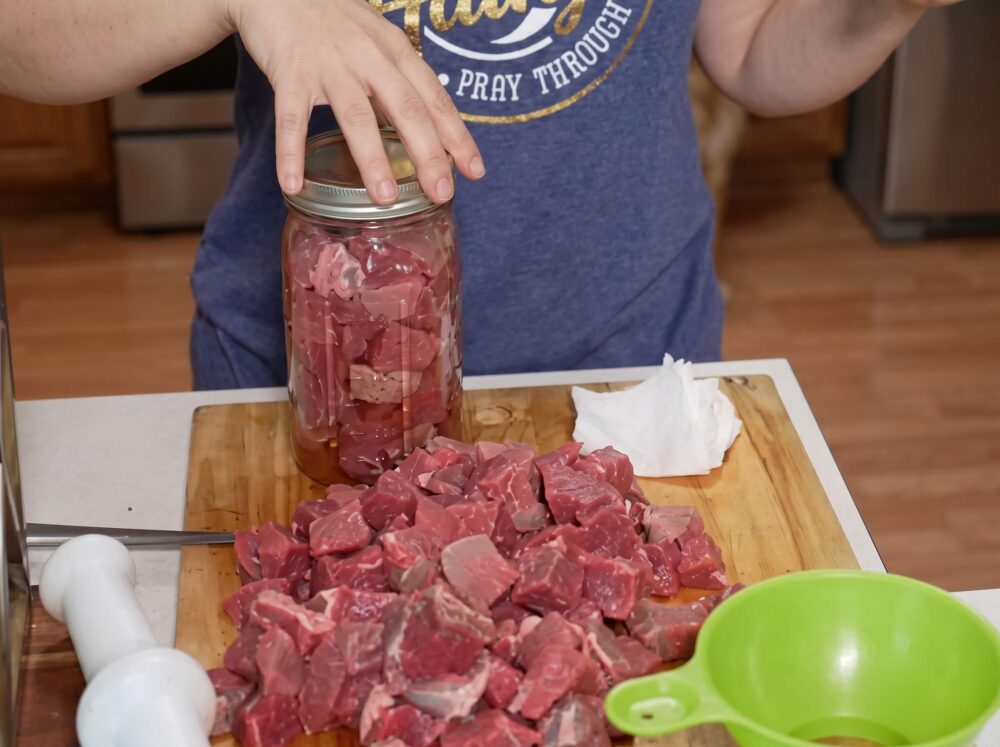
Screwing the Lids On

Step 8: Set Up Your Pot

You don’t need a fancy water bath canner. Any pot that’s deep enough to fully submerge your jars will work. A few tips:

  • Use a heavy-bottomed pot if you can. Thin pots put a lot of direct heat on the jars.
  • Put something under the jars. A canning rack is ideal, but a folded dish towel works too. It buffers the heat and keeps jars from bouncing around during the boil.
  • Fill empty space. If you don’t have a full load, add empty jars to fill the gaps so your full jars can’t knock into each other once the water’s at a hard boil.
  • Cover the jars completely. The exact amount of water doesn’t matter as long as it’s over the tops of the lids. More water means less chance you’ll have to top it off later.

The process is the same whether you’re doing three jars in a stockpot on the stove or 70 jars in an 80-quart crawfish pot over a propane burner outside.
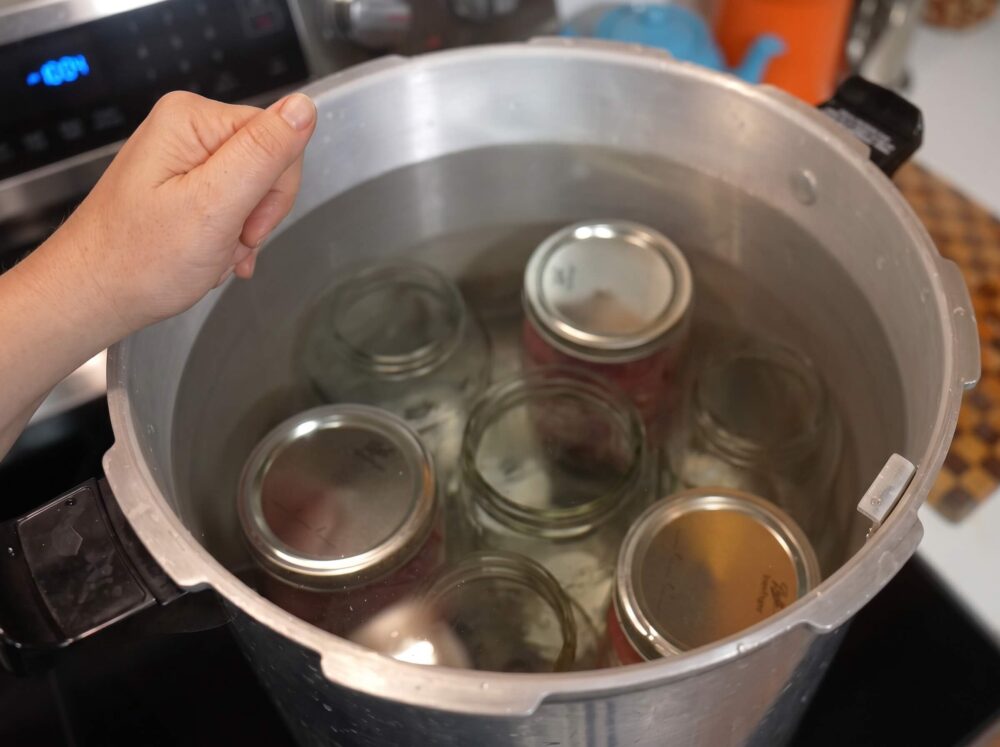
Cans in Water

Step 9: Boil for 3 Hours Straight

This is the big one. Once the water reaches a hard, rolling boil, start your timer for 3 hours. Not before. You can put a lid on the pot to help it come to a boil faster.

The boil has to be continuous for the full 3 hours. If it stops boiling at any point, you have to bring it back up to a hard boil and start the timer over.
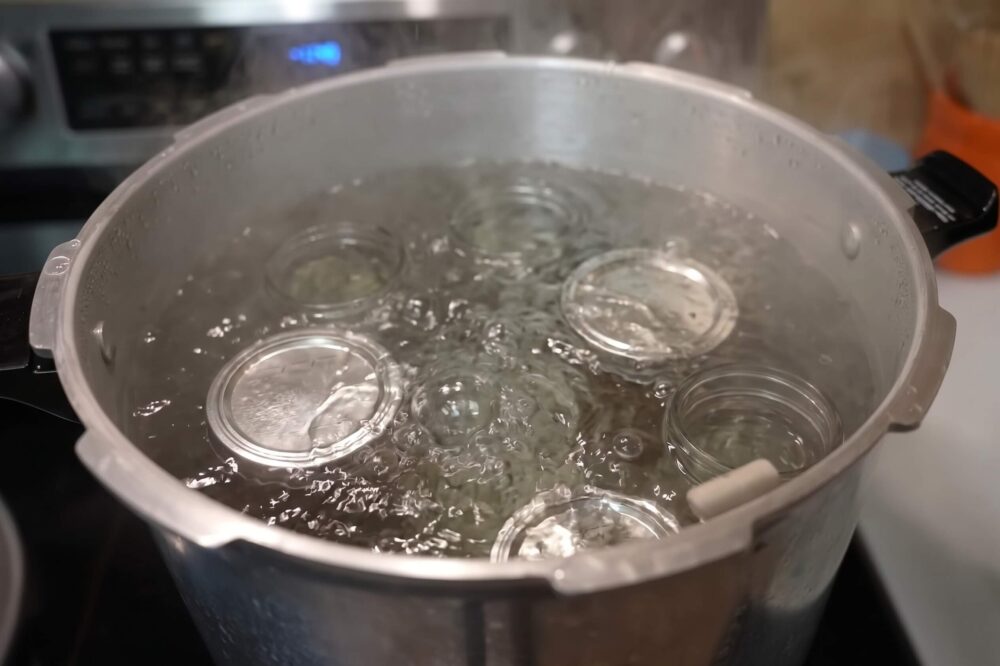
Boiling Water

Important: Keep Hot Water on Standby

Three hours is a long time, and your water is going to evaporate. If the level drops below the tops of your jars, you’ll need to top it off, but only with hot water. Adding cold water will knock the pot off its boil and reset your clock.

Keep a kettle or a second pot of water heating nearby so you’re ready the moment you need it. Even if you’re using a big pot and don’t expect to need it, have it ready anyway. You don’t want to get two and a half hours in and have to start over.

Step 10: Let the Jars Cool Overnight

When the 3 hours are up, turn off the heat and let the pot settle down a bit. When you pull the jars out, you should see the contents still boiling inside the jars. That’s a good sign that everything got heated through.

Then leave them alone. Let them sit undisturbed overnight so they can cool completely and seal.
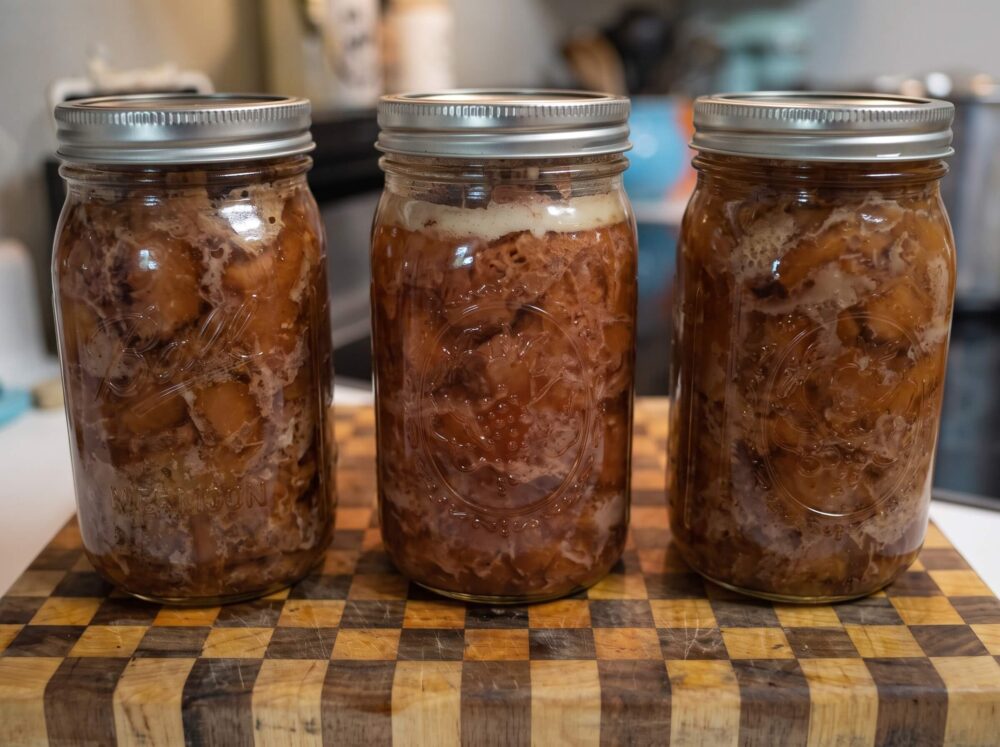
Fully Canned meat

Step 12: Check the Seals and Remove the Rings

The next day, check your seals. A good one will let you lift the jar by the lid alone.

Once everything’s fully cooled and sealed, take the rings off before storing. There are two reasons for this:

  1. If a jar loses its seal and the contents start to spoil, the gas will just pop the lid off instead of building up pressure and possibly cracking the jar.
  2. With the ring on, a jar can lose its seal and then appear to reseal as temperatures change, so you might never know something went wrong.
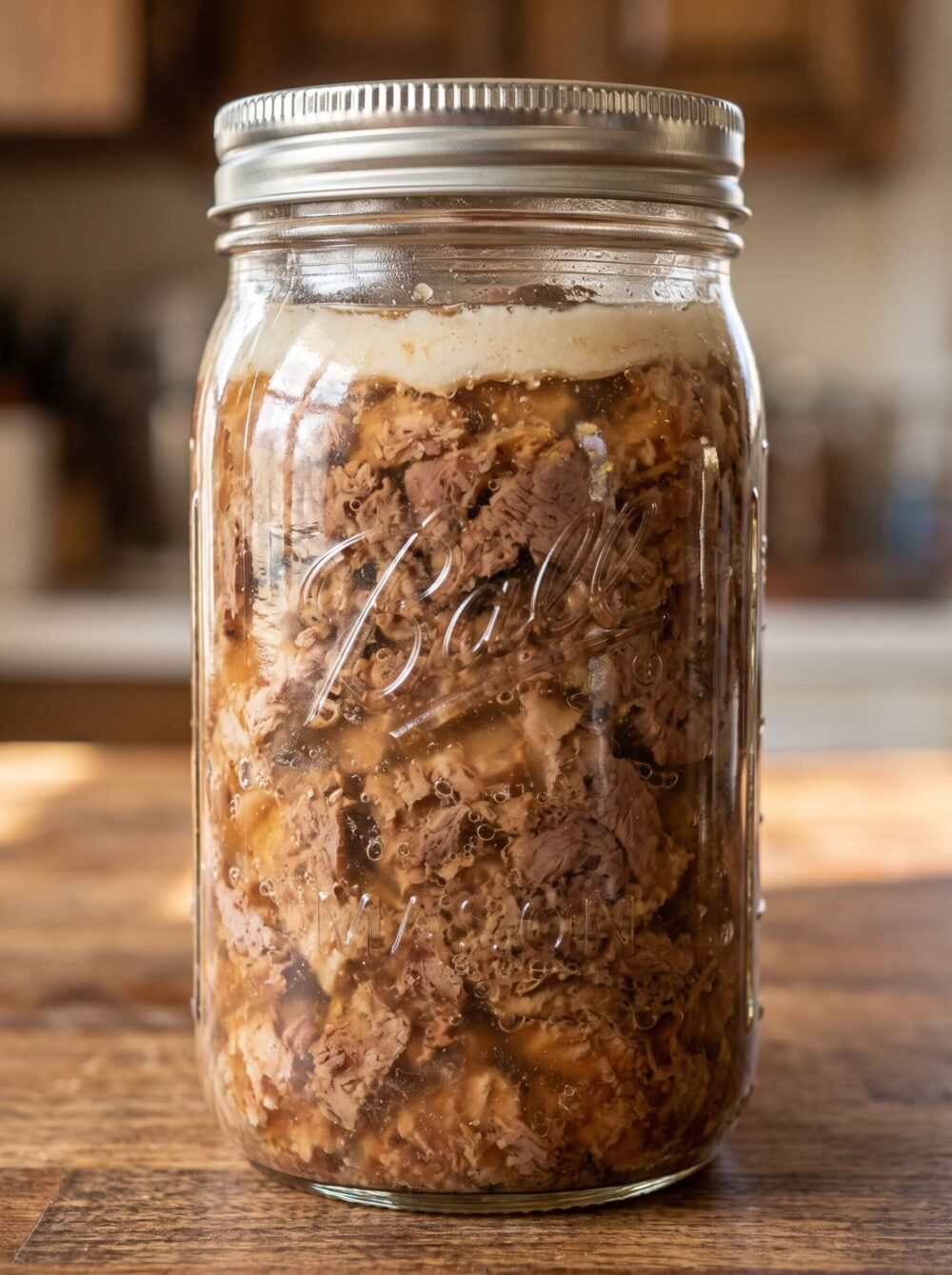
Fully Canned Meat

Step 13: Label Your Jars “WB”

When you mark your lids, write “WB” on them so you know at a glance which jars were water bathed and which were pressure canned. Down the road, that’s going to matter.

Step 14: Always Reheat Before Eating

This one’s non-negotiable. Before you eat water-bathed meat, heat it thoroughly to a boil. (Many canning sources recommend boiling home-canned low-acid foods for at least 10 minutes before eating.) She actually recommends doing this even with pressure-canned meat.

That’s why water-bathed meat is best saved for dishes you’re going to cook again anyway, like soups, stews, gravies, pot pie filling, etc. That way you’ve got an extra layer of protection every single time.

Final Thoughts

Water bathing meat isn’t the officially recommended method, and if you’ve got a pressure canner, that’s still your best bet. But it’s a valuable skill to have in your back pocket, especially if the power goes out with a full freezer or you ever need to put up a lot of meat at once. Just follow the steps in the video carefully, never cut the 3-hour boil short, label your jars, and always reheat before eating.

Like this post? Don't Forget to Pin It On Pinterest!

You May Also Like:

The post How to Water Bath Meat appeared first on Homestead Survival Site.


from Homestead Survival Site https://ift.tt/eDyLi9S

How to Avoid Scams After a Disaster, Before They Knock on Your Door

[…]

The post How to Avoid Scams After a Disaster, Before They Knock on Your Door appeared first on The Survival Mom.


from The Survival Mom https://ift.tt/nIEjx1P

Hackers May Have Destroyed Food at U.S. Military Bases: Could Your Food Supply Be Next?

Sometime overnight in late August, freezers at a military grocery store in Arizona switched themselves into defrost mode. By morning, the food inside had been heated until it spoiled.

It wasn’t the only one. Now the Pentagon is investigating whether hackers were behind a string of refrigeration failures at U.S. military commissaries, and the answer could matter for every family that depends on a freezer full of food.

What Happened

According to Nextgov/FCW, the outages hit about six commissaries, the on-base grocery stores that serve service members and their families. Reports have named locations including Fort Huachuca in Arizona, Fort Irwin in California, and Naval Station Newport in Rhode Island.

Fort Huachuca’s commissary said its freezer went into defrost mode and heated everything inside. Other bases restricted sales of perishable food while they placed emergency orders to restock.

U.S. Cyber Command and military law enforcement units are now investigating. Officials have not confirmed a cyberattack, and it’s still unclear who might be responsible.

Why Investigators Suspect Hackers

The timing raised red flags. Earlier this month, hackers overrode temperature controls on commercial refrigeration equipment at more than 350 businesses in France, forcing supermarkets to throw out spoiled food. U.S. investigators are now working with French authorities to compare the incidents.

Federal agencies have warned about exactly this scenario for years. A 2021 Department of Homeland Security assessment flagged refrigeration failures and shipping delays as cyber risks that could cause spoilage and shortages.

Food industry security experts have also warned that attackers are targeting internet-connected industrial controls that often lack strong defenses. Modern store freezers, warehouse chillers, and distribution systems are all run by software, and software can be manipulated from far away.

The Food System Has Been Hit Before

This isn’t just a theoretical risk. In June 2025, a cyberattack on United Natural Foods, one of the largest grocery distributors in North America, left shelves empty at stores across the country for weeks.

According to TechCrunch, that attack even disrupted deliveries to 53 Defense Commissary Agency stores. Military families saw bare shelves and delayed shipments because a single distributor’s computers went down.

The lesson is simple. Your food supply depends on a long chain of computers, freezers, trucks, and warehouses, and a failure anywhere along that chain can reach your kitchen.

Could Hackers Hit Your Home Freezer?

There’s no sign that home appliances were targeted in these incidents. Most home freezers aren’t connected to the internet, although some smart refrigerators are.

The bigger risk is upstream. If grocery chains, distributors, or the power grid go down, your freezer can fail just as easily from a blackout as from a hacker. Either way, the fix is the same: be ready to protect your food when the cold stops.

What to Do When Your Freezer Fails

The USDA’s power outage food safety guidance is the place to start. Keep an appliance thermometer in both your refrigerator and freezer, with the fridge at 40°F or below and the freezer at 0°F or below.

When the power goes out, keep the doors closed. A refrigerator keeps food safe for about 4 hours, while a full freezer holds its temperature for about 48 hours, or 24 hours if it’s half full.

For a longer outage, dry ice or block ice can buy you time. The USDA says 50 pounds of dry ice should keep an 18-cubic-foot freezer cold for 2 days, but never touch it with bare hands or let it touch food.

A good high-performance cooler packed with ice is your backup for refrigerated food. And never taste food to decide if it’s safe, because when in doubt, throw it out.

Keep the Cold Running

A freezer full of meat is a big investment, and a backup power source protects it. A portable power station or a properly installed generator can keep a freezer running through a multi-day outage.

Fill empty freezer space with jugs of water. A full freezer stays cold longer, and that ice doubles as drinking water or cooler ice when you need it.

Don’t Let Your Freezer Be Your Only Pantry

The real answer is to stop depending on electricity to keep all your food safe. Generations of families kept a full larder long before home freezers existed.

Canning, dehydrating, salting, and smoking all preserve food without power. A pressure canner lets you safely can meat, beans, and vegetables, and a food dehydrator turns produce and lean meat into lightweight staples that last for months.

Pair those skills with a stockpile of shelf-stable foods like rice, beans, oats, canned meat, and peanut butter, as recommended in FEMA’s basic disaster supplies kit. That way, a dead freezer is an inconvenience, not a crisis.

The Bottom Line

Investigators still haven’t confirmed whether hackers spoiled food at U.S. military bases. But the threat to food refrigeration is real, and it’s growing.

If a coordinated attack can empty freezers on military bases and in hundreds of French supermarkets, your local grocery store isn’t immune. Protect your freezer, learn to preserve food without power, and keep a pantry that doesn’t need electricity to stay safe.


You may also like:

watch a video on how to make bacon long-lastingWhy You Shouldn’t Stockpile Beans and Rice

Smoke This Backyard Herb to Support Your Lungs This Season (VIDEO)

Signs You’re (Probably) Not Taking Prepping Seriously

The Amish Never Store These Foods in The Root Cellar

How to Make Finger-Licking Brisket in a Jar


The post Hackers May Have Destroyed Food at U.S. Military Bases: Could Your Food Supply Be Next? appeared first on Ask a Prepper.


from Ask a Prepper https://ift.tt/a0BJSR8

Why Our Grandparents Never Threw Away Cooking Fat

I grew up in a world where grease was something you drained off, wiped out of the pan, and eventually threw away. The older I get, the stranger that seems. For most of human history animal fat was valuable. People cooked with it and baked with it. They turned it into candles and soap, greased […]

from Survivopedia

Sunday, November 1, 2026

Worst States to Be in During the Fuel Crisis This Winter

Back in the spring, a lot of us thought the trouble with Iran would be over in a few weeks. Now gas averages around $4.27 a gallon, and diesel costs more than $6 in many places. Then in mid-October, drivers in Omaha and Lincoln went to fill up and found the pumps empty.

The Strait of Hormuz has been mostly closed for months, so that oil never reaches the market. And Gulf Coast refineries moved their maintenance to this fall, right when harvest pushes diesel demand to its peak. That’s why empty pumps may not stay a Nebraska-only problem for long.

In August, I wrote a piece called Avoid These States in the Next Fuel Crisis, and back then much of it still read like a warning. But in just two months, those warnings turned into empty pumps and record prices. So I went back through the latest numbers to show you how bad things got since then. And I also looked at how much harder it could hit this winter, as we head into 2027.

In some states, you’ll just pay more every time you fill up. But in others, you could be driving from town to town on an almost empty tank. And back home, your heating oil could run low just as the cold sets in.

California: Highest Gas Prices and Shrinking Refinery Capacity

If you filled up in Los Angeles this week, you paid about $6.08 a gallon for regular, and diesel ran close to $8.50. Back in August, regular in California averaged $5.64 a gallon, and diesel averaged $7.13. So in just two months, gas went up more than 40 cents, and diesel jumped well over a dollar.

And the state has fewer refineries to fall back on, after Phillips 66 shut its Los Angeles plant in October 2025 and Valero closed Benicia in 2026. That leaves six refineries to make the special CARB blend the state requires. So more of California’s fuel now arrives by tanker, and one late ship can thin out supply along the whole coast. If one of those six refineries has a fire or an unplanned outage, you could sit in a two-hour gas line in Sacramento with a quarter tank and a doctor’s appointment across town.

So before you end up in that line, find out which are the best types of fuel to keep at home and how to store them properly

Nebraska: Empty Gas Pumps in Omaha and Lincoln

Prices in Omaha and Lincoln stayed close to the national average, and that’s why the empty pumps caught people off guard. Then in mid-October, stations across both metros ran out of fuel. Gov. Jim Pillen signed an executive order on October 19 to get more trucks moving. It waives hours-of-service limits for fuel haulers and lets them run up to 10% over weight limits through November 18.

Even so, haulers told local news they’re driving west to find fuel and waiting in long lines at terminals. Harvest pushed diesel demand to its peak, and every load of diesel on a truck leaves less room for gasoline. So out past the metros, your pickup competes with combines and grain trucks for the same deliveries.

That’s why I started making my own diesel from old cooking oil. Once you learn the backyard biodiesel method, your truck stops depending on whether the hauler shows up this week. Just make sure you work outside, because the lye and methanol in the mix can burn your skin and catch fire easily. So set up well away from the house, where kids and pets can’t wander over while you’re working. 

And if you’d like to watch it done before you try it yourself, the video below takes you through the whole process step by step:

video showing how to make biodiesel at home from food scraps play video button

Hawaii: One Refinery and an Ocean Between You and Resupply

Out in the middle of the Pacific, drivers pay around $5.65 a gallon, second only to California. And the whole state runs on one refinery, Par Hawaii in Kapolei, fed with crude through a single mooring buoy off Barbers Point. From there, the neighbor islands depend on barges for their share.

That chain has very little backup. If the buoy gets damaged or a tanker runs late, an entire island chain feels it, and there’s no next state to drive to for a fill-up. Hawaii also gets about 93% of its jet fuel from South Korea, which pulls roughly 70% of its crude through Hormuz. And since the islands burn oil to make electricity, a fuel squeeze shows up on your power bill too. On Maui or the Big Island, a late barge can leave your local station dry while Honolulu still has fuel.

Luckily, I found a way to keep my lights on even when the power plant runs short of oil. And on a sunny day, even during winter, this innovative solar setup stores enough power to run my lights and radio well into the night. So when the grid goes dark, I can still see around the house and hear the news until the next tanker comes in. 

And if the grid goes down, the pumps that push water to your tap can stop too. So you’ll want to know how to turn a flower pot into a water purifier before the faucet runs dry.

Nevada: A Desert State Running on California’s Fuel

Gas in Las Vegas and Reno averaged about $5.34 this week, the fourth-highest in the country. Both cities still get their fuel by pipeline from California refineries. So every problem over there, including the Benicia closure, shows up at Nevada pumps too.

Still, the rural counties carry the bigger risk, because tanker trucks cover long stretches of empty highway to reach small-town stations along routes like US 50. So if the station in Austin or Eureka runs dry, the next open pump could be more than an hour away. And on a cold November night in the high desert, running out of gas between towns with no cell signal can turn dangerous fast.

In a blackout, your flashlight and weather radio quickly become the most precious things in your stockpile. But every hour they run, you burn through batteries you can’t restock until the grid comes back. And chances are you don’t know exactly how many good ones you have left, or how long they’ll hold.

So it pays to learn how to bring dead batteries back to life before the lights go out. You can start with the battery revival project in No Grid Survival Projects (p. 64 and 65), and keep it ready for the next outage. Then again, if you want someone to walk you through every step, the EZ Battery revival class shows you how to restore everything from small AA cells to car batteries. Enroll here before November 15th, and you’ll lock in the discount while it’s still available. 

Alaska: Rural Villages Supplied by Barge Before Freeze-Up

Up in Anchorage, regular runs around $4.89 a gallon, which sounds mild next to California. But city prices hide what happens off Alaska’s road system. Many rural villages get their entire winter supply of gasoline and heating fuel by barge. And once the rivers and coastline freeze, that delivery window closes until spring.

So whatever price a village paid this summer, at the height of the crisis, stays locked in all winter. If a barge came up short, there’s no highway to send a truck down. If you live in a river village, you could spend February rationing stove oil at 30 below, with the next delivery months away.

That’s why you shouldn’t burn precious fuel just to see at night. Instead, you can make your own homemade oil lamp from things already in the house, and it stays lit with the biodiesel you make from cooking oil that I mentioned in the chapter above.

You can also learn how to recycle wax into long-burning candles, so every drop in the tank goes toward heat.

North Dakota: Record Diesel Prices in Farm Country

On September 29, diesel averaged about $6.17 a gallon across North Dakota, and the state declared an emergency over diesel supply. So Gov. Kelly Armstrong let farmers run cheaper red-dyed diesel on highways through November 30. That saves them 19 cents a gallon in state tax, and it barely dents the bill. NDSU estimates North Dakota farms will spend roughly $100 million more on diesel this year.

Then comes winter, and the state has been here before. Back in February 2025, a cold snap left North Dakota extremely low on propane and petroleum products. This year, fuel goes into the cold season already tight and expensive. For a farmhouse 40 miles from town, a delivery truck stuck behind a blizzard can leave the furnace running on the last few inches in the tank.

And many oil and propane furnaces need electricity to run the blower, so a downed power line can shut off your heat with a full tank. But I have a trick for that. I put together Ron’s famous modular generator that keeps the furnace fan going, and I can add pieces to it as my needs grow.

Maine and New England: Heating Oil at Record Highs

Of all the places on this list, New England could be the most dangerous, since so many homes there heat with oil. About 3.4 million Northeast households heat with oil, roughly 82% of all oil-heated homes in the country. Heating oil in New England averaged about $6.11 a gallon on October 19. That’s up 77% from a year ago.

And the storage tanks are running low. In mid-October, distillate stocks in New England sat about 45% below their five-year average. Distillate covers both diesel and heating oil, so truckers and homeowners pull from the same shrinking supply. The Department of Energy agreed to loan up to 315,000 barrels from the Northeast Home Heating Oil Reserve, though that only adds about 13% to regional supply.

So filling a standard 275-gallon tank now runs more than $1,600, and the coldest months haven’t even started. Then picture a January cold snap in Bangor, with the oil dealer a week behind on deliveries. An elderly couple could be closing off rooms and sleeping in their coats while the pipes freeze in the walls.

And if oil prices keep climbing, you can lean on 10 old ways to heat your home that need neither fuel nor electricity.

Other States Already Under Emergency Orders 

And the trouble reaches well past the seven states above. South Dakota’s governor signed an order on September 28 letting farmers haul crops and livestock at 10% over weight limits. That same order has the state watching fuel supplies in case dyed diesel runs short. Meanwhile, diesel sits around $6.17 in Iowa and $6.23 in Minnesota, so farm families there pay nearly as much as North Dakota does. 

Out east, Maryland got hit just as hard. Diesel there set a record of about $6.47 on October 5, up 76% in a year. Four days later, Gov. Wes Moore let farm and forestry vehicles run on dyed diesel. So if you live along the East Coast, you’re drawing from the same thin supply as New England, and a delivery truck running late could hit you just as hard. 

How to Prepare for a Fuel Shortage in 2027

Living in one of these states, you can’t fix a refinery fire or speed up a late barge. But you can make sure the fuel you already have still burns clean when the deliveries slow down.

So before the first cold snap, you can work through these steps one at a time: 

  • Learn the rules of fuel storage first. Before you fill a single can, read up on the 7 rules of storing fuel, because one mistake can ruin your whole supply. 
  • Rotate your gas cans. Keep them in a detached shed, and pour the oldest one into your truck every few months so your stock keeps turning over.
  • Keep diesel tanks full. Diesel lasts longer, but condensation forms in a half-empty tank, and that water feeds a microbial growth people call diesel bug. That slime clogs filters right when you need the tractor or generator to start.
  • Treat stored diesel with a biocide. It kills the growth before it spreads, so your fuel stays clean through the winter.
  • Top off your oil or propane tank now. Dealers still deliver on schedule today, and that could change fast once the cold sets in.
  • Set up a backup heat source. A wood stove or an indoor-rated kerosene heater can keep one room livable if the truck doesn’t show.

What to Expect From the Fuel Crisis This Winter

Still, the people who track oil for a living don’t see relief coming soon. The International Energy Agency warns diesel could stay tight well into next year, because refineries can’t replace what the world lost.

And home heat looks just as rough. The Energy Information Administration expects heating oil to cost about 34% more this winter, with East Coast stocks 20% to 30% below average. Even that grim forecast counts on a mild Northeast.

Right now, NOAA does lean toward a warmer-than-average winter across the northern U.S., thanks to a very strong El Niño. But that only shifts the odds, and one week of Arctic air in January can empty a half-full tank before the oil dealer even calls you back. 

Meanwhile, the same El Niño tilts the odds toward stormier weather across the South, from the Gulf Coast to the lower mid-Atlantic. So if ice and flooding slow the fuel trucks heading north, New England could run short in the coldest weeks of the year.

So, if the fuel stops coming and the lights go out in January, you’ll want a plan you can follow step by step. The Blackout Survival Manual walks you through a winter blackout, an EMP, and a long fuel crisis from the first hour on. You won’t have to guess what to do while the house gets colder by the minute.

This way you will learn:

  • What to do in the first hour after the power goes out, before the house loses its heat
  • How to keep one room warm enough to sleep in when the furnace sits dead
  • How to stop your pipes from freezing and bursting while the grid stays down
  • How to stretch the fuel you have when deliveries stop for weeks
  • Which electronics an EMP could fry, and how you can protect them ahead of time

So before the first cold snap tests your stockpile, grab your copy of the Blackout Survival Manual and keep it somewhere you can reach in the dark.


You may also like:

Read This Before Stockpiling Your Fuel!

How to Start a Fire With Water (VIDEO)

12 Items You’re Storing in Your Garage That Could Kill You in a Crisis

10 Forgotten Fuels You Can Still Use Today

How to Siphon Gas from a Car with Anti-Siphon

The post Worst States to Be in During the Fuel Crisis This Winter appeared first on Ask a Prepper.


from Ask a Prepper https://ift.tt/5aI2OBo