Estimated reading time: 8 minutes
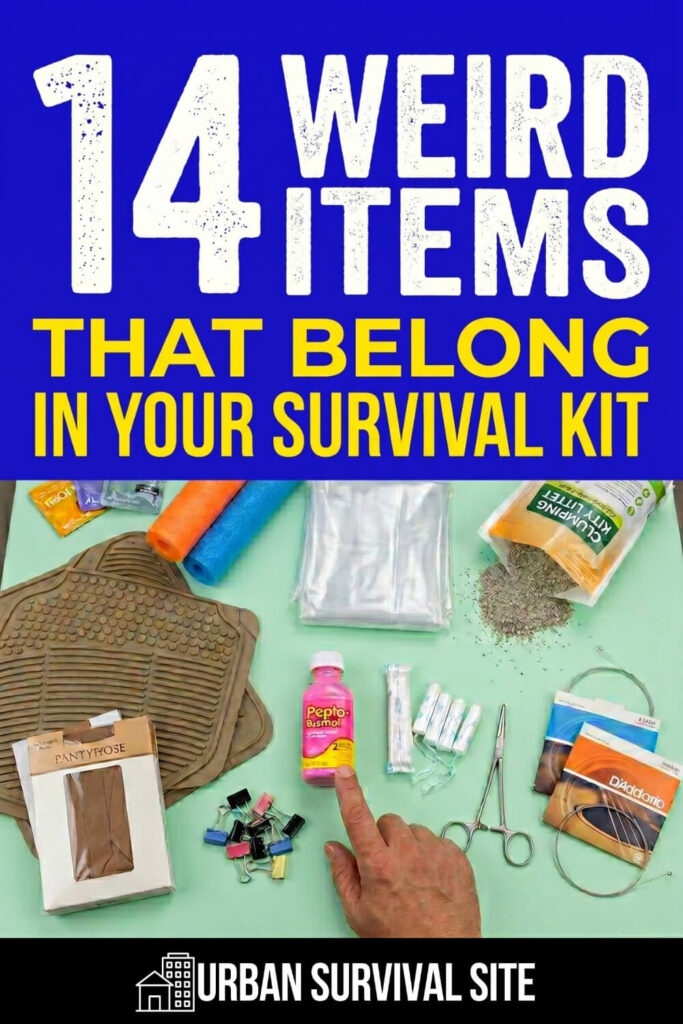
When most people think about emergency preparedness, their minds jump to classic survival items like flashlights, matches, water filters, and so forth. But some of the most useful items aren't the ones you'd find on a typical prepper checklist.
Consider the garbage bag: it's cheap, lightweight, and most people already have them around the house, yet it can serve as an improvised rain poncho, a water collector, a ground cover, an emergency flotation device, and many other things. The lesson? Ordinary, overlooked items can be very valuable if you know how to use them.
Recently, I can across a video from the YouTube channel DIY Prepper TV, where the host talks about 14 items that most survival lists tend to ignore. And not because they're useless, but because they're…a little weird. You can watch the video and see the list below.
1. Condoms
Yes, really. An unlubricated, spermicide-free condom can hold a surprising amount of water, making it a lightweight emergency water carrier. They can also be used to waterproof small items like matches, lighters, phones, and medical supplies, or even to cover the end of a rifle barrel in muddy or sandy conditions (and you can shoot right through it).
Thanks to their elasticity, they can also function as improvised tie-offs or compression bandages. Just wrap gauze over a wound, then use the condom to hold it in place with steady pressure. Here are some other unusual uses for condoms that might surprise you.
2. Pool Noodles
Those foam cylinders collecting dust in your garage have more going for them than you might think. Pool noodles are structurally similar to pipe insulation and can be used to protect pipes from freezing in winter. They can pad the sharp corners of tables, doors, and tools, which is especially handy if you have young children around.
In a flood or water emergency, they can serve as improvised flotation devices when life jackets aren't available. Cut them into flat sections to cushion and separate fragile gear like radios and optics. They can also be used to make an emergency toilet.
3. Pepto-Bismol
This one might seem obvious, but it earns its place on the weird list because people rarely think of it as a survival item. In a grid-down or travel scenario, gastrointestinal problems like diarrhea, nausea, and vomiting can hit unexpectedly and quickly become dangerous due to dehydration.
Pepto-Bismol addresses all of those issues in one bottle (or tablet). One important caution: it's chemically similar to aspirin, so anyone who can't take aspirin should avoid it. It should also not be given to children 16 and under due to the risk of Reye's syndrome.
4. Trash Cans
A large, clean plastic trash can is an excellent for water storage. Put one under a downspout or at the end of a tarp funnel to collect rainwater for garden irrigation, toilet flushing, and general cleaning.
A galvanized steel trash can can also function as an improvised Faraday cage to protect electronics from electromagnetic interference. Trash cans are also useful for protecting stored supplies like animal feed or seed corn. Just remember that they're not food-safe, so line it with a trash bag instead of putting it in direct contact with the interior.
You can also use a trash can to make a huge survival kit. Just pack your supplies inside, put it in the corner of your shed or somewhere it would likely be overlooked by intruders, and you'll have it when you need.
5. Shower Curtains
Pair one with your trash can and you've got a functional rainwater catchment system. The curtain funnels water right into the container. Beyond that, shower curtains can serve as ground cloths under a tent, privacy screens, window coverings after storm damage, or drop cloths for messy repair work.
Two caveats worth keeping in mind: they're not particularly durable, and many have anti-mold chemical coatings, so water collected from them shouldn't be consumed unless it's run through a good filtration system first.
6. Kitty Litter
One of the more versatile sanitation items on this list. In a bucket toilet setup, kitty litter works just as well for humans as it does for cats. It absorbs and consolidates liquid waste and cuts down on odor. It also excels at soaking up oil and fuel spills in the garage.
Scattered on icy or muddy surfaces, it provides good traction underfoot. And in any situation involving human waste cleanup (illness, flooding, loss of plumbing) kitty litter helps contain and manage the mess.
7. Kiddie Pools
Inexpensive and surprisingly capable. In advance of a storm or power outage, a kiddie pool can be filled quickly and stored in a garage as an emergency water reserve, similar in concept to a commercial WaterBOB.
Their wide surface area also makes them excellent for passive rainwater collection. During an extended emergency, they can be pressed into service for hand-washing laundry, dishwashing, bathing, or watering pets and livestock. In warmer months, a dark-colored pool left in the sun can serve as a solar water heater.
8. Car Floor Mats
Heavy-duty rubber floor mats can provide traction under a tire when you're stuck in ice or mud. They also work as kneeling pads when changing a flat in wet or dirty conditions, keeping your clothes reasonably clean.
Beyond the vehicle, they make decent protective work surfaces for setting down tools, batteries, fuel cans, or doing messy repairs. Old mats that you've already cycled out of your vehicle are perfect candidates for this kind of repurposing.
9. Pantyhose
These are good for pre-filtering dirty water. Just stretch a section over a container before pouring water through, and it will catch leaves, insects, and larger debris before the water hits your main purifier. Because pantyhose are made from synthetic materials, they may not be entirely food-safe, so pairing them with a quality filter like a Grayl purifier is a good idea.
They also work well for organizing gear inside a pack. Loose small items stay contained and quiet. Their elasticity makes them great as light-duty tie-downs, or as slings and wraps to hold ice packs and bandages in place. Here are some other survival uses for pantyhose.
10. Binder Clips
Simple, cheap, and endlessly handy. The most obvious use is keeping open bags of food sealed, but they're also good for organizing cables and cords, hanging up tarps for shelter, or stringing up lights during a power outage. Larger binder clips can be used to secure tarps to ropes or poles when rigging improvised shelters. Keep a handful in your kit and you'll find uses for them constantly.
11. Tampons and Pads
Feminine hygiene supplies are frequently overlooked in preparedness planning, and that's a significant oversight for any household with women. However, I'm gonna have to disagree with the video's suggestion that tampons are useful for wound care.
This is a claim that has circulated widely in survival and prepper circles, but medical professionals are pretty skeptical of it. The core problem is that tampons are designed to absorb passively, not to apply outward pressure against wound walls, and pressure is what actually stops serious bleeding.
Beyond that, the cotton fibers can stick to a clotting wound, to the point where when you remove it, the wound will start bleeding again. There's no solid evidence that tampons effectively slow or stop a significant bleed, and the American College of Surgeons points out that ordinary clothing pressed firmly against a wound is actually more useful.
Pads are a different story. Because they're used externally rather than inserted, the adherence problem is less of an issue, and they can reasonably serve as an improvised dressing for surface wounds, absorbing blood and providing a barrier while you work on a better solution.
The cotton material in tampons does have one legitimate survival application that the video mentions: it ignites relatively easily, making it useful as tinder for fire starting, especially if treated with petroleum jelly beforehand.
12. Medical Clamps (Hemostats)
These look like surgical scissors and are available cheaply at many hardware or sporting goods stores. Beyond their obvious medical applications, hemostats shine as precision maintenance tools. They're excellent for holding small springs during firearm or mechanical repairs.
They can also be used to reach into tight spaces, mop out the inside of a small fuel tank, or clamp off a fuel line while you remove a part from a small engine without soaking everything in gasoline.
13. Old Bed Sheets
Cotton bed sheets, in particular, have a lot of life left in them after they're retired from the bedroom. Cut or torn into strips, they become bandages, cleaning rags, and general utility cloth.
A pillowcase stretched over a bucket and held in place with a bungee cord makes an effective pre-filter for dirty water, catching sediment and debris before it reaches your main filtration system. Sheets can also serve as sun shades, privacy barriers, improvised slings, or emergency bedding in a pinch.
14. Guitar Strings
Guitar strings can be used to set snares for small game or as tripwire for perimeter alarms. Because they tolerate heat better than most improvised binding materials, they're useful for securing things near heat sources.
The same wire-cutting principle that lets a thin wire slice through cheese means guitar strings can also cut through soft materials. One important safety note: guitar strings are sharp enough to cut skin easily, so always handle them with gloves.
You May Also Like:
The post 14 Weird Items That Belong in Your Survival Kit appeared first on Urban Survival Site.
from Urban Survival Site
No comments:
Post a Comment