Submissions     Contact     Advertise     Donate     BlogRoll     Subscribe                         
Showing posts with label Nuclear. Show all posts

Monday, June 26, 2023

How To Make Your Home Fallout Proof

 Original Article


by MICHAEL MAJOR


 A nuclear attack or disaster will come without warning, and while it is not practical to harden your home against the shockwave and thermal blast of an atomic bomb, you can take steps to shield yourself and your family from the impending fallout.

A purpose-built fallout shelter is ideal but also prohibitively expensive and outside the reach of most of us. The good news is that we can take steps to secure our homes against fallout without digging a bunker in our backyard.

What Is Fallout?

Nuclear fallout is caused by the vaporized debris mixing with the radioactive particles that make up a mushroom cloud. The wind then carries this fallout downwind from the blast.

Related: A Strange Thing That Might Save Your Life in A Nuclear Aftermath

Fortunately, most of the fallout in the immediate area will fall within twenty-four hours and look like ash or sand.

Sunday, July 3, 2022

What Is The Closest Power Plant To Your Home? Are You Living In The High-Risk Zone?


by RICH M.

We do a lot of talking about electrical power in the prepping and survival community: specifically, how we can survive without it. But surviving without electrical power isn’t the only way that we should be concerned about it. Electrical power production can be dangerous in and of itself, especially when we talk about things like nuclear power.

There are plenty of statistics around, which show just how safe nuclear power is. But there are also some rather spectacular examples of accidents involving nuclear power plants.

While nuclear power is safe, when all those safety measures fail, the results can be catastrophic. All anyone has to do is mention nuclear power and people instantly remember the Fukushima Daiichi nuclear disaster of 2011, the Chernobyl disaster in 1986 and the Three Mile Island accident in 1979. Those aren’t the only reactor accidents, by the way; but they three of the top five.

We currently have 60 commercially operated nuclear power plants, containing a total of 98 nuclear reactors. Surprisingly, the state of Illinois has the most, with a total of 11 operating reactors. A total of 12 states generate more than 30% of their power through the use of nuclear power.

Related: Alphabetical List of Operating Nuclear Power Reactors by Name

In addition to these, there are another 39 smaller nuclear reactors which are not used for the generation of electrical power, but are housed in research facilities. These reactors produce radioisotopes for nuclear medicine, as well as being used in training and as laboratory tools. Some are working on developing new technologies, seeking to make nuclear power even safer for use.

Our fleet of nuclear power plants is aging though, with the average age being 39 years. That’s fairly serious, when we consider that they have been designed to last a mere 50 years. The oldest of those plants entered service in 1969, putting it over that 50 year threshold. That’s only one of four which have already surpassed their expected service life.

On the other end of that scale, there is only one nuclear power plant which is less than 20 years old. Thanks to environmental activists, it is extremely difficult to open nuclear power plants, even though it is one of the cleanest forms of energy production there is.

How Much Risk is There?

In today’s day and age, the big question isn’t so much how many reactors we have or whether they are inherently safe, but whether anyone could make them unsafe. Stories abound about hackers trying to break into our electrical grid, including our nuclear power plant. There’s even one story about some foreign power hacking into one of our nuclear power plants and taking control of it for several hours.

The potential damage that could be caused by someone taking control of one of our reactors is definitely something to be concerned about. Can you imagine the panic that would occur if one of the recent ransomware attacks that have hit our country were to have been aimed against one of our nuclear power plants? Or how about if the pilots who flew those airliners into the twin towers on 9-11 had aimed for a nuclear power plant instead?

The truth of the matter is, with people who are willing to do anything, including putting their own lives on the table as gambling chips, our nuclear power plants are vulnerable to attack. While I have been assured that the computer controls to those plants are not tied into the internet or any other network, making them supposedly impervious to hacking, all it would take is one unscrupulous worker accepting a bribe to make them vulnerable. There are also many ways in which a direct attack on one of the plants could be catastrophic.

Related: The First Thing You Should Do After a Nuclear Attack

Our big question isn’t whether something could happen to a nuclear power plant, but how bad it would be and whether or not we should be concerned. That will vary for all of us, depending on how close we live to one of those plants. Even the 19 states which don’t have a nuclear power plant could be at risk of fallout, if a plant were to be destroyed upwind of them.

Nuclear Emergency Planning Zones

The Nuclear Regulatory Commission (NRC) has established two different types of emergency planning zones (EPZs) around every nuclear reactor in the country. The closer in zone is called the “plume exposure pathway EPZ” and extends about 10 miles in every direction around a nuclear plant.

The big concern in this case, is the inhalation of airborne radioactive contamination. The farther zone is called the “ingestion pathway EPZ” and is concerned with food and liquids which might become contaminated and then ingested. This zone extends roughly 50 miles around the power plant.

As the power plants are constantly monitored, with extensive redundancy in the monitoring methods used, the NRC expects to be able to issue warnings and alerts should any unexpected radiation escape from one of our nuclear power plants.

But there is ample reason to question these EPZs, based upon past nuclear accidents. Japanese officials weren’t able to determine a proper safe zone from the Fukushima Daiichi nuclear power station. As a compromise, they set a distance of just 30 km, with the first 20 km being a mandatory evacuation zone and the following 10 km being voluntary.

Many organizations, including the UN’s International Atomic Energy Agency (IAEA) came out saying that 30 km wasn’t far enough. Several countries, including the United States, recommended that citizens visiting Japan keep a minimum of 80 km away.

Yet radiation from that accident spread from four of the six reactors, contaminating the Pacific Ocean. That radiation, as well as airborne radiation carried by air currents reached the western coast of the United States, killing a considerable amount of marine life.

Related: A Strange Thing That Might Save Your Life in A Nuclear Aftermath

What About Explosion?

One of the big questions about nuclear power plants is whether or not they can explode. This has been a popular theme in science fiction and even a few movies; but in reality, a nuclear power plant cannot produce a fission explosion. The nuclear fuel is too dilute to form the critical mass necessary to produce a chain reaction, leading to an explosion. So at least we’re all safe from that.

While we don’t have to worry about a nuclear explosion from the reactors, that doesn’t mean any of us are safe. The Fukushima accident was created by an earthquake that caused a tsunami. Other similar disasters could cause similar results at literally any other nuclear reactor, anywhere in the world.

Are You in Danger?

Whether or not you are in danger from a nuclear power accident depends mostly on your proximity to a nuclear power plant. Fortunately, this information is public and easy to find. All you have to do is search online for nuclear power plants and you can find the information, either in map form or in list form.

Check the location of nuclear power plants in your state and in neighboring states if you live near the state’s border. If you are outside the 50 mile zone, about the only way that you could be affected by a nuclear power plant catastrophe, would be if someone blew the plant up with a large enough bomb to cast nuclear material into the atmosphere, creating fallout. Other than that, you’re safe.What Is The Closest Power Plant To Your Home? Are You Living In The High-Risk Zone?
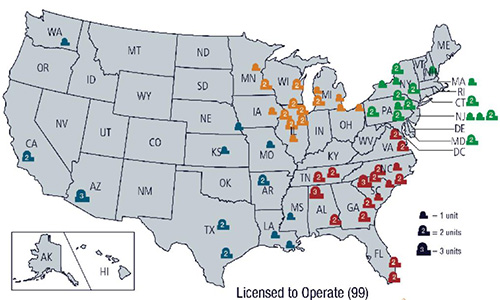
If you live within the danger zone, I’d recommend having an emergency evacuation plan in place; one which will take you far enough away to keep your family safe. That plan has to be one that you can put into place quickly, so that you can beat everyone else who might be evacuating as well. Don’t stop for anything, including driving back home to pick up your bug out bag. This is the type of disaster where it’s best to take action first, and then do the analysis later.

That means you have to have a supply cache somewhere outside the EPZ, so that you will have basic supplies to use if you find yourself forced to evacuate. I’d recommend establishing it at or near your survival retreat, either at the home of a friend or in a rented storage unit.

What About Fallout?

If someone actually manages to blow up one of our nuclear power plants, sending nuclear material into the upper atmosphere, then the abovementioned EPZs won’t really matter all that much. They weren’t done with that scenario in mind. Nevertheless, if you live within the 10 km zone, I’d still bug out.

The bigger, more difficult question will be about fallout. Where fallout occurs, how long it lasts and how far it extends all depend on the weather. The National Weather Service will be monitoring that, in conjunction with other government agencies. You can be sure that the government will be providing constantly updated information about that.

Evacuation isn’t necessarily required due to fallout, although it isn’t a bad idea. But you can do just as good sheltering in place, in your basement (assuming you have a basement). The fine particles of radioactive material that are fallout won’t penetrate below the ground. So as long as you are in your basement, you’re fairly well protected.

Depending on the situation, you might have to shelter in place for as long as 30 days. That means having enough supplies and other essentials stored in your basement, for your family to survive that long.

You’ll also need such things as bathroom facilities and a means to cook food. Essentially, you’ll need to plan on living in your basement, as if it were a bunker.

Sunday, April 4, 2010

Nuke your hometown

Well, at least see what the blast radius would be. Cool simulator--plug in the warhead yield, drag the Google Map to your hometown and there you have it! Fun stuff.

High Yield Detonation Effect Simulator >

Thursday, December 10, 2009

Radiation Sickness

If you should ever happen to stumble upon some radioactivity, and become ill, you need to cleanse your thyroid asap.

Keep these items handy.

Potassium iodide
is a nonradioactive form of iodine. Because iodine is essential for proper thyroid function, the thyroid becomes a "destination" for iodine in the body. If you have internal contamination with radioactive iodine (radioiodine), your thyroid will absorb radioiodine just as it would other forms of iodine. Treatment with potassium iodide may fill "vacancies" in the thyroid and prevent absorption of radioiodine. The radioiodine is eventually cleared from the body in urine.

Prussian blue,
a type of dye, binds to particles of radioactive elements known as cesium and thallium. The radioactive particles are then excreted in feces. This treatment speeds up the elimination of the radioactive particles and reduces the amount of radiation cells may absorb.

~definitions of what they do found at the Mayo Clinic


Of course only a doctor can tell you if you have the correct radiation poisoning for these treatment to be helpful.

Tuesday, May 19, 2009

Radiation Fallout Preparation

I love this title:
The Good News About Nuclear Destruction

I was able to get an old (but in good shape) civil defense kit for a little over $65 a few years back on Ebay...I got it from the ki4u.com folks, who have a lot of good information on their websites.

First, I'd recommend you read the myth-busting "You WILL Survive Doomsday"

Then, check out "What to Do if a Radiation Attack is Imminent".
Well, depending on what Iran, Israel, India, and Pakistan are up to, maybe you should check this out first :)

Then, check out this Radiation Shelter FAQ

Basically, in a nutshell, you can't do much about being in a blast zone, but you can easily take steps to avoid the fallout (which could result in 10X more fatalities than the blast itself). So, depending on the size of device yield, wind conditions, and distance, a healthy adult should really only have to hide under the lead blanket for 7 hours, in the basement for ~3 days, and can spend a limited amount of time outside after only a week or two.

The dust is the key, as this carries the radiation - put mass and distance between you and where dust collects around the base of your home, and keep from ingesting any (wash off food)...I personally plan to use some cheap plastic sheeting to make a 2-partition "changing room", where you would change into/out of clean clothes in the first one, and into/out of "dirty" ones in the second, outer partition by the outside door.

Also, keep your radiation dosimeter on your belt, and not your shirt pocket (more accurately measures the rads your guts are getting)...and even after it is safe for adults to go outside, carry children on your shoulders (to keep them above the radioactive dust on the ground).

The ki4u.com guys will sell a "Package" of pre-tested counters for $354.

What we have here: (not the package mentioned above...I got mine from them but they were much cheaper because they weren't tested with their Cesium-137 rad source)

2 Geiger counters + instructions (one with a remote sensor - very important unless you feel like taking some rads just to see how hot is still is outside). It is important to get the sensors calibrated against a rad source of known strength, which is on my to do list...looks like ki4u.com are offering a $48 deal on ebay.

(6) Dosimeters (charger is in box between the Geiger counters). They work by statically charging the tube, which draws a needle from "Lots of radiation" down to "No radiation". When you wear it in a radioactive environment, the charged particles pass through, and take out some of the static charge, thus moving the needle back to the "You are gonna glow" end of the scale.

(2) 2-week supplies of potassium iodide tablets. Much more important for the kids than adults (many more years to be irradiated from within). The KI works because radioactive iodine can be absorbed into the body, and concentrates in the thyroid...so the solution is to take a full dose of "clean" KI so any "dirty" iodine will not be absorbed by the body.

My personal plan is for the adults to take them for the first few days, then use the rest for the kids for an extended period.

(4) N90 dust masks. Again, it's all about the dust, and not breathing, eating, or drinking it.

Not pictured - Batteries...and you have those, right? RIGHT?

I also keep gloves, and a "bunny suit" for dust/dirt leftover from attending 2 C-section births (also good to keep in car in case you need to work on it in good clothes)...I don't know where to buy the paper suits but if I find out I'll post.

I know this is like a commercial for the ki4u.com folks, but they did provide a lot of information to the community, and you could do worse trying to find a reliable detector.

-DaveP

PS: Oh, and don't worry about suitcase nukes...if they ever truly existed (some doubt that), they are all duds by now:
1: due to specialized explosives that need to be serviced and replaced annually
2: the radioactive decay makes the beryllium sphere that reflects the radiation inwards to achieve critical mass too brittle.

Maybe if there's interest I'll write up a real post for that.

PPS: DISCLAIMER: I Am NOT an Atomic Scientist, and quite possibly don't know what I'm talking about. I could be stupid, crazy or both. Actually, don't listen to me. Please do your own research.


Original: http://pennsylvaniapreppersnetwork.blogspot.com/2009/02/radiation-fallout-preparation.html

Thursday, May 7, 2009

You Can Survive a Nuclear Blast


The only known nuclear attack on a civilian population was the attacks on Hiroshima and Nagasaki. Collectively, 210,000 people were killed in the blasts. At least 260,000 people have been officially recognized by the Japanese government as survivor's of the blasts and at least one of those, 93 year old Tsutomu Yamaguchi, has been officially recognized as having survived both blasts.

According to officials, Mr Yamaguchi was in Hiroshima on a business trip on Aug 6, 1945, when a US B-29 dropped an atomic bomb on the city. He then returned to his home in Nagasaki just in time for the second attack. The amazing part of this tale is that he, defied all kinds of odds, and survived both blasts. Of course, his health over the long term, was almost certainly compromised, but he's still alive at 93 years old. My point? You can survive a nuclear assault.

This amazing man really endured what can only be described as hell on earth. Check out this description of the assault from the Department of Energy's website. "Those closest to the explosion died instantly,Victim of atomic attack with the pattern of her clothing burned into her back. their bodies turned to black char. Nearby birds burst into flames in mid-air, and dry, combustible materials such as paper instantly ignited as far away as 6,400 feet from ground zero. The white light acted as a giant flashbulb, burning the dark patterns of clothing onto skin (right) and the shadows of bodies onto walls. Survivors outdoors close to the blast generally describe a literally blinding light combined with a sudden and overwhelming wave of heat. (The effects of radiation are usually not immediately apparent.) The blast wave followed almost instantly for those close-in, often knocking them from their feet. Those that were indoors were usually spared the flash burns, but flying glass from broken windows filled most rooms, and all but the very strongest structures collapsed. One boy was blown through the windows of his house and across the street as the house collapsed behind him. Within minutes 9 out of 10 people half a mile or less from ground zero were dead.

People farther from the point of detonation experienced first the flash and heat, followed seconds later by a deafening boom and the blast wave. Nearly every structure within one mile of ground zero was destroyed, and almost every building within three miles was damaged. Less than 10 percent of the buildings in the city survived without any damage, and the blast wave shattered glass in suburbs twelve miles away. The most common first reaction of those that were indoors even miles from ground zero was that their building had just suffered a direct hit by a bomb. Small ad hoc rescue parties soon began to operate, but roughly half of the city's population was dead or injured. In those areas most seriously affected virtuallyHiroshima mushroom cloud (picture taken from the ground) no one escaped serious injury. The numerous small fires that erupted simultaneously all around the city soon merged into one large firestorm, creating extremely strong winds that blew towards the center of the fire. The firestorm eventually engulfed 4.4 square miles of the city, killing anyone who had not escaped in the first minutes after the attack. One postwar study of the victims of Hiroshima found that less than 4.5 percent of survivors suffered leg fractures. Such injuries were not uncommon; it was just that most who could not walk were engulfed by the firestorm."

Source articles: Double Atomic Bomb Survivor found in Japan

The Atomic Bombing of Hiroshima

As you can see, his survival is amazing.

Related Articles:

Is the Threat of Suitcase Nukes Real?

A Nuclear Bomb Just Detonated...Now What

Protect Yourself From a Nuclear Blast

Can One Nuclear Weapon Cripple America?


Original: http://feedproxy.google.com/~r/SurviveTheWorst/~3/BAXv50krVA4/you-can-survive-nuclear-blast.html

Tuesday, May 5, 2009

The Initial Effects of Nuclear Weapons

In order to prepare yourself to survive in a nuclear environment you must have a clear understanding of what to expect and how to react to a nuclear threat. The initial effects of a nuclear weapon are typically classified as occurring during the initial blast, up to one minute after the explosion.

The principle events that cause the initial damage are the blast and radiation.

A blast occurs immediately after detonation and can be described as the rapid movement of air away from the center of detonation along with the accompanying pressure. Strong winds typically are experienced as a result of a nuclear detonation. Blasts are so overwhelmingly powerful that they can hurl personnel and debris, collapse lungs, rupture eardrums, collapse buildings and cause immediate death and injury. The rapid movement of air has a crushing effect on everything that stands in its way.

Another by-product of a nuclear explosion is thermal radiation. When a nuclear weapon explodes it produces a powerful fireball. This fireball emits intense heat and light. Thermal radiation will cause extensive fires, burns, and flash blindness.

Up to one minute after the initial detonation, the blast will produce intensive gamma radiation. This radiation can cause a host of problems in the exposed individual. From severe headaches to nausea, vomiting diarrhea, and even death. The major problem for anyone caught in this situation is that you will have no control over how much radiation you are exposed to. More than likely, the blast will catch you off guard and you will not have enough time to seek shelter. In one minute you could receive a lethal dose of radiation.

Related Articles:
You Can Survive a Nuclear Blast
Is the Threat of Suitcase Nukes Real?
A Nuclear Bomb Just Detonated...Now What
Protect Yourself From a Nuclear Blast
Can One Nuclear Weapon Cripple America?


Original: http://feedproxy.google.com/~r/SurviveTheWorst/~3/58Jswee0LEs/effects-of-nuclear-weapons.html

Friday, April 24, 2009

Types of Nuclear Bursts


A nuclear weapon can produce a burst in three completely different ways. The different types of bursts are subsurface, surface, and air. The type of burst directly affects your ability to survive.

A subsurface burst occurs completely underground or under water. Of the three, this is the best case scenario as its effects remain beneath the surface or in the immediate area of the blast. Typically the surface will collapse into a crater immediately above the location of the burst. There is little to no chance of being exposed to radiation unless you enter the area of the crater.

An airburst occurs in the air above its intended target. The atomic bombings of Hiroshima and Nagasaki were examples of this type of attack. This type of burst provides the maximum radiation effect on the target, and is, therefore, the most dangerous to you , in regards to your immediate personal survival. With an airburst you should expect to see enormous shock waves, searing heat, a blinding light, fires, and extensive damage.

A surface burst occurs on the ground or water surface. This type of blast produces the most fallout and poses the most long term health effects. This type of blast is the worst of the three due to the large amount of radioactive fallout it produces. A survivor of this type of event would be forced to seek shelter for a long period of time and would experience a greater risk of exposure to radiation. While the airburst is the most dangerous a surface burst poses the greatest overall nuclear hazard due to the amount of fallout produced.

Related Articles:
The Initial Effects of Nuclear Weapons
You Can Survive a Nuclear Blast
Is the Threat of Suitcase Nukes Real?
A Nuclear Bomb Just Detonated...Now What
Protect Yourself From a Nuclear Blast
Can One Nuclear Weapon Cripple America?


Original: http://feedproxy.google.com/~r/SurviveTheWorst/~3/QDiAXC2vRcw/types-of-nuclear-bursts.html

Tuesday, April 21, 2009

What if Map

Check out this map. It shows you the probable zone of destruction for any area surrounding an nuclear detonation. This information could be very helpful in determining if your bug out location is in a good spot. I found out mine would be vaporized under this contingency.


Original: http://feedproxy.google.com/~r/SurviveTheWorst/~3/RPnJnK_TFSM/what-if-map.html

Wednesday, April 15, 2009

Man Made Disasters - Surviving a Nuclear Explosion

The threat of a nuclear attack has been around since I was small. I remember discussing the cold war in grade school and while we didn’t practice hiding under our desks like the kids did in previous decades, it was nonetheless a known threat. While we will most likely not have any warning of a nuclear attack, there are things you can do to prepare and certainly in this situation knowledge can save your life.

If you’re within half a mile of the initial blast, depending on the surrounding architecture your percentages of survival are extremely low. If you somehow see the flash, or have some warning, take shelter immediately. The basement or middle floors of a building are best. Concrete, wood, earth, brick and books all can protect you from the blast. The farther away from the initial detonation you are, the higher your chances of survival.

Most of us will be mostly worried about radioactive fallout. The fallout can be carried hundreds of miles and cannot be seen or smelled by humans. You can purchase radiation monitoring devices, but most of us will rely on local radio broadcasts for drift information. Have a family plan in place that you will follow in the event of a nuclear blast. If you’re in a close proximity, you will need to evacuate immediately, but remember your car doesn’t provide much defense against radioactive particles. If you plan on sheltering at home, make sure your food and water supplies are available and your radio has fresh batteries at all times. You should keep a supply of thick plastic sheets and duct tape to seal up a safe room - which should be an interior room without windows if possible. Remember if it’s the bathroom to seal up all the vents and heating ducts.

If you become contaminated act quickly and find shelter, cut off your clothes so as to avoid pulling the contamination over your mouth, nose and eyes. Shower or wash gently and avoid rubbing your face, instead blotting with a wet, soapy cloth. If you wear contacts you’ll need to remove them and throw them away, glasses can be dipped in a bleach solution and rinsed. Thoroughly rinse your eyes. Throw your contaminated clothing in a trash bag and place outside of your shelter area. Regular soap and water is enough to decontaminate yourself and any clothing you have stored in your closets and drawers will most likely be safe.

Food and water that you have stored in plastic or metal containers should be safe. Watch for dirt and dust on surfaces and decontaminate with a bleach solution if you feel it’s necessary. Water from wells will generally be safe to drink and reverse-osmosis water filtration systems will remove the radioactive particles. Any fresh garden produce or animal products from live animals that may consume fallout should not be eaten. Stick with the food you have stored until authorities have determined it’s safe.

The danger of radioactive fallout will pass rather quickly, within a few days. Have a plan ahead of time to determine how long you will shelter and listen closely to any news reports and instructions. If you think you’re suffering from radiation sickness, seek medical help as soon as possible. Nausea and weakness are the initial effects, followed by problems with your central nervous system, immune and gastro-intestinal systems. There is no specific therapy for radiation sickness, other than general care of the victim. In an emergency situation medical facilities will most likely be understaffed and overcrowded with those seeking help.

More likely than a direct nuclear bomb attack is the possibility of an EMP or electromagnetic pulse. A nuclear weapon detonated in or above the earth’s atmosphere will create an EMP. While it’s unlikely to have direct human casualties, it will in essence damage all electronic devices, including our grid systems. Most electrical equipment within 1000 miles of the detonation would be affected and have some major catastrophic results affecting everything from our water supplies to vehicles. Make sure you take precautions with your emergency electrical equipment, including battery-powered radios by keeping them grounded. If you have a pacemaker you may have difficulties and should consult your doctor about how to lower your risk.

Be prepared, have a plan and keep aware of the world around you and you can keep yourself and your family safe in the event of a nuclear disaster.


Original: http://survivallady.com/?p=218

Monday, February 9, 2009

Microwaves, Faraday Cages, and EMP Protection

152270386_4ed8498aae_m Microwaves, Faraday Cages, and EMP Protection
photo credit: t-squared

One of the related risks to a nuclear attack is an EMP blast. Rather than detonating the nuke at ground level and thus destroying infrastructure and human life, the bomb is deployed in the atmosphere, and an EMP blast results. In the former scenario you’d be dead immediately; in the latter, many would die slow deaths, widespread panic would result, and terror would take a drastic toll—all because people wouldn’t have access to their machinery and gadgets that enable them to do all of their basic, day-to-day activities.

Just think about all the things you do on a daily basis that require electricity: turn on the sink to brush your teeth; get in the car to get groceries; withdraw cash from the ATM; refrigerate your food; use the internet to follow the news; call your parents; turn on the lights at night. All of these simple, daily tasks require the electricity we enjoy in abundance today.

But an EMP blast would immediately change all of that.

What can you do to prepare for a possible EMP blast in the future? How can you shield your electronics to ensure that you can play with your iPod in a TEOTWAWKI scenario, or scan the radio for news updates? One option is to shield your gadgets with a Faraday cage.

A Faraday cage—named after its inventor Michal Faraday—is essentially nothing more than a simple electromagnetic shield. Basic versions are just metal containers or enclosures that block the penetration of electromagnetic radiation. For one example (that you can purchase), see here. If you’re really adventurous, you can build your own.

But me? I’m both a cheapskate and completely lacking in the DIY skill department. So I took the easy route. I bought a microwave.

Microwaves are a sort of reverse-faraday cage, in that they are constructed to keep the radiation inside the box. But it works both ways, meaning that the structure also prevents radiation from getting in. I found a cheap microwave on Craigslist, brought it home, and cut off the power cord (so that somebody couldn’t accidentally plug it in and turn it on, thus cooking my toys). Keep in mind that the microwave need not be functional to serve as a faraday cage—all it needs is its original structural integrity, but no electric bells and whistles.

Inside the microwave you would put whatever electronic gadgets you would want to have access to in a post-EMP environment. I’ve got a HAM radio, GMRS radio, AM/FM radio, and a few other electronic devices inside of mine. It’s important to realize, of course, that the use of electronic equipment implies having access to necessary batteries or generators, as well as any needed sister devices (i.e. a second radio with which to communicate). So you can store a couple of radios (to communicate with friends/family if somebody needs to leave), or have a HAM radio setup to communicate with remote parts of the country/world that were not affected by the localized EMP.

What’s the likelihood of an actual EMP attack? Well, that of course depends on where you live, and who you ask. :) But as in all things, general preparedness implies a broad “what if” mentality that tries to take in as many factors as possible. Having a cheap, old microwave is just one more item to check off the list!


Original: http://feedproxy.google.com/~r/UtahPreppers/~3/wJ-cTDCQQjk/

Sunday, January 4, 2009

EMF and faraday cages

By Joseph Parish

Over the last several months my friend Wayne and I have had several discussions centered upon defeating the effects of EMF from a nuclear blast. As we all are aware these EMF signals are suppose to affect anything that has electronics in it from small radios to your automobile.

It really does not matter if you have your radio plugged into the electrical outlet it would still be "Zapped” by the EMF. The EMF from nuclear blasts travels through the air and would destroy many of the static sensitive devices which are in the radio circuit boards. The same is true of your car. Most of the modern automobiles have an assortment of electronic components in them from the ignition systems to the fuel system. Theory has it that none of these modern vehicles will work after a nuclear blast.

In the military when I was in the electronics field we would have a specific room where we would repair certain pieces of equipment. This room would prevent any signals from escaping as well as entering the immediate confines. We referred to the room as a “screen room” but in reality it was nothing more then a large faraday cage. For those who are not familiar with faraday cages they are metal enclosures which capture the EMF signals and route them to a ground connection rather then through the electronic components.

I figure that since we are concerned about specific pieces of equipment functioning after an EMF situation then perhaps we should also consider the possibility of using a faraday cage. We could use it to protect our lanterns and radios and any other electronic equipment which would fit within the confines of the designated space. Lanterns by there very nature may make it without the protection of the cage however the electronic equipment would require some sort of faraday cage in order to survive.

If you happen to be outside of the blast zone then you may not necessarily be affected by the EMF. Many of the current AM radios have what is known as a ferrite core which serves as their antenna. These cores would also pick up any of the induced EMF surges and route them into the electronic circuitry of the radios. These signals may very well be strong enough to actually blow the components in the radio itself even if it were not actually turned on.

Now here is one idea that I would like to present for consideration. Suppose that you take a metal can of some sort that is a bit larger then your radio that you wish to protect. On this can connect a bonded ground strap and secure that to a good earth ground. In this way the metal can should by all respects absorb the EMF signal and properly channel it to the ground connection in place of going through the radio. In theory this would be the same as having a copper cage created with wire mesh and having a ground strap connected to it.

The particular type of EMP which more then likely would be employed to damage America would likely be the HAEMP burst or the High Altitude Electro Magnetic Pulse. The enemy could very well employ about 4 to 6 high altitude bursts in their efforts to produce enough EWMF to effect our equipment. This would be enough to deactivate most of our power grids as well as the large number of our communications systems which would include landline phones and cell phones.

Lastly, I would like to enlarge this idea to include a garage or steel building. Why could we not create a series of ground connections attached to a metal type building which is large enough to house a vehicle in it. This would perhaps afford enough protection to save our bug out vehicle for our needed departure should the time come. I look forward to hearing from those people who have their own opinions concerning my theories.

Copyright @2009 Joseph Parish