I want to share my ideas for the best water storage containers today. We all want to store water for our family in case of an unforeseen natural disaster and as part of our emergency preparedness plan. In my book, “Prepare Your Family For Survival,” I recommend 4 gallons of water per person per day. We need water for hydration, cooking, personal hygiene, and limited laundry. When it comes to cooking or preparing food in an emergency, the water we store complements our food storage, since many items require water during preparation.

A Little Note From My Heart About Water Storage
Friends, I have to be honest with you about something that has been weighing on me. I wrote my post on how to store water because I truly believe it is one of the most important things any family can do to prepare. Water is life. We can go weeks without food, but only days without water. I have been encouraging people for years to start storing water now, before they need it.
Now so many of the items I recommended are out of stock, and my inbox is full of sweet people asking me where they can find them. I have to tell you, it breaks my heart, and it frustrates me. We don’t have a secret warehouse. I am seeing the same empty shelves and the same “currently unavailable” messages you are. It is hard to tell people to get prepared and then watch the tools they need disappear.
This is exactly why I keep saying we need to prepare before the rush, not during it. When everyone tries to buy the same thing at the same time, the shelves empty fast. I don’t say that to scold anyone. I say it because I care about you and your family, and I want the next time to be easier for you.
Please Don’t Panic
Please don’t give up, and please don’t panic. You can still start storing water today with what you already have. Clean, sturdy plastic bottles that held juice or soda can be washed, sanitized, and refilled. Skip milk jugs because they break down and are hard to clean thoroughly. Check your local hardware stores, farm supply stores, and restaurant supply stores, because they sometimes have food-grade containers when the big online stores are sold out. Ask friends and neighbors, too. Many of us have extra containers tucked away in the garage. And check back with the stores often, because restocks do come.
Start small. One case of water a week, or one refilled bottle at a time, adds up faster than you think. Preparedness is not about doing it all at once. It is about doing a little bit, consistently.
Thank you for trusting me and for caring enough about your family to take this step. I’m right here with you, and I’ll keep sharing what I find as things come back in stock.
Now, the American Red Cross recommends one gallon per person per day for your emergency water storage needs. I get thirsty just thinking about only one gallon being available. Is it because I live in the desert? Possibly. In case you missed this post, The Best 5-Gallon Water Jugs.
I use a product called Water Preserver to protect the water in my long-term water storage containers from contamination, so I only have to change out the water every five years. I know other products are available, but I use this. Water Preserver (unavailable)
I have a 160-gallon water storage tank and a large heavy-duty 250-gallon tank stored in my garage. These tanks are made from food-grade plastic and are BPA-free. I don’t want to change the water every six months, as I would if I used unscented chlorine bleach as my treatment agent. Besides, I’ve never liked the taste of the water supply when treated with bleach.
Unscented Bleach
I don’t recommend unscented bleach, but if you decide to use it, you should add 2 drops to 1 quart of water and rotate your water every 6 months using this bleach treatment.
If you’re still deciding which water storage container(s) to buy, let’s discuss some options today. Keep in mind that I’m talking about long-term containers.
You may have seen some of my containers before, but many people haven’t. I suggest we need several methods for storing water. Let’s get started with a few today. I’m visual, so I’ll share pictures of my containers with you so you know exactly what I’m talking about.
Please keep your water safe by storing it on two-by-4s of wood to keep it off the ground or concrete, which may leach into the container. You don’t want chemicals to leach into the water container(s)! Please use a lead-free hose, like this one, when filling your water containers from any water source, including tap water. Lead-Free Hose
The Best Water Storage Containers
High-Capacity Water Tanks
The tank shown below holds 250 gallons of water. It sits on top of 2-by-4s to keep it off the concrete. We also used a strap around it, attached to the wall with a strong hook screwed into a wood stud, to hold it in place in case of an earthquake.
You can fill it from the top and drain it with a spout about 18 inches off the ground. Another spigot is close to the floor, so it can be completely drained when needed. I saw a unit very similar to this one at Costco last month. I think they had it priced at about $599, which was a great deal, but I didn’t see one the last time I was there.

Medium Size Tanks
Some years ago, I purchased the water storage tank shown below from WaterInsured.com. I just tried to check out any new product offerings on their website, but they didn’t come up, so I’m not sure this company is still in business. I’m sure there are other companies with similar tanks.
This one stores 160 gallons. It is unique in shape, being oblong, measuring 36″ x 29″. It measures approximately 42″ tall, including the tank filler cap on top. I understood that they built it to that width so it could fit through a door at least 30″ wide.
Note the large filler cap that screws on the top of the unit. I did notice it had a small cap in an indentation on the side of the tank’s top, so you can use natural water pressure when draining by simply loosening the cap.
Also, note the raised ridges on top. These were designed to accommodate another tank stacked on top so the second tank wouldn’t be prone to shifting or sliding. The tank has a bottom-mounted fixture for efficient draining if needed.
I also used the Water Preserver product in this tank to protect the 160 gallons of water. Note the 2″ x 4″ wood slats on the bottom for support. This is the company where I bought mine years ago: Water Prepared.

Small 55-Gallon Barrels
This is my least favorite way to store water. The good thing is, at least in Utah, they cost about $40.00 without the covers. They used to carry these at Walmart, but I’m not sure if they still do.
Because I live in the desert, I opted to buy UV Barrel Bags to protect the blue barrels from the heat. I purchased the first set of Barrel Bags about ten years ago.
I just recently replaced them. Remember that temperatures can reach 117 degrees in Southern Utah in the summer. When I removed the old covers, the barrels looked like new ones. I was so happy to see no destruction from the sun.
Occasionally, we get freezing temperatures, so I never fill them completely full. I leave room for expansion in case the water freezes in the winter. Here are the things you will need if you decide to get 55-gallon barrels:
- A Bung (to loosen or tighten the closure cap)
- A Barrel Pump ( you need this to get the water out; there are no spigots)
- UV Barrel Bags
- Water Preserver (one container per barrel). Sorry, unavailable.

WaterBricks
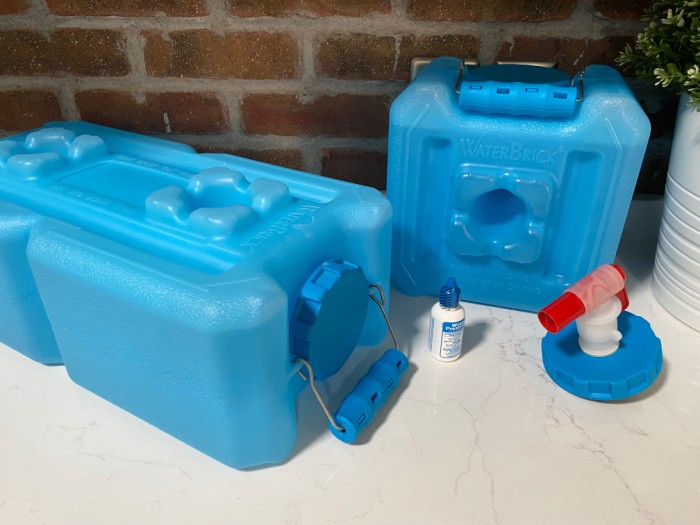
The WaterBrick on the left can hold 3.5 gallons of liquid or 27 pounds of dry food. The WaterBrick on the right can hold 1.6 gallons of water (currently unavailable) or 13 pounds of dry food. If you want a WaterBrick Spigot, this is it. The Water Preserver is needed if you only want to rotate your water every five years. WaterBrick (some items are delayed)
Years ago, in my guest room, I stored 56 gallons of water in my WaterBricks under a queen-size bed (depending on your bed frame and leg height).

WaterBrick Tips – Great Portable Containers
- Dimensions of the WaterBricks (3.5-gallons) 9″ W x 18″ L x 6″ H
- Dimensions of the WaterBricks (1.6-gallons) 9″ W x 9″ L x 6″ H
- These are stackable and offer portability; 16 of the 3.5-gallon sizes will fit under my queen-sized bed (56 gallons total)
- They also stack/interlock for easy storage, yet you can quickly grab one and go with the provided handle.
- Add 1/2 teaspoon of Water Preserver to store for five years of clean water; change the water every five years (for the 3.5-gallon size)
- They have convenient handles with a “grip” to protect your hand. The handle folds into the unit for easy storage and stacking. Though portable, they are highly durable.
What about using smaller containers like empty milk jugs?
I’ve often been asked why I don’t write about or recommend the smaller jugs. I worry about several issues, such as whether they were adequately cleaned out before water was added, whether they are made of food- or water-safe plastic designed for extended storage, and whether chemicals will leach into the container if left on the ground or concrete.
My experience has been that they are also prone to leaking. However, they are pretty handy for short-term use if other options aren’t available, and they are free since you’re reusing them.
A better option may be the heavier plastic containers used for fruit juices. They tend to have thicker plastic that should hold up better over time. I’ve also heard that larger vinegar containers tend to hold up okay for short-term water storage.
Water Filter Systems Are A Good Investment
This post lists the containers I suggest you use, but don’t forget that the water may need to be treated BEFORE it’s placed in the container. You don’t want to fill these storage containers during a disaster, but you may need to replace the water if it’s used during the emergency. Hopefully, the local water utility has been able to keep the water from contamination during the emergency. A wise backup plan is to have water filter systems in place before you need them.
I like products from Big Berkey and PortaWell. The Big Berkey units rely on gravity to filter water, while the PortaWell units use a battery-powered pump. They even have a solar panel option to charge the battery, if needed. That makes the PortaWell approach more feasible if you plan to filter a larger volume of water, such as the 250-gallon tank discussed today. The PortaWell units can filter up to 60 gallons per hour, which is awesome!
Water Storage: How Much Do You Really Need?
PortaWell™: The Best Portable Water Filtration Unit
Final Word
Please think about adding more water storage containers to your stash. It’s all about being prepared for the unexpected. We can do this one container at a time, right? Please tell me your favorite containers for storing water; I’d love to hear from you. May God bless this world, Linda
The post The Best Water Storage Containers appeared first on Food Storage Moms.
from Food Storage Moms
No comments:
Post a Comment