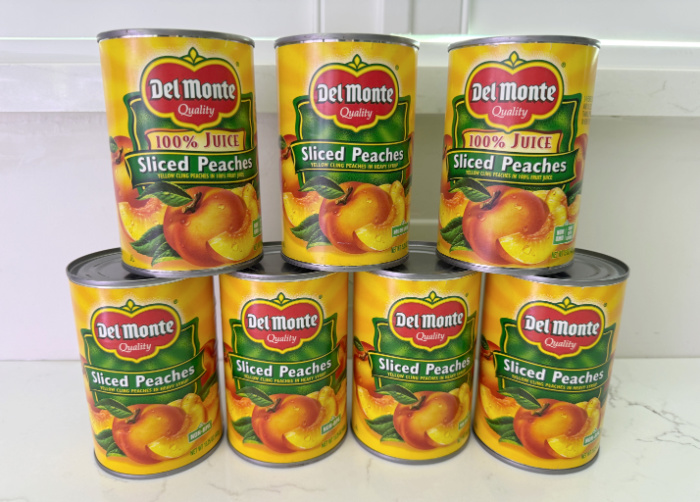
Canned Peaches: Do we need to worry about purchasing them now? If you have seen headlines lately about Del Monte™ cutting down hundreds of thousands of peach trees, I don’t blame you for feeling a little rattled. As a family that leans on canned and home-preserved fruit for our food storage, this is exactly the kind of story worth understanding before it turns into a rumor at the next church potluck. So let me walk you through what’s actually happening, and whether it means trouble for the canned peaches sitting on your pantry shelf.
Del Monte Foods™
Del Monte Foods™ filed for Chapter 11 bankruptcy protection in July of 2025. This is a nearly 140-year-old American company, and the filing came after the company took on heavy debt, struggled with shoppers moving away from canned goods toward fresh produce, and got squeezed by rising costs. By April of 2026, Del Monte™ had permanently closed two of its California canneries, one in Modesto and one in Hughson. Those two plants alone had handled somewhere between 30 and 35 percent of all the cling peaches processed in California.
Here’s the piece that matters most for growers. Clingstone peaches, the variety grown almost entirely for canning, don’t really have a fresh market. When the cannery that buys them shuts its doors, and no replacement buyer steps in for that plant, the farmers who grew that fruit are left holding a crop with essentially nowhere to go.
The Number 420,000
You may have seen the figure 420,000 tossed around alongside the word acres. That’s not quite right, and I want my readers to have the correct picture. The number refers to roughly 420,000 individual peach trees, spread across about 3,000 acres of Central Valley orchards. The United States Department of Agriculture approved up to 9 million dollars in relief funding, matched by another 3 million from the California Canning Peach Association and industry partners, to help farmers remove those trees before this year’s harvest even ripened. The goal is to pull about 50,000 tons of peaches off the market so growers aren’t stuck trying to sell fruit that has no buyer, which USDA estimates will save farmers roughly 30 million dollars in losses they would otherwise absorb.
It’s a hard trade. Removing the trees early protects the farmers who remain in business by preventing a glut that would crash prices further. But it also means a lot of fruit that could have fed people will simply never be picked.
Del Monte™ Isn’t Liquidating Entirely
Here’s the reassuring part. Del Monte™ isn’t liquidating entirely. The company has been selling off pieces of its business to multiple buyers, including Fresh Del Monte™ Produce, B and G Foods, and Pacific Coast Producers, and operations have continued through the restructuring rather than shutting down all at once. Pacific Coast Producers has already stepped in with one-year contracts covering a portion of the fruit that Del Monte can no longer take. So this isn’t a total collapse of the canned peach supply chain; it’s a painful regional restructuring that’s hitting Central Valley growers the hardest.
That said, with roughly a third of California’s cling peach processing capacity gone from the Modesto plant closure, it wouldn’t surprise me to see some tightening in canned peach supply or a bump in prices over the next year or two as the industry finds its new balance. This is exactly why I always encourage families to keep a working stock of canned fruit on hand rather than waiting until shelves look thin.
California Peaches
California grows virtually all of the peaches that get canned in the United States. There’s no other domestic region that fills that gap. But the country doesn’t rely on California alone. Roughly 30 percent of the canned peaches sold in the United States already come from overseas, mostly China and Greece, with Chile also supplying fresh peaches into the market. So even with California’s cling peach capacity shrinking, imported canned peaches will likely fill more of the gap on store shelves in the months ahead.
Buy American
I want to gently flag something here for my readers who care about buying American. A few years back, a Modesto school lunch program was caught serving canned peaches packaged in Thailand that were actually grown in Greece, despite Buy American sourcing rules. If keeping your food dollars with American farmers matters to you the way it does to our family, this Del Monte™ closure is a good reminder to read the fine print on your canned goods. Look for wording like grown in USA or packed in California rather than assuming a familiar brand name guarantees a domestic peach. As more of our canned peach supply shifts overseas, that label check becomes more important, not less.
Frozen Fruit
It helps to remember that canned peach consumption has been declining for decades as families shifted toward fresh and frozen fruit, so this closure didn’t come out of nowhere. It’s the continuation of a trend that’s been building since the 1970s and 1980s, combined with a debt load Del Monte™ took on after overordering supplies during pandemic-era demand spikes. Rising tariffs on the steel used to make cans added even more pressure on the company’s margins. Understanding that broader context helps explain why one company’s bankruptcy could ripple out to affect thousands of acres of orchards.
Check Country of Origin
Here’s what I would add to your preparedness plan. Check the country of origin on your canned peaches at the store, since more imported product will likely appear on shelves this year. If you can peaches yourself, this may be a good year to buy extra fresh peaches directly from local orchards while cling peach growers are still selling what they can, since some of these trees will not produce again. Keep an eye on canned fruit prices generally through the rest of 2026, since a supply shift this size tends to show up gradually rather than all at once. And remember that food storage isn’t about panic buying; it’s about steady, informed stocking so your family is never caught off guard.
Final Word
The Del Monte™ bankruptcy is a reminder that even the most familiar brands in our pantry can shift without warning, and that our food supply is more interconnected than most of us stop to think about on a normal grocery run. This isn’t a reason to panic or to clear the shelves. It’s simply another nudge to keep doing what we already do here, stocking steadily, checking labels, supporting local growers when we can, and trusting that a well-prepared pantry will carry our families through whatever changes come next. May God bless this world, Linda
The post Do We Need To Worry About Canned Peaches? appeared first on Food Storage Moms.
from Food Storage Moms
No comments:
Post a Comment