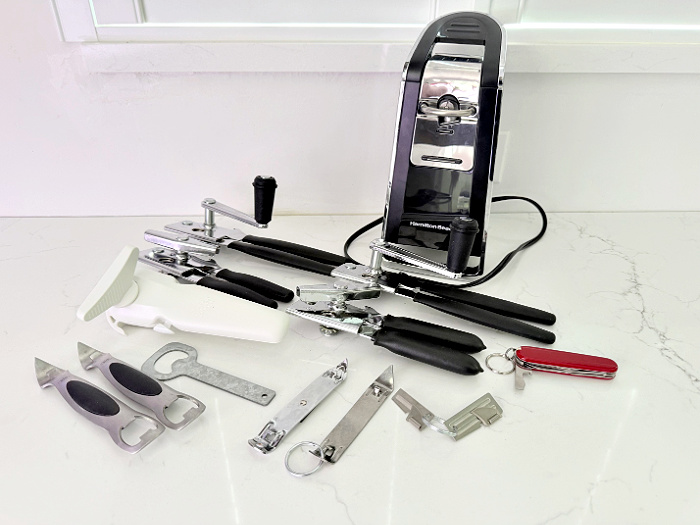
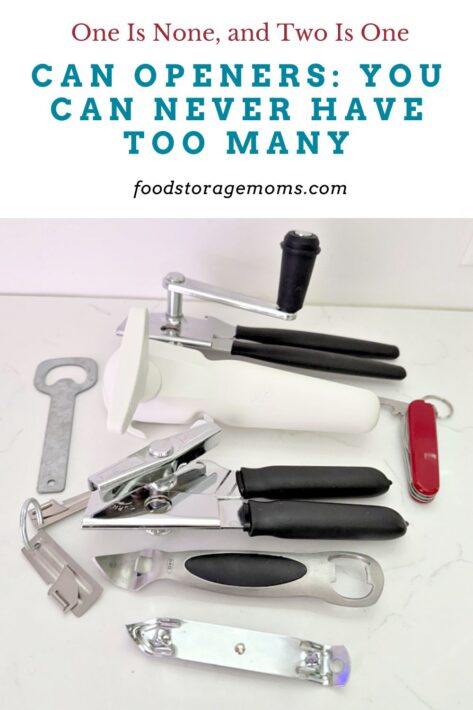
Can openers, you can never have too many. Open any well-stocked kitchen drawer, and you’re likely to find at least one can opener. Check the drawer of a truly prepared cook, and you might find three or four. There’s a reason for that. I have lots of can openers, some in my car, some in my EDC (every day carry bag), and Mark and I each have one in our 72-Hour Kits.
Yesterday, I wrote a post about which cans of beans to stock, and after Matt’s comment, I laughed all day. Did you know you can take a can, smack it several times on concrete all the way around it, and lift the lid off? I learn something new every single day.
Years ago, I used to teach emergency preparedness classes, and I can still see the lady attending ask me why she needed a can opener. I got the giggles; most of you know I love to laugh, and this statement got me going. I was shocked, and then I burst out laughing. I asked her how she was going to open the #10 cans she had stored. She said she only buys fresh vegetables and fruits, so there was no need for a can opener in her home. She bought one the next day.
Oh my gosh, this has been my dream my whole life, to buy a house that I could walk to a farmers’ market every single day and buy fresh fruits and vegetables. When Mark and I were newlyweds, we started gardens from day one. I grew up gardening. I asked Mark to think about buying some land to have a mini-farm, not too big but enough where we could grow our own food. You may not know this, but we have been married for 56 years. It never happened, it wasn’t in the cards, and I still regret that. We did have a half-acre lot in River Heights, which is located in Northern Utah. We had our biggest garden there, where we grew corn, green beans, tomatoes, and various melons. It was over 150 feet long and about 40 feet deep. We also had a strip between neighbors where we had our girls plant June-bearing and ever-bearing strawberries. We loved that property.
Humble Can Opener
The humble can opener has been a kitchen staple since canned food became widely available in the mid-1800s. For decades, cooks simply stabbed a blade around the rim of a tin and hoped for the best. Today, the landscape looks very different. From sleek electric countertop models to tiny military-issue tools that fit on a keychain, there’s a can opener designed for virtually every situation, hand strength, and storage constraint. Understanding what each type does well helps you choose the right one and, yes, justifies keeping more than one on hand.
Can Openers: You Can Never Have Too Many
Electric Can Openers
Electric can openers are the workhorses of a busy kitchen. Designed to do the heavy lifting for you, these countertop appliances grip the can automatically and rotate it through the cutting mechanism with the press of a button or lever. They’re particularly useful for people who regularly open large volumes of cans, those with arthritis or limited hand strength, and anyone who wants a consistently smooth cut with minimal effort.
To use an electric can opener, place the cutting wheel against the outer edge of the lid, engage the drive mechanism, and let the motor carry the can around until the lid is fully separated. Most modern electric openers are designed to cut below the rim, which means the lid drops safely inward rather than leaving a sharp edge exposed. When shopping for one, look for a powerful motor, easy-to-clean components, and a magnetic lid holder that retrieves the lid after cutting to prevent it from falling into your food.
Pampered Chef Can Openers
Pampered Chef has built a reputation for kitchen tools that are engineered with thoughtful ergonomics and durable construction, and their can openers are no exception. The Pampered Chef Safe-Cut Can Opener is one of their most well-regarded tools, using a side-cutting design that removes the entire lid rather than punching through the top. This leaves no sharp edges on either the lid or the can, which is a genuine safety improvement over traditional styles, particularly if you have your kids help you open the cans.
Using a side-cut opener like the Pampered Chef model involves positioning the cutting wheel against the side wall of the can just below the rim, rather than on top of the lid. Turn the knob or handle, and the tool rolls smoothly around the perimeter. When finished, a built-in lid lifter removes the top without any finger contact. The result is a can with a clean, safe edge and a lid you can dispose of without worrying about cuts. These openers work beautifully for everyday cooking and make a smart gift for households with children or older cooks.
I confess, I went to a Pampered Chef party, and the can opener looked so great and easy to use. I bought two, of course. It takes several weeks to get them delivered, but I’ve heard they’re great. I couldn’t figure out how to use the model I bought. I gave one to my granddaughter because she had it on her wedding registry. She knows exactly how to use it! Yay! The other one is sitting in my kitchen drawer.
Bottle Can Openers
The bottle can opener, sometimes called a church key, is one of the oldest and most versatile tools in the kitchen. The name comes from the days when the pointed end was used to punch triangular holes into the tops of flat cans, often of beer or juice. One end features a sharp, pointed blade for puncturing cans, while the other end offers a hook-shaped opener for prying off bottle caps.
To use the puncturing end, position the pointed tip over the edge of the can lid and press down with a rocking motion. For vented cans, such as large juice tins, punch two holes on opposite sides to allow air in and liquid out freely. For bottle caps, hook the curved end under the edge of the cap, use the lip of the bottle as a lever point, and press down with a firm snap. Church keys are inexpensive, virtually indestructible, and compact enough to toss in a bag or picnic basket without a second thought.
Military Can Openers
Military-issue can openers represent a brilliant intersection of minimalism and function. Born out of necessity in wartime field kitchens and survival kits, these tools were designed to be as small, light, and reliable as possible, while still doing the job under difficult conditions. They’ve since earned a loyal following among campers, hikers, preppers, and anyone who appreciates ingeniously simple engineering.
The general technique for using a military can opener involves hooking the small blade over the rim of the can lid, then rocking the tool forward and backward in short strokes while walking it around the perimeter of the lid. It takes a little practice to develop the rhythm, but once mastered, it becomes second nature. The appeal is obvious: a tool this small and inexpensive can live permanently in a go bag, a camping kit, a drawer, or on a key ring without adding any meaningful weight or bulk.
Small Can Openers
Small manual can openers are the classic kitchen drawer standard. Usually five or six inches long, they consist of a cutting wheel, a feed wheel, and a pair of handles that the user squeezes together to engage the mechanism. These compact tools are affordable, widely available, and effective on virtually any standard can size. They store easily, require no power source, and are simple to clean.
The key to using a small manual can opener well is positioning. Start by clamping the cutting wheel to the very inner edge of the can rim, ensuring it bites cleanly before you turn the knob. Turn steadily and keep gentle downward pressure on the handles to maintain contact through the cut. When you return to your starting point, the lid should be nearly fully detached. Pause before the final separation and use the lid itself to lift away from the can to avoid drips. A quality small can opener with sharp, hardened cutting wheels will serve reliably for years.
Extra Large Can Openers
Commercial kitchens, catering operations, and serious home cooks who work with number-ten cans or large institutional-size tins need a more substantial tool. Extra-large can openers, including heavy-duty countertop models that clamp to a table edge or mount to a wall, are built to handle cans that a standard household opener would struggle with. Their oversized cutting heads, reinforced drives, and ergonomic long handles make short work of large-format cans.
Using an extra-large can opener follows the same basic principles as a standard manual model, but the increased leverage and larger gear ratio mean you apply far less physical effort per rotation. For wall-mounted or clamp-on commercial versions, align the cutting wheel carefully before engaging, since a misaligned start can make the job harder. These tools are essential for anyone regularly opening large cans of tomatoes, beans, or stock, and a worthwhile investment if you do any quantity cooking.
P-38 and P-51 Can Openers
P-38 Can Opener and P-51 Can Openers
The P-38 and P-51 are two of the most iconic small tools in American military history. Issued to U.S. troops beginning in World War II as part of field rations, these tiny folding can openers were small enough to fit in a shirt pocket or hang from a dog tag chain, yet capable of opening any military-issue ration can in the field. The P-38 is approximately 1.5 inches long when folded, while the P-51 is slightly larger at about 2 inches, offering a bit more leverage and ease of use.
The name P-38 is widely believed to refer to the 38 punctures required to open a standard C-ration can, though the exact origin of the designation is a matter of some debate among military historians. The P-51 designation follows the same naming convention and is simply a larger version of the same fundamental design.
To use a P-38 or P-51, unfold the small blade so it sits at roughly a right angle to the body. Hook the lip of the body over the rim of the can lid so the blade rests on the top surface. Press down to pierce the lid, then rock the tool forward with a small pivoting motion, advancing it slightly around the rim with each stroke. Repeat all the way around the can. The technique feels awkward at first, but becomes quick and reliable with a little practice. Despite their age, these tools remain in production today and are available at most outdoor supply stores and surplus retailers for just a few dollars apiece.
The enduring popularity of the P-38 and P-51 speaks to a broader truth about can openers as a category. The best tool for a given situation is not necessarily the largest, the most expensive, or the most technologically sophisticated. It’s the one that works reliably when you need it, fits the context you are operating in, and suits the hands holding it.
Choosing the Right Can Opener for Your Needs
The case for owning more than one can opener is practical. An electric model on the counter handles the bulk of everyday cooking with effortless consistency, as long as you have power. A compact manual opener or a Pampered Chef side-cut model lives in the drawer for times when the counter is crowded, or you need a safer edge. A church key handles bottles and puncture-top cans. And somewhere in a camping kit or emergency bag, a P-38 or P-51 waits patiently, occupying almost no space at all, ready to be exactly what is needed.
Consider hand strength and dexterity when selecting any manual opener. Look for smooth-rolling cutting wheels, comfortable grip handles, and a construction that feels solid without being unnecessarily heavy. Stainless steel components resist rust far better than plated finishes over time. And for any opener, a quick wipe or water rinse after each use goes a long way toward extending its working life. However many can openers currently live in your kitchen, there’s a good chance the right collection is one more than you have right now.
Whether you’re outfitting a professional kitchen, a camping pack, or simply upgrading a well-used drawer staple, the variety of can openers available today means there’s a perfect match for every need, hand, and habit.
How To Declutter Every Room In Your Home
101 Ways To Save Money Every Day
Final Word
Can openers are one of those kitchen tools that reward having options. Whether you reach for a plug-in electric model on a busy weeknight, a Pampered Chef side-cut opener for a clean edge, a trusty church key for bottles and punch-top cans, or a P-38 tucked into a camp bag, the right opener makes the job effortless. From small everyday models to extra-large heavy-duty openers built for commercial use, there is a can opener for every hand, every kitchen, and every situation. Since power outages are one of the most common issues during an emergency, don’t forget that every kitchen needs a manual unit you can rely on. You truly can never have too many can openers. May God bless this world, Linda
The post Can Openers: You Can Never Have Too Many appeared first on Food Storage Moms.
from Food Storage Moms
No comments:
Post a Comment