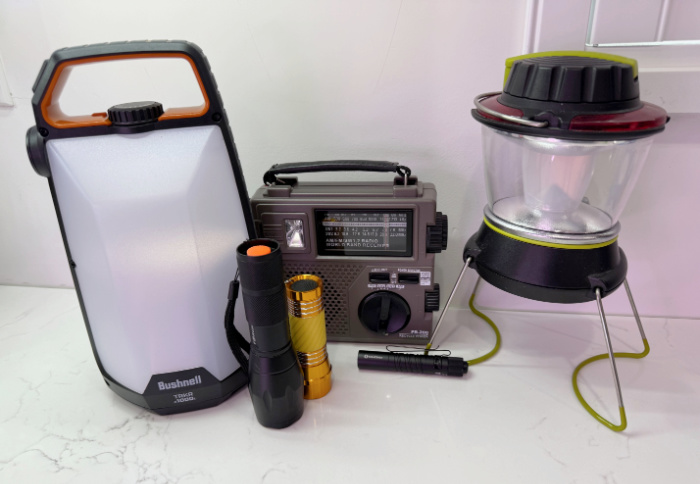
If We Have A War: Don’t Be In The Dark. Many people never think about what happens when the lights go out, and there’s nowhere to plug in. A war doesn’t announce itself politely. Infrastructure is one of the first things to go, and with it the power that runs every corner of modern life. Darkness falls fast, and darkness has a way of making every other problem worse. The families who come through hard times are almost always the ones who planned ahead, and planning ahead for light is one of the simplest, most overlooked acts of true readiness.
When conflict reaches the point of disrupting the electrical grid, day becomes manageable and night becomes a different world entirely. You can’t cook safely in the dark. You won’t be able to properly tend to an injury you can’t see. It’s impossible to read instructions on a medication bottle, comfort a frightened child, or navigate your own home without stumbling into something. Light is not a luxury in a crisis. It’s a fundamental requirement for safety, sanity, and survival.
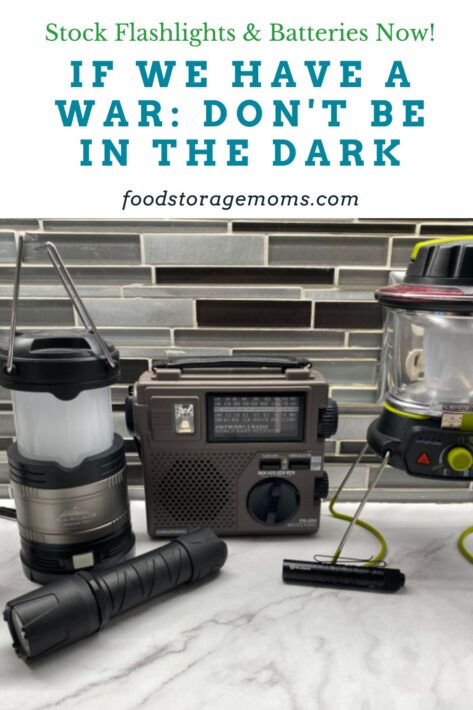
This post is about building a lighting plan before you need one. It covers the tools that will serve you best across days, weeks, or longer stretches without power: battery flashlights, solar flashlights, solar lanterns, solar yard lights, and the batteries to keep them all running. Each has a specific role. Used together, they form a complete system that leaves no corner of your preparedness in the dark.
The families who survive hardship longest are almost always the ones who secured their lighting options first. Everything else follows from being able to see.
Why the Night Is Your Biggest Threat When the Grid Goes Down
Power outages during war are not the same as a storm-related blackout that lasts a few hours. Wartime grid disruption can last for weeks or months, and in some historical conflicts it’s stretched into years. The electrical infrastructure of a region, once targeted, doesn’t come back quickly. Repairs require supply chains, skilled workers, and security that may not exist in a conflict zone.
When the sun sets in a world without electricity, the psychological weight is immediate. Studies of populations living through prolonged blackouts consistently show increased rates of accidents and injuries, slower responses to medical emergencies, and a measurable deterioration in morale. The practical effects compound the emotional ones. Food spoils faster when you can’t see what you’re working with. Strangers become harder to identify. Threats that would be obvious in daylight become invisible in the dark.
None of this needs to be your reality. A modest investment in the right lighting tools, assembled now while stores are stocked and shipping is reliable, changes the equation entirely. The cost of being prepared is relatively small. The cost of being unprepared is enormous.
Battery Flashlights: Your First Line of Defense When Night Falls
Battery flashlights are the foundation of any emergency lighting plan, and they should be the first thing you secure. They’re immediate, portable, and require no setup. The moment the lights go out, a battery flashlight is what you reach for. For emergency preparedness, you want at least one quality flashlight in every room, one in every vehicle, and one dedicated to every person in your household who is old enough to use one responsibly.
When selecting battery flashlights for war preparedness or extended grid-down scenarios, lumens matter, but so does runtime. A flashlight that burns at 1000 lumens for 30 minutes is far less useful than one that runs at 300 lumens for 10 hours on the same batteries. Look for models with multiple brightness settings to conserve power when full brightness isn’t needed. A low setting used for reading or moving through familiar spaces can dramatically extend battery life compared to running the flashlight at maximum output.
Water resistance is essential. Rain doesn’t stop because of a crisis, and the conditions under which you might need your flashlight most are often the ones least friendly to electronics. Look for flashlights rated IPX4 or higher for splash and rain resistance, or IPX7 or IPX8 if you anticipate submersion risks. Military-grade and tactical flashlights often meet these standards and are built to withstand the demands of emergency scenarios.
Headlamps
Consider having at least one high-quality headlamp for each adult in your household. A headlamp leaves both hands free, which matters enormously when you’re cooking, performing first aid, working on repairs, or carrying supplies. The best emergency headlamps run on AA or AAA batteries and offer a red light mode that preserves night vision and is less visible from a distance, both of which are practical advantages in any scenario where security is a concern. Headlamps or Battery Headlamps
Solar-Flashlights: Sustainable Light That Costs Nothing to Recharge
Solar flashlights represent one of the most important advances in emergency lighting technology of the past decade. Whereas a conventional battery flashlight eventually drains its power and goes dark, a solar flashlight recharges each day using sunlight and is ready again by nightfall. In a prolonged emergency where replacement batteries may not be available, this renewable quality changes everything.
The best solar flashlights for emergency preparedness include a built-in photovoltaic panel that allows them to charge while hanging in a window, resting on a sill, or sitting outside in partial shade. Many models also accept USB charging, giving you flexibility if you have access to a power bank or a vehicle charging port. In a scenario where grid power is unavailable but you still have a functioning vehicle, this dual-charging capability considerably extends your options.
Solar flashlights do have one limitation that you must plan around: they need sunlight to charge, and cloudy days extend the recharge cycle. This is exactly why solar flashlights should complement your battery flashlight supply rather than replace it. Use your solar units as your primary light sources whenever possible, conserving your battery flashlights for situations where immediate, full-power light is needed without waiting for a solar charge.
When evaluating solar flashlights, look for units with internal lithium-ion batteries, as they retain their charge longer and withstand more charge cycles than older battery technologies. A good solar flashlight can provide reliable light for years of daily use with no operating costs. For preparedness, keep several charged and ready, rotating them into sunlight regularly so they’re always at full capacity. Solar Flashlights and Battery Flashlights. We have numerous solar flashlights resting on window sills all the time, and that fact provides confidence and comfort.
Solar-Lanterns: Lighting a Space, Not Just a Path
A flashlight illuminates where you point it. A lantern lights a room. This distinction becomes critical when you’re living in a grid-down environment for an extended period. Solar lanterns are the indoor workhorses of emergency lighting, providing ambient illumination for cooking, eating, caring for children, treating injuries, and maintaining the semblance of normal life that is so important to morale during extended crises.
Solar lanterns designed for emergency use typically fold flat for storage and expand to expose a solar panel for charging. Many models include a hook or handle for hanging, which allows you to position them for maximum coverage in a room. The best units run 8 to 12 hours on a single charge and are bright enough to comfortably illuminate a small room or table workspace without harsh glare. Lanterns with Batteries and Solar Lanterns
For a household of four people, plan on having a minimum of four to six solar lanterns. You want at least one per room in active use, with additional units charging at any given time. Rotating lanterns between charging and use ensures that you always have light available, regardless of how much sun the day provides. In households with young children or older family members, keeping a lantern on through the night at low brightness provides safety and comfort that is worth the modest power cost.
Collapsible solar lanterns are particularly valuable for preparedness kits because they pack small and weigh almost nothing. A family with a well-stocked emergency kit might include two or three collapsed solar lanterns that take up no more space than a book. When deployed, they can transform from a compact package into a reliable light source within seconds, requiring no tools, no fuel, and no special knowledge to operate. Emergency Power Outage Lights
Solar-Yard Lights: Turning Your Exterior Into A Safer Space
When we talk about war preparedness and lighting, most people think only of the inside of their home. But the exterior of your property matters just as much, and in some scenarios, it matters more. Solar yard lights are a simple, low-cost solution that keeps your immediate surroundings illuminated through the night without drawing on any stored battery supply.
Solar yard lights stake into the ground along paths, driveways, and entry points. They charge during the day using their individual solar panels and switch on automatically at dusk. They require no wiring, no maintenance, and no operating costs. In a normal residential setting, they are a convenience and an aesthetic choice. In a grid-down emergency, they become security infrastructure.
A yard that remains lit at night is less attractive to those who prefer to operate in darkness, whether that means opportunistic theft, trespassing, or more serious threats. Motion-activated solar yard lights add an extra layer by flooding specific areas with a sudden burst of bright light when movement is detected. This serves as both a deterrent and an alert, giving the household a moment of warning before an approaching person reaches the door.
For preparedness purposes, install solar yard lights along every approach to your home and around any areas where you store supplies or equipment. Focus especially on gates, garage doors, and secondary entry points that might not be immediately visible from inside. Even modest solar yard lights that produce 10 to 20 lumens each provide meaningful visibility improvements over total darkness, and the cumulative effect of six or eight of them, positioned strategically, can make a property feel and function like a well-lit environment even without grid power. Yard Solar Lights
Consider also keeping a small supply of replacement solar yard lights in storage. These units are inexpensive in bulk, and having extras means you can quickly replace any that are damaged, stolen, or stop functioning during an extended emergency. The resilience of a yard lighting system depends on its reliability, and redundancy is the simplest way to ensure that reliability when supply chains are disrupted.
Batteries: The Currency of Emergency Lighting
In a world where the grid is down and solar panels are charging during daylight hours, batteries become one of the most valuable commodities in your possession. They’re the stored energy that powers your flashlights through long winter nights, runs the devices your household depends on, and gives you flexibility when solar charging is not sufficient. Treating your battery supply with the same seriousness as your food and water supply is one of the wisest things a preparedness-minded household can do.
Alkaline Batteries
Start with a standardized battery strategy. The more variety of battery sizes your devices require, the more complicated your supply management becomes. Where possible, select flashlights, lanterns, radios, and other emergency devices that all run on AA batteries. AA batteries are the most widely available battery size worldwide, making them the easiest to find if you need to resupply or buy in bulk. A household that has consolidated its batteries around AA and AAA has a far simpler storage and rotation challenge than one that maintains inventory in six different sizes. Alkaline batteries are fine for regular rotation and use. I buy mine from Sam’s Club and have them shipped to me. I paid for the Plus membership, worth every penny.
Rechargeable Batteries
Rechargeable batteries are an essential complement to your disposable supply. A set of high-quality rechargeable AA and AAA batteries paired with a solar battery charger creates a self-sustaining power loop that keeps your battery-powered devices running indefinitely as long as sunlight is available. The initial investment is higher than that of buying disposables, but the long-term value during an extended emergency is extraordinary. Look for rechargeable batteries with low self-discharge ratings, as these hold their charge for months between uses rather than draining themselves within weeks.
Store your battery supply properly. Batteries should be kept at cool, stable temperatures away from metal objects and out of humid environments. A dedicated waterproof storage container in a cool interior closet is ideal. Avoid storing loose batteries in a junk drawer where they can come into contact with metal objects and slowly discharge or short-circuit. Label your supply with purchase dates and rotate through older stock first, moving freshest batteries to the back of the storage container as you add them.
Batteries are the currency of the dark. Store them the way you store money in uncertain times: carefully, abundantly, and with a long horizon in mind.
Building Your Complete Emergency Lighting System
The real power of emergency lighting preparedness comes not from any single item but from the way the pieces work together as a system. Battery flashlights give you instant, portable, powerful light on demand. Solar flashlights extend that capability indefinitely using free energy from the sun. Solar-powered lanterns transform dark rooms into functional living spaces. Solar yard lights secure your exterior perimeter without depleting any stored energy. Batteries serve as the bridge between these technologies, keeping everything running through the nights when solar charging alone is not enough.
A practical starting point for a household of four people might look like this: eight high-quality battery flashlights distributed throughout the home and vehicles, with four headlamps included in that count. Four solar flashlights kept charged and rotating through the window charging positions. Six solar lanterns are stored, collapsed, and ready for immediate deployment. 12 solar yard lights were installed around the exterior of the property. Two sets of 16 rechargeable AA batteries and a solar battery charger capable of refreshing all of them within a day of sunlight. Solar Lights For Outside
This may sound like a lot. It’s less than many families spend on entertainment in a single month, and it’s an investment that doesn’t expire. The flashlights and lanterns will serve you for years. The yard lights will keep running season after season. The batteries in cool storage will be just as ready in 15 years as they are today. Unlike food storage, which requires ongoing rotation and vigilance, a lighting system built once largely takes care of itself.
Lithium Batteries
Lithium batteries are different. I bought some, and they weren’t interchangeable in all units that require batteries. I heard they last longer, but if they don’t work in my smoke alarm, they’re useless to me. Let me know if you have had good luck with lithium batteries.
The Moment You Cannot Afford to Regret
There is a particular kind of helplessness that comes from sitting in the dark, knowing you had every opportunity to prepare and chose not to. Nobody who has lived through a prolonged power outage, a wartime infrastructure attack, or an extended natural disaster wishes they had fewer flashlights or less fuel for their lanterns. The regret always runs the other direction.
The time to build your emergency lighting supply is now, while stores are stocked, while shipping is reliable, while the decision is entirely calm and unhurried. When the situation changes, and history gives us every reason to believe it can change quickly and without warning, the families who acted in advance will step into the darkness with confidence. Those who waited will wish they hadn’t.
Start with a quality flashlight. Then add a solar lantern. Then work through the list at whatever pace fits your budget and timeline. Any step forward is better than standing still. The night is patient. It will come regardless of whether you’re ready. The question is simply whether you intend to be ready when it does.
Final Word
You don’t have to be a survivalist or a soldier to understand what’s at stake when the lights go out. You just have to be someone who loves their family and is ready. The tools covered in this post are simple, affordable, and available right now. Battery flashlights, solar flashlights, solar lanterns, solar yard lights, and a solid battery supply aren’t extreme measures. They’re common sense in uncommon times. Buy them before you need them, store them where you can find them in the dark, and rest a little easier knowing that whatever comes, the night won’t catch you unprepared. May God bless this world, Linda
The post If We Have A War: Don’t Be In The Dark appeared first on Food Storage Moms.
from Food Storage Moms
No comments:
Post a Comment