A lot of emergencies do not begin with a foreign enemy, a civil collapse, or some dramatic event on the evening news. Sometimes they begin with a bridge that should have been repaired years ago. Sometimes they begin with a dam that has been patched, inspected, warned about, and ignored. Sometimes they begin with an […]
from Survivopedia
Tuesday, August 25, 2026
Monday, August 24, 2026
Let’s Have a Look Inside the Doomsday Bunkers of the 1%
Somewhere near Washington D.C., a company is spending $300 million to dig a luxury apartment complex 200 feet into the ground. The swimming pool sits 20 stories down but looks like it’s perched on the edge of a cliff. Robots run the medical wing. A single membership costs $20 million, and only 625 people will ever hold one.
The project is called Aerie, built by a Virginia firm named SAFE, short for Strategically Armored and Fortified Environments. They’ve spent decades building panic rooms and fortified estates for the mega-rich, including one home with its own Formula 1 track.
Aerie is their biggest swing yet: a members-only survival club marketed as a five-star way to ride out nuclear fallout, an EMP that fries the grid, or the kind of civil breakdown that tends to follow either one.
Forbes got the full tour. The details are worth your time, because they show you what the richest people alive are actually afraid of, and where they’re about to sink a fortune into the wrong things.
What $300 Million Buys You Underground
The first Aerie will run more than 20 stories deep, with room for over 200 apartments. The smallest is a 2,000-square-foot suite. The largest are multi-level penthouses topping 20,000 square feet, all of it buried 200 feet below the surface. Only the rooftop penthouse sits above ground. Everything else is underground for security.
To keep residents from feeling like they’re living in a hole, the walls and ceilings are giant screens that simulate open views, so a pool 20 stories down looks like it’s floating over a skyline:

SAFE calls each unit an NBCET sanctuary, meaning it’s built to hold up against nuclear, biological, chemical, electromagnetic, and technological attack. Getting in means clearing biometric scanners and tactical mantraps, the layered entry designed to trap an intruder between locked doors before they ever reach the living space.

Then there’s the medical wing, which is where the marketing gets loud. It’s called MediShield, an AI-run intensive care unit with robotic imaging, robotic nurses running IV therapy, a hyperbaric oxygen chamber, and an ice plunge for recovery. SAFE claims it delivers the same standard of care as the White House Medical Unit.

Add a gourmet dining program, a bowling alley, and a climbing wall, and you start to see the pitch. This is survival with room service.
Why the Wealthy Are Digging In
Aerie is only the first. SAFE wants 50 of them across U.S. cities and around a thousand affiliate sites worldwide. And these people aren’t alone.
Mark Zuckerberg’s Hawaii compound reportedly includes an underground shelter. Bill Gates and Kim Kardashian have both been tied to similar builds. When people with access to the best private security briefings on earth start spending this kind of money to get underground, that’s a signal worth reading.
 SAFE’s founder, Al Corbi, doesn’t soften it. He describes a massive solar flare knocking out the global grid, supply chains failing within hours, and society coming apart soon after. He calls that a likely reality rather than a movie plot.
The company also says the idea for Aerie came partly from a client who spent $10 million on home security and was still shot dead by a gunman at a concert, away from all that protection. The lesson the rich took from it: safety has to travel with you.
So far, so reasonable. A seasoned prepper would agree with most of that premise. The disagreement starts the moment you look at how they’re solving it.
The Problem With a Bunker That Runs on Robots
Every headline amenity in Aerie depends on things that break. The AI medical suites need power and a steady stream of software updates. The robotic nurses need spare parts and someone on site who can actually repair them. Even the digital walls go dark the second the power supply hiccups. The more complex a system is, the more ways it can fail, and the harder it is to fix once SHTF.
So, a robot surgeon is impressive on day three. On day 300, with no replacement sensors and no engineer on call, it’s a very expensive gadget. Anyone who has nursed a generator through a long outage already knows how this goes: the complicated gear fails first, and it fails right when you need it. A hand pump keeps working long after the smart pump quits.
That’s why other projects beat a luxury bunker. For example, this root cellar was approved by a nuclear inspector and comes with sturdy blueprints. It’s built to hold up against a nuclear event, a blackout, and an EMP, with a setup that keeps it from ever running out of electricity.
Best of all, it costs a tiny fraction of what the rich sink into their shelters. Most backyard builds like this run somewhere around $400 to $1,500 in materials, depending on size and what you already have on hand, next to nothing against a bunker that runs into the millions.
If you’re interested in the plans, you can see a preview here.
The Food Problem Money Can’t Solve
None of these luxury bunkers grow food. They store it. Even a warehouse of gourmet supplies has an end date, and 625 people eat through a pantry faster than any brochure wants to admit. Gourmet dining underground assumes fresh deliveries keep arriving, which is exactly the assumption a real collapse tears up.
A family with a garden, saved seed, a few chickens, and the know-how to can and preserve a harvest has something no $20 million membership includes: food that renews itself. That’s the irony of the whole project. The ultra-rich are paying a fortune to store what a self-reliant household already produces in the backyard for the price of some labor and a growing season.
But growing food underground, with no light, can be a tricky business. Even so, there are 6 forgotten tricks that will help you have fresh produce underground. One of them is a Walipini, a pit greenhouse the Bolivians perfected high in the Andes. Even during winter, the ground stays warm enough to grow greens, tomatoes, and peppers.
Also, did you know there’s one crop that grows in complete darkness? It might be the single most valuable thing you can produce when you’re stuck below ground.
A Known Bunker Is a Target
A publicized luxury shelter holding hundreds of billionaires is close to the worst-kept secret in the survival world. The construction crews, the vendors, the staff, they all know exactly where it sits. In a genuine breakdown, desperate people move toward resources, and a glowing fortress full of the wealthy is a beacon that pulls trouble straight to the door.
There’s a deeper crack in the plan, and SAFE all but admits it. Corbi says their systems are built to give the owner control, “not their staff.” Sit with that for a second. They designed the security around the possibility that the people running the place turn on the people who own it. When the money that pays the guards and the robot technicians becomes worthless paper, what keeps the staff loyal? A luxury bunker is only as secure as the least trustworthy person who knows the door codes.
While the rich pour fortunes into bunkers and hire armies to guard them, the average American family is left standing in the open. Every household in the country faces the risk of burglaries, assault and riots. We have never been this vulnerable, and the wealthy know it better than anyone.
That’s why I’d urge you to watch a mind-blowing short documentary. It cuts through the noise and shows you how to secure your home against exactly these threats.:

You can’t build a $300 million fortress. What you can do is harden the home you already have, and you’d be surprised how far a few deliberate changes go. The billionaires are betting everything on concrete and robots. Your edge is being ready where you already stand, and this documentary shows you how.
What the 1% Can’t Buy
So before you envy the way these people are prepping for the end of the world, understand something. This is the most unrealistic way to do it. They’re buying their way out, sealing themselves in a bubble, betting that money and concrete will carry them through. And they’ve left out the things that actually keep a person alive.
Do you know what the rich never accounted for? The things money can’t buy:
- How to grow vegetables and fruit through the dead of winter.
- How to survive in the wild if you can’t reach your shelter.
- How to cook a real meal in a total blackout.
- How to purify water when the taps run dry.
- How to repair what breaks with your own two hands.
Couldn’t check off every box? Then you need this survival manual.
Our grandparents could do all of it without a second thought, and every one of those skills has been gathered into a single guide, laid out step by step so anyone can follow.
 Click here to see the 200+ survival skills the rich forgot
They’re betting on a fortress they’ll never test. You’ll be the one who doesn’t need one.
Editor’s Note: The ultra-rich don’t hand out tours of their doomsday bunkers, so the images here are AI-generated to bring the descriptions to life.
You may also like:
 This Is How Much It Actually Costs to Build a Bunker
Jerry-Rig a Radio like the PoWs in WW2 Prison Camps (VIDEO)
Doomsday-Proof Medicinal Stockpile
Why You Should Think Like a Navy SEAL
Root Cellar Mistakes You Need To Avoid At All Costs
The post Let’s Have a Look Inside the Doomsday Bunkers of the 1% appeared first on Ask a Prepper.
from Ask a Prepper https://ift.tt/kgfVcvu
10 Books To Get While You Still Can
Estimated reading time: 8 minutes
Think about how you solve problems nowadays. Your water heater starts leaking, so you pull out your phone and look up how to fix it. Someone in the family has a strange rash, so you type the symptoms into a search bar. You want to can this year's tomato harvest, so you pull up a recipe. We take all of that for granted because the answer is always a few clicks away.
Now imagine the grid is down. Permanently. How would you solve those problems with no Internet?
When a real disaster strikes, you won't be able to order a book from Amazon or run to the nearest Barnes & Noble. You won't be able to hop online and look up whatever you need to know. All of that accumulated human knowledge that feels so accessible right now simply disappears the moment the internet does. That's exactly when you'll wish you had certain reference books sitting on your shelf.
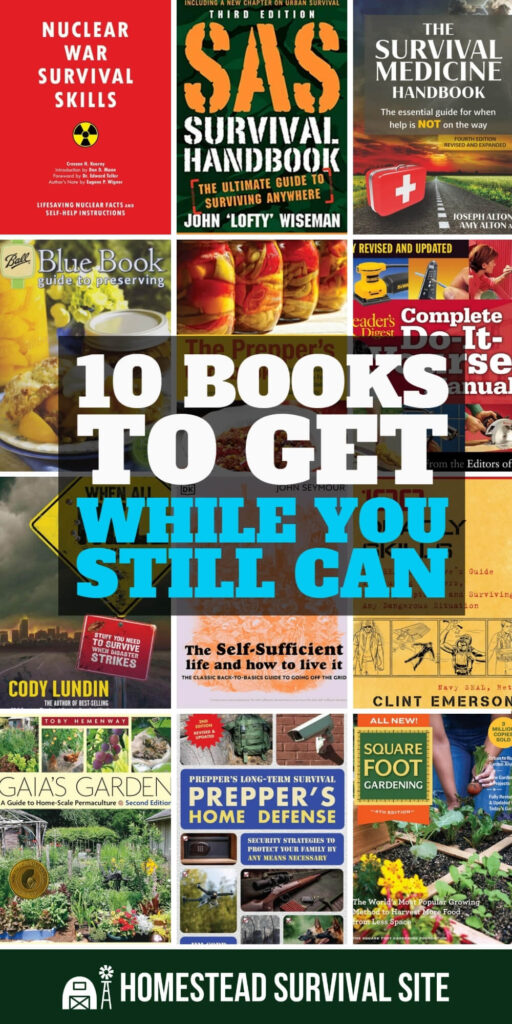
Below are 10 categories of books worth owning before you need them, with a standout title in each and a note on why it's worth getting. This list comes from the YouTube channel, City Prepping, which put together an excellent rundown of the books worth having when the grid goes dark.
You can watch his video and view the list below.
1. Medical: The Survival Medicine Handbook
If there's one category to get right, it's this one. In a true disaster, when an ambulance might be hours away or not coming at all, solid medical information could be the most valuable thing on your shelf.
The Survival Medicine Handbook by Dr. Joseph Alton and Amy Alton (the couple behind the Doom and Bloom channel) is written specifically for situations where professional help isn't available. It walks you through handling injuries and illnesses when you have to be the end of the line, which is a very different mindset from a normal first-aid guide.
For longer grid-down scenarios, pair it with Where There Is No Dentist. It was written for developing regions without dental care, and anyone who has suffered through a bad toothache knows how quickly that becomes a serious problem with no easy fix.
2. Food Preservation: The Ball Blue Book Guide to Preserving
Storing food is one thing. Preserving it so it lasts is another skill entirely, and it's one of the first every prepper should learn. The go-to reference here is the Ball Blue Book Guide to Preserving, the long-running canning classic that has sold millions of copies and shows up on nearly every list of recommended food preservation guides. It covers canning, pickling, and preserving in clear, tested steps.
Good supplements in this category include The Prepper's Cookbook by Tess Pennington, which centers on cooking from the kinds of staples you'd have stored away, and Meals in a Jar by Julie Languille, which helps you assemble ready-to-store meals. The key theme across all of them is rotation: you want to actually cook and eat your stored food regularly so nothing goes to waste and you stay familiar with it.
3. Gardening: All New Square Foot Gardening
When your food supply eventually runs low, the ability to grow more becomes priceless. All New Square Foot Gardening by Mel Bartholomew is where most new gardeners are told to start, and for good reason. It's practical, beginner-friendly, and makes efficient use of small spaces, which matters if your growing area is a suburban backyard.
Round it out with a few specialized titles: Gaia's Garden by Toby Hemenway for a permaculture approach, Carrots Love Tomatoes by Louise Riotte for companion planting (which plants help each other thrive when grown side by side), and The Forager's Harvest by Samuel Thayer for identifying and collecting wild food when your garden isn't enough.
4. Homesteading: The Self-Sufficient Life and How to Live It
Homesteading is gardening's more ambitious cousin. It's about turning your property, however big or small, into something that can sustain you. The Self-Sufficient Life and How to Live It by John Seymour is the title that consistently rises to the top. It's a bit more advanced and tends to assume you have some land, but it covers an enormous range of self-reliance skills in depth.
For a more approachable, suburban-friendly starting point, The Backyard Homestead is excellent. If you're keeping animals, The Chicken Whisperer's Guide to Keeping Chickens goes deep on backyard flocks. And the Foxfire series is worth having for its documentation of old-time skills and traditional ways of doing things that were nearly lost.
5. Survival and Prepping: When All Hell Breaks Loose
This is the broad, all-purpose survival category, and two books stand out. When All Hell Breaks Loose by Cody Lundin comes up again and again as one of the most recommended practical survival books, and the SAS Survival Guide by John “Lofty” Wiseman is the compact classic packed with useful field skills. If you could only grab one, the SAS guide is a hard one to beat as a starting point.
Beyond those, this category is deep: How to Survive the End of the World as We Know It by James Wesley Rawles, The Prepper's Pocket Guide by Bernie Carr for beginners, Prepper's Long-Term Survival Guide by Jim Cobb, 52 Prepper Projects by David Nash for hands-on learning over a year, and The Survival Mom by Lisa Bedford for getting a household ready.
6. Home Repair: The Complete Do-It-Yourself Manual
We don't often think of a repair manual as survival gear, but consider the reality of a prolonged grid-down situation. Something breaks and there's no handyman to call and no video to watch. You have to fix it yourself. The Reader's Digest Complete Do-It-Yourself Manual is a thorough, updated reference covering repairs and projects throughout the house. It's the kind of book you don't appreciate until the moment you desperately need it.
7. Self-Defense: 100 Deadly Skills
If things go sideways, being able to protect yourself and your family becomes a real concern. 100 Deadly Skills by Clint Emerson, a former Navy SEAL, gets strong reviews and offers practical, memorable techniques worth filing away in the back of your mind.
Pair it with Prepper's Home Defense by Jim Cobb, which approaches the topic from a preparedness angle: how to harden and defend your home if the situation calls for it.
8. Nuclear and Disaster-Specific: Nuclear War Survival Skills
Some threats are severe enough to warrant their own dedicated reference. With nuclear tensions weighing on a lot of minds, having solid information on this specific scenario is reassuring rather than alarmist. Nuclear War Survival Skills by Cresson Kearny is a well-known guide to surviving nuclear fallout, and the official U.S. Armed Forces survival manuals cover the subject from a military standpoint. These are books you hope to never open, but you'd be glad to have if you did.
9. Finances: Financial Peace and Rich Dad Poor Dad
People rarely connect finances with preparedness, but the link is direct: prepping costs money. Gear, food storage, and supplies all add up, and getting your financial house in order is what makes the rest possible. Financial Peace by Dave Ramsey is a strong starting point for learning the basics of getting out of debt and living within your means.
From there, Rich Dad Poor Dad by Robert Kiyosaki reshapes how many readers think about money and assets, and The 10X Rule by Grant Cardone lights a fire under anyone looking to get more aggressive about their goals. (Kiyosaki's Cashflow Quadrant is another eye-opener in the same vein.) Read the ideas, take what's useful, and don't get too hung up on the personalities behind them.
10. The Future: Principles for Dealing with the Changing World Order
The last category is about zooming out and understanding where the world is heading, drawing on people who spend their careers studying exactly that. Principles for Dealing with the Changing World Order by Ray Dalio lays out the big historical cycles that shape economies and nations. (Dalio also has a 43-minute video by the same title that's well worth the time.)
For balance, read it alongside The End of the World Is Just the Beginning by Peter Zeihan, who sees the coming decades a little differently. And The Sovereign Individual, written back in 1997, is a dry but fascinating look ahead, much of which you can watch playing out in real time. The common thread among all three is simple: the world is changing, and it pays to get ready for it.
Where to Start
That's a lot of books, and you don't need to buy all of them at once. If you're just getting started and want a place to begin, three titles rise above the rest: the SAS Survival Guide, When All Hell Breaks Loose, and The Survival Medicine Handbook. Get those three on your shelf first, then fill in the categories that matter most to your situation.
The bigger point is this. All of the information in these books is easy to get right now, which is exactly why now is the time to get it. Knowledge stored on a shelf doesn't care whether the power is on. Build that library while you still can.
You May Also Like:
The post 10 Books To Get While You Still Can appeared first on Homestead Survival Site.
from Homestead Survival Site https://ift.tt/6vDwxHZ
Family Divided: Politics and Religion
Family Divided: When Did Politics and Religion Start Coming Between Us? I remember a time when Sunday dinner was Sunday dinner. Grandpa might grumble about the news, Aunt Sue might roll her eyes at something on the church bulletin, and then someone would pass the potatoes and life would go on. Nobody left the table. Nobody stopped speaking for a year. These days, it feels different, and I know I’m not the only mother or grandmother who has noticed.
So when did this start? When did politics and religion turn from dinner table topics into dinner table dividers? I don’t think there’s one single answer, but there are several threads worth pulling on, and I want to walk through them with you today, mother to mother, grandmother to grandmother.
A quick look back at how families used to handle disagreement
It helps to remember that families have never fully agreed on everything. Grandparents and parents have argued about elections since there were elections to argue about. What kept those disagreements from becoming permanent breaks was structure. Families lived close together. They saw each other every week, sometimes every day. A disagreement on Tuesday got smoothed over by Sunday because there was no way to avoid each other long enough for it to fester. Distance and silence are what turn a disagreement into a rift, and for most of history, families simply didn’t have the luxury of that kind of distance.
The slow build before the breaking point
Family researchers and sociologists point to a gradual shift that picked up real speed in the 2000s and accelerated hard after 2016. It wasn’t one election or one Sunday sermon. It was a slow build of a few things happening at once.
First, we stopped living near each other. Extended families used to share a town, a church pew, a Thanksgiving table every single year almost by default. Now our children and grandchildren are scattered across states, and much of our family contact has moved online, where a stray comment can be read by twenty relatives instead of just the person sitting across from you at the table.
Second, our news sources split apart. Grandma and Grandpa might be watching one channel and the grandkids might be getting their news from a completely different app or a different set of online voices, and by the time everyone sits down together, they aren’t even arguing about the same set of facts anymore. When two people can’t agree on what’s even true, agreeing on what to do about it becomes nearly impossible.
Third, and this one matters more than people give it credit for, our sense of identity got tangled up in our opinions. A political stance or a change in faith practice used to be something a person held. Now it often feels like something a person is. When disagreement feels like a rejection of who someone is, rather than just a difference of opinion, family members dig in harder and forgive more slowly.
Social Media Is Loud
Fourth, social media rewards the loudest, most extreme version of every opinion. Nobody’s feed is showing them the calm, measured middle ground. That means when family members do talk politics or faith, they’re often unconsciously borrowing the sharpest language they saw online instead of speaking the way they would face-to-face over coffee.
Fifth, we lost a lot of our shared community spaces. Fewer people belong to the same civic clubs, churches, and neighborhood groups that used to regularly bring people with different views together for a shared purpose. When the only interaction left is a holiday dinner once or twice a year, there’s no ordinary, low-stakes practice at disagreeing well.
Why religion adds its own layer
Faith differences have always existed in families, but a few newer patterns have made this harder. More adult children are stepping away from the denomination or faith tradition they grew up in than in past generations. For a mother/father or grandmother/grandfather who built her whole life around church community, that can feel like grief, even when nobody meant it as an attack.
At the same time, some families are seeing the opposite: a grown child becomes far more devout or joins a different faith community than the one they were raised in, and that shift can feel just as unsettling to parents who don’t understand the pull.
There’s also the matter of blended families bringing together two very different religious backgrounds under one roof. That’s not a bad thing at all, but it does mean holidays and traditions require more conversation and more compromise than they did when everyone in the family tree shared the same faith by default.
Either direction can leave a mother or father quietly wondering in the kitchen at night where they went wrong. I want to say gently, you probably didn’t go wrong. People grow. Faith journeys are rarely a straight line, and they’re almost never a reflection of a failure in how a child was raised.
The particular pain of political division inside a family
Political disagreement inside a family stings differently than political disagreement with a stranger. You can’t simply walk away from a son or a sister the way you might end a conversation with someone at the grocery store. The relationship has history, obligation, and love tangled up in it, which is exactly why the arguments cut so deep.
Many families are also navigating something new: disagreement not just over policy, but over which sources of information to trust at all. That makes conversations feel less like a debate over ideas and more like a disagreement over reality itself, and that’s exhausting for everyone involved, especially the mother/father or grandmother/grandfather who just wants everyone to get along at Christmas.
What actually helps, from one mother/father to another
I’m not a family therapist or a pastor, so please take this as practical, prepared-mom advice and not professional counsel. If tension in your family runs deep, a licensed family counselor or your own clergy can help far more than a blog post ever will.
That said, here’s what I’ve seen work in my own circle of family and friends.
Keep the relationship bigger than the argument. You can love someone fully and disagree with them fully. Those two things are allowed to sit side by side at the same table.
Set a house rule, not a gag order. Many families do best with a simple understanding that certain topics get a lighter touch at gatherings, not because they don’t matter, but because Grandma’s ninetieth birthday isn’t the venue for a debate.
Ask questions before you respond
Ask questions before you respond. When a grandchild says something that surprises or unsettles you, try asking what led them there before telling them what you think. You’ll learn more, and they will feel heard instead of corrected.
Protect the traditions that aren’t about the argument. Keep baking the same pie. Keep saying the same blessing, or let each person offer their own if that becomes the family’s way forward. Continuity matters more than we realize when everything else feels shaky.
Choose your moment. A serious conversation about faith or politics rarely goes well in the middle of a crowded holiday dinner. If something truly needs to be discussed, a quiet phone call or a one-on-one walk often works far better than an audience.
Watch your own tone before you watch theirs. It’s tempting to focus on how someone else spoke to us, but the fastest way to soften a hard conversation is to notice our own sharpness first and adjust it.
Give it time and give it grace. Some family rifts heal in a season. Some take years. A closed door today isn’t always a closed door forever.
Remember what the relationship is actually for. Family isn’t a debate club. Nobody needs to win. The goal was never agreement; it was always connection.
When healing doesn’t come
I want to say something honest here, because I think too many articles on this subject skip past it. Not every estrangement resolves. Some words, once spoken, leave a mark that doesn’t fade easily, no matter how much time passes. Some family members have hurt each other in ways that were not a simple misunderstanding but real, lasting harm, and pretending that a phone call or a holiday visit can undo that does a disservice to anyone living through it.
If you’re in that position, please know that stepping back from a relationship that continues to hurt you isn’t a failure of love or faith. Forgiveness, when it’s real, happens on its own timeline; sometimes it doesn’t happen at all, and that’s a valid place to land. Forgiveness is also not the same thing as reconciliation. A person can release their own bitterness for their own peace without ever returning to a relationship that isn’t safe or healthy for them.
If distance protects your well-being or your children’s well-being, that distance isn’t a moral failing. Some families do find their way back to each other after a period apart. Others don’t, and both outcomes deserve to be spoken about honestly rather than wrapped in false cheer. Grief over a relationship that may never be repaired is real grief, and it deserves to be honored rather than rushed.
A word for the grandmothers/grandfathers reading this
If you’re the matriarch/patriarch trying to hold a divided family together, please hear this. It’s not your job to make everyone agree. It never was. Your job, the one that actually matters, is to keep the door open and the table set. Agreement is optional. Love doesn’t have to be.
You may be the only person in your family who still talks to everyone. That’s not a small thing. That is a quiet, steady kind of leadership, and it matters more than you know. I also believe some comments or statements made can’t be forgiven. Therefore, we must let go of the stress and live our own lives. That may seem harsh, but some words will never be forgotten.
Does Prepping Mean You Don’t Have Faith
The Final Word
Family will always be made up of different people with different minds, and that’s never been a flaw; it’s always been the design. What’s changed is how loud the disagreements have become and how far apart we have drifted in our daily lives. I believe the families who weather this well are the ones who decide, on purpose, that the relationship matters more than being right, and I believe those who can’t weather it deserve compassion rather than judgment too. May God bless this world, Linda.
Copyright Images: Old Abandoned Church AdobeStock_212120257 by Scott Book
The post Family Divided: Politics and Religion appeared first on Food Storage Moms.
from Food Storage Moms
Apple Butter Recipe for Canning – The Complete Tested Method
We’ve already covered the basics of getting apple butter onto your shelf with a two-year shelf life elsewhere on the site. This one goes deeper into the parts that actually separate a good batch from a mediocre one: the exact tested recipe ratios, the doneness tests almost nobody explains properly, a genuine reduced-sugar option that’s still fully tested and safe, and the troubleshooting for when a batch doesn’t turn out right.
If you’ve ever ended up with apple butter that’s too thin, scorched on the bottom, or never quite sets right, this is the guide that explains why, and how the tested recipe avoids each of those problems in the first place.
Why Apple Butter Is Safe for Water Bath Canning
Unlike green beans or other low-acid vegetables, apples are naturally acidic enough to process safely in a boiling water bath rather than requiring a pressure canner. The combination of that natural acidity with the reduction in moisture during long cooking is what makes apple butter shelf-stable, which is also why the cooking time and final consistency matter for safety, not just texture.
Choosing Your Apples
A blend of apple varieties produces better flavor than any single type on its own. Mixing a tart variety with a sweeter one gives the finished butter the balance it needs, since an all-sweet batch tends to taste flat and one-dimensional once concentrated down.
- Tart varieties: Granny Smith, McIntosh, and other cooking apples that break down easily and add brightness
- Sweet varieties: Fuji, Gala, or Golden Delicious to round out the flavor and add natural sweetness
- Avoid apples that are overly mealy in texture, since they tend to produce a grainier finished product
The Standard Tested Recipe
This recipe follows the National Center for Home Food Preservation’s tested method, adapted from the USDA Complete Guide to Home Canning.
- Wash, peel if desired, core, and slice apples
- Cook slowly in cider or apple juice, with a small amount of vinegar if desired, until the apples are completely soft
- Press the cooked apples through a colander, food mill, or strainer to remove skins and seeds and create a smooth pulp
- Return the pulp to the pot and stir in sugar and spices such as cinnamon, cloves, or allspice
- Cook slowly, stirring frequently to prevent scorching, until the mixture thickens and passes the doneness test described below
- Fill hot into sterile half-pint or pint jars, leaving ¼-inch headspace. Quart jars don’t need to be pre-sterilized
A typical starting ratio is about ¼ to ½ cup of sugar per cup of fruit pulp, adjusted to taste once the mixture has cooked down and concentrated.
The Reduced-Sugar Tested Version
Most apple butter content online skips this entirely, but NCHFP has a separately tested reduced-sugar apple butter recipe that’s just as safe for water bath canning as the standard version. The process is nearly identical, cooking the pulp down with less sugar and relying more heavily on the natural concentration from extended cooking time to reach a safe, shelf-stable consistency.
This matters because sugar in apple butter is primarily a flavor and texture ingredient rather than the main safety factor, unlike jams that rely on sugar for pectin gel formation. That means you have real flexibility to cut sugar without compromising shelf stability, as long as you still cook the batch to the correct final consistency.
How to Actually Know When It’s Done
This is the step most home canners get wrong, either underselling how important it is or not understanding what the tests are actually checking for.
The Spoon Mounding Test
Remove a spoonful of the hot apple butter and hold it away from the steam for a full 2 minutes. If it stays mounded on the spoon rather than running off, it’s done. If it slumps or runs, it needs more cooking time.
The Plate Test
Spoon a small amount onto a cool plate and let it sit for a moment. If a ring of liquid separates and pools around the edge, the butter isn’t ready yet. When the mixture holds its shape with no liquid separating out, it’s fully cooked.
Both tests are checking for the same thing: enough moisture has cooked off that the mixture holds together at room temperature. This matters for both texture and shelf stability, so don’t skip this step even if the color and thickness look right.
Cooking Method Comparison
- Stovetop: The fastest method, typically 30 to 45 minutes once the pulp starts a gentle boil, but requires the most attention and frequent stirring to prevent scorching on the pot’s bottom
- Slow cooker: The most hands-off option, taking 2 to 4 hours on high or 6 to 8 hours on low. Prop the lid open slightly near the end to let excess moisture escape, since a fully sealed lid traps steam and slows down the thickening process
- Oven: A middle ground, cooking uncovered at a low temperature and stirring occasionally, which reduces scorching risk compared to stovetop while still allowing moisture to evaporate more efficiently than a sealed slow cooker
Whichever method you choose, the doneness tests above are what actually determine when it’s ready, not the clock.
Processing Times and Jar Sizes
Apple butter is processed in a boiling water bath canner, using the tested times for half-pint and pint jars. Always check the current NCHFP or USDA table for your specific altitude, since processing times increase at higher elevations to compensate for water’s lower boiling point.
- Half-pints and pints are the standard, tested jar sizes for apple butter
- Sterilize jars beforehand if your processing time will run under 10 minutes, since a shorter process time isn’t enough to sterilize the jar itself during processing
- Wipe rims thoroughly before applying lids, since any apple butter residue on the rim can prevent a proper seal
Troubleshooting Common Apple Butter Problems
- Too thin even after the mounding test seems close: Keep cooking. It’s better to slightly overcook than to can an under-thickened batch that may separate in the jar
- Scorched flavor or dark spots on the bottom of the pot: Heat was too high, or stirring wasn’t frequent enough. Lower the heat and stir more often, especially as the mixture thickens and starts sticking more easily
- Liquid pooling on top after jars have cooled: This usually means the batch wasn’t fully cooked down before canning. It’s still generally safe to eat if properly sealed, but the texture won’t be ideal
- Overly dark or bitter final product: Often from cooking at too high a heat for too long, essentially over-caramelizing the sugars past the point of pleasant flavor
- Grainy texture: Usually traced back to using mealy apple varieties or not straining the pulp thoroughly enough
Common Mistakes
- Adding all the sugar at the start instead of tasting and adjusting as the mixture concentrates, since flavors intensify significantly during cooking
- Walking away for extended periods without stirring, especially in the final stage when the mixture is thick enough to scorch easily
- Skipping both doneness tests and relying only on visual color or a rough time estimate
- Using quart jars for a recipe only tested in half-pints and pints
- Not adjusting processing time for altitude
Take the Next Step: Reclaim the Skills That Once Made Every Household Independent
Making and safely preserving your own apple butter is about more than filling a few jars. It’s part of a much bigger tradition of knowing how to provide for yourself with what you have—growing food, preserving a harvest, cooking from scratch, repairing instead of replacing, and keeping a household running when modern conveniences aren’t available.
Those practical skills were once ordinary knowledge passed from one generation to the next. Today, many of them are disappearing.
The Lost Skills of Independence brings that knowledge back together in one place. Inside, you’ll discover practical, old-fashioned skills for food preservation, self-reliant cooking, gardening, household preparedness, traditional remedies, repairs, and making better use of the resources around you.
If learning to turn a harvest of apples into shelf-stable food appeals to you, imagine being able to do the same across far more areas of everyday life.
Whether you want to depend less on the grocery store, become more prepared for disruptions, save money by doing things yourself, or simply recover the practical knowledge your grandparents took for granted, this is a resource designed to help you build those skills one project at a time.
Don’t let another generation of useful knowledge disappear.
Frequently Asked Questions
Can I use any apple variety for apple butter?
Most varieties work, but a blend of tart and sweet apples produces noticeably better flavor than an all-sweet or all-tart batch. Avoid overly mealy varieties, which tend to produce a grainier finished texture.
Is reduced-sugar apple butter as safe as the regular version?
Yes, when made according to the specifically tested reduced-sugar recipe rather than simply cutting sugar from the standard recipe on your own. The tested version accounts for the change and still reaches a safe, shelf-stable result.
Why does my apple butter separate after canning?
This almost always means the batch wasn’t cooked down enough before it was jarred. Cook until it passes both the spoon and plate doneness tests next time, rather than stopping at a target time or color alone.
Can I substitute honey or maple syrup for the sugar?
This moves outside the specifically tested recipe, so it’s worth treating cautiously and using it only for a batch you plan to refrigerate and eat soon rather than shelf-stable canning, unless you’re following a recipe specifically tested with that substitution.
You may also like:
Canning Green Beans – The Complete Guide
The US Army’s Forgotten Food Miracle (VIDEO)
Canning Supplies: The Ultimate Guide for Preppers
Amish Cinnamon Bread: Friendship Recipe
Join Our Prepper WhatsApp Community For Daily Tips And Tricks!
The post Apple Butter Recipe for Canning – The Complete Tested Method appeared first on Ask a Prepper.
from Ask a Prepper https://ift.tt/1RfrLCD
Subscribe to:
Posts (Atom)