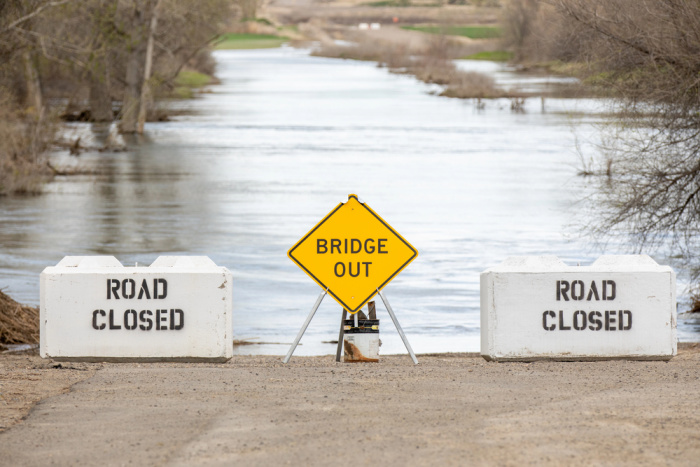
Flooding is happening more often these days. If it feels like you’re hearing about flooding on the news more than you used to, you’re not imagining it. Flood events across the United States have become more frequent and more damaging in recent years, and it’s worth understanding why, how flood risk is actually measured, and what your family can do to be ready if water starts rising near your home.
Flooding is happening more often these days!
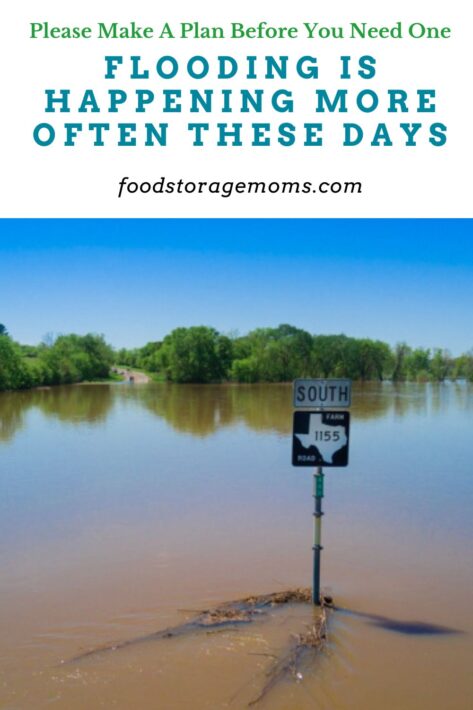
Flooding by the numbers
The last several years have been rough ones for flooding across the country. 2023, 2024, and 2025 rank as the three years with the highest annual number of billion-dollar weather disasters in the United States, with 28 such events in 2023, 27 in 2024, and 23 in 2025. 2025 also set a new record for billion-dollar severe storm events, with 21.
Some of these events were catastrophic. The flash flooding that struck the Texas Hill Country in July 2025 is considered one of the deadliest inland floods in United States history. That flood struck the Guadalupe River watershed on July 4 and 5, 2025, with rainfall totals reaching over 20 inches in some spots, and it claimed at least 139 lives, most of them in Kerr County, Texas.
Flooding is also taking a heavy toll on agriculture. One 2024 study estimated that flooding caused more than 6 billion dollars in crop losses across the country that year alone.
Interestingly, families are starting to respond to this risk with their feet. Counties with the highest flood risk in the country lost a net of more than 63,000 residents between mid 2024 and mid 2025, nearly double the outflow of the year before, while counties with lower flood risk gained nearly 70,000 residents on net. People are noticing the risk and making decisions accordingly.
Why are floods becoming more common?
There is no single cause. Heavier rainfall events, more intense hurricanes and tropical storms, aging infrastructure, and continued development in flood-prone areas all play a role. Sea levels are also rising along the coasts, which means coastal communities are experiencing more routine tidal flooding on top of storm-related flooding. Whatever the exact mix of causes in your area, the practical result is the same. Flood risk isn’t shrinking, and being prepared matters.
What do 100-year, 500-year, and 1000-year floods actually mean?
These terms get thrown around constantly after a big storm, and they honestly confuse a lot of people. Let me walk you through what they really mean, in plain language.
The recurrence interval is based on the probability that a given flood event will be equaled or exceeded in any given year. In other words, a 100-year flood isn’t a flood that happens once every 100 years like clockwork. It’s a flood so large that, based on historical data, there is only a 1-in-100 chance of a flood of that size or larger occurring in any single year. Because the 1 percent annual exceedance probability flood has a 1 in 100 chance of being equaled or exceeded in any one year, and has an average recurrence interval of 100 years, it’s often called the 100-year flood.
The same logic applies to bigger, rarer floods. A 500-year flood corresponds to a 0.2 percent annual exceedance probability, meaning a flood of that size or greater has a 0.2 percent chance, or a 1 in 500 chance, of happening in any given year. A 1000-year flood follows the same pattern, representing an even smaller annual chance, about 0.1 percent, of a flood that severe occurring in a given year.
How do scientists actually determine these numbers?
This is where it gets interesting. To determine flood probabilities, scientists examine all the annual peak streamflow values measured at a streamgage, which is a location on a river where the height of the water and the quantity of flow are recorded. The United States Geological Survey operates more than 7,500 streamgages nationwide to make this kind of assessment possible. By looking at decades of recorded peak flows on a particular river, statisticians can calculate the probability of various flood magnitudes occurring in any given year.
A station with 40 years of data can estimate a 100-year or even 500-year flood magnitude, though the uncertainty grows the further out you extrapolate. Longer historical records yield more reliable estimates, and a gauge with 80 years of data provides a much tighter estimate than one with only 15 years.
One important thing to understand is that these figures aren’t fixed forever. The USGS collects data over time at a given river site, determines the largest flood of each year, and recalculates the statistics for that river as new data comes in. That’s why you may hear that a 100-year flood zone has been redrawn on updated flood maps. It’s not that the math changed; it’s that more real-world data became available.
Because the terminology confuses so many people, many scientists and agencies now prefer to talk about annual exceedance probability instead of recurrence interval. Saying a location has a 1 percent chance of flooding this year is a lot clearer than saying it’s due for its 100-year flood, especially since a 100-year flood can happen two years in a row and still be statistically normal. Houston, Texas, actually experienced three separate 500-year floods in three consecutive years, in 2015, 2016, and 2017, since each year’s probability is independent of what happened the year before. Floods simply don’t follow a countdown clock.
What this means for your family
Don’t let the label on a flood fool you into a false sense of security. A home outside the mapped 100-year floodplain can still flood. A 500-year flood is rare in any single year, but over a 30-year mortgage, the odds of experiencing one are higher than most people assume. The safest approach is to prepare your home and family for flooding regardless of what the official flood zone map says about your property.
Items to have on hand in case your home floods
Here’s a list I recommend every family keep ready before flood season arrives in your area, not after the water is already rising.
Water and food
Store at least a three-day supply of drinking water per person, more if you’re able. Keep a supply of shelf-stable food that doesn’t require cooking, along with a manual can opener.
Documents
Keep copies of insurance policies, identification, birth certificates, medical records, and property records in a waterproof container or stored digitally in the cloud. Consider a small fireproof and waterproof safe for original documents.
Power and light
A battery-powered or hand-crank radio, extra batteries, flashlights, and a portable phone charger will help you stay informed and in contact if the power goes out.
First aid and medications
Keep a well-stocked first aid kit along with a two-week supply of any prescription medications your family relies on.
Sanitation
Pack hand sanitizer, disinfecting wipes, garbage bags, and a portable toilet option in case sewer systems back up during flooding.
Protective gear
Rubber boots, work gloves, and a change of dry clothing for each family member are worth having on hand, along with a basic tool kit.
Sump pump and sandbags
If you live in a flood-prone area, a working sump pump with a battery backup and a supply of sandbags can help protect your home before water gets inside.
Evacuation supplies
Keep a bag packed with essentials for each family member so you can leave quickly if authorities issue an evacuation order. Include pet supplies if you have pets at home.
A written family plan
Talk through where you’ll meet if separated, and identify your evacuation route in advance, since roads can flood or wash out with little warning. Have some alternatives identified in case the original plan doesn’t work out.
Flooding is one of those disasters that can affect almost any home, whether you live near a river, along the coast, or simply in a low-lying part of your neighborhood. Understanding what these flood terms really mean and having the right supplies ready before the water rises gives your family the best chance of staying safe and getting through it with less stress, lower costs, and less possible injury.
Flooding Is Happening Right Now in Texas Again
Just over a year after the devastating Fourth of July floods that killed more than 130 people in the Texas Hill Country, that same region is once again underwater. As of this morning, Friday, July 17, 2026, south-central Texas is in the middle of a dangerous, fast-moving flood emergency, and I wanted to get information to you quickly since so many of you have family, friends, or property in that part of the state.
What is happening right now?
Storms have been dumping heavy rain across the Hill Country, the Rio Grande Plains, and the southern Edwards Plateau for several days in a row. In some spots, more than 20 inches of rain have fallen. The Guadalupe River near Comfort rose from about 5 feet at 5 in the morning to over 37 feet by 8 in the morning on Thursday, a rise of more than 30 feet in just three hours, according to United States Geological Survey gauge data. That kind of rise happens fast enough that people have very little warning.
Governor Greg Abbott
Governor Greg Abbott has issued a disaster declaration covering 59 counties. As of Friday morning, at least two deaths have been confirmed, including a man in Kerrville who was swept away in an RV near Comfort along the Guadalupe River, and a man in Uvalde County who was swept away while driving across a flooded roadway. Flood watches remain active across dozens of counties, and the National Weather Service has warned of life-threatening and locally catastrophic flash flooding of creeks, streams, and other low-lying areas. Rescue crews have been working around the clock, with the state mobilizing roughly 2,350 emergency responders, more than 1,400 vehicles, 85 boats, and 21 aircraft.
Roads have become rivers in parts of South Texas, with one area reporting more than 10 inches of rain and roughly 18 roads impassable in a single county west of San Antonio. Power outages have hit Gillespie, Kerr, and Kendall counties, and a water treatment plant in Kerrville has reported operational issues. Officials are asking residents to remain at home unless they’re in immediate danger or their current location is no longer safe.
Why does this keep happening in this part of Texas?
The Texas Hill Country sits in an area sometimes called Flash Flood Alley. The terrain has thin soil over rock, which means rain doesn’t soak in; it runs off quickly into rivers and creeks that can rise with almost no warning. Add in slow-moving storm systems that dump tropical-level rainfall over the same watershed for days at a time, and you get exactly the kind of fast, violent flooding this region has now seen in back-to-back years. The combination of events could be called a Perfect Storm effect.
What to do if you are in the affected area
If you live in or near the Hill Country, the Rio Grande Plains, or the southern Edwards Plateau, please take this seriously. Avoid driving through any flooded roadway, no matter how familiar the road feels. It takes surprisingly little moving water to sweep away a vehicle. Stay away from riverbanks and low water crossings until officials confirm it’s safe. Keep a charged phone and a battery-powered radio on hand so you can receive emergency alerts even if the power goes out. If you’re told to evacuate, go immediately rather than waiting to see how bad it gets.
If you’re watching from elsewhere in the country, this is a good moment to check your own flood supplies, review your family’s evacuation plan, and make sure your important documents are backed up. Flash flooding like this can happen with very little notice, in Texas or anywhere else with the right conditions.
Please keep the families in Kerr County, Uvalde County, and surrounding areas in your thoughts as search-and-rescue efforts continue. I’ll keep watching this situation and update you as more information becomes available.
Final Word
This flooding is still unfolding, and the numbers above may change as rescue crews continue their work. What matters most right now is safety. If you have loved ones in the affected counties, check in on them, and if you’re in the area yourself, please heed every warning from local officials. Preparedness isn’t about fear; it’s about giving your family the best chance when a fast-moving disaster like this one shows up with little warning.
Flooding isn’t something we can control, but preparedness is. Knowing what these flood terms mean helps you make wiser decisions about insurance, evacuation, and where you build or buy a home. Having the right supplies ready ahead of time helps your family weather the storm, literally, with a lot less fear and a lot more confidence. Take a little time this week to check your supplies and talk through a plan with your family. May God bless this world, Linda
Copyright Images: Flooding On The River In Texas Depositphotos_341777052_S, Yellow Sign Bridge Out Depositphotos_835449440_S
The post Flooding Is Happening More Often These Days appeared first on Food Storage Moms.
from Food Storage Moms
No comments:
Post a Comment