Saturday, May 27, 2023
Wednesday, May 3, 2023
6 Essential Safety Tips You Need To Follow When Using a Generator in Summer
By SARA TIPTON
Making sure we put our safety and the safety of our family first is a priority for most. With the concern over rolling blackouts, brownouts, and power grid failure during this summer, many have turned to generators to power their homes. However, these, like everything, can present a safety concern if not used correctly.

Making sure we prioritize our safety and our family’s safety is a priority for most. With the concern over rolling blackouts, brownouts, and power grid failure during this summer, many have turned to generators to power their homes. However, these, like everything, can present a safety concern if not used correctly.
Because most of us rarely use a generator in our day-to-day life, it can be incredibly easy to overlook the safety protocols.
One man was left homeless after his brand new generator exploded causing a massive wildfire. While the investigation is still ongoing about how a brand new generator exploded, it is a good time to go over summer safety tips when using a generator, especially with the increased concern for rolling blackouts this summer.
Here are a few summer generator safety tips to stay safe:
First and foremost, have a carbon monoxide alarm in your home. Most generator-related injuries are caused by CO poisoning, not explosions. Whether your generator has a CO shutoff (a safety feature that will kill the generator if the CO gets too high) or not, having your own can help alert you to issues of carbon monoxide dangers if the generator’s safety feature fails, and that’s always a possibility.
Never run a generator in an enclosed area. Always place the generator at least 20 feet from the house with the engine exhaust directed away from windows and doors.
Turn off a gas-powered generator and let it cool before refueling. Gasoline spilled on hot engine parts can ignite. Allowing the engine to cool also reduces the risks of burns while refueling.
Store your gasoline properly. If you think you’ll need to use the generator for an extended time, you’ll want extra fuel on hand. Just be sure to store gas only in an ANSI-approved container in a cool, well-ventilated place. Adding a stabilizer to the gas in the can will help it last longer, but don’t store gasoline near any potential heat or fire sources or inside the house.
Avoid electrical hazards. If you don’t yet have a transfer switch, you can use the outlets on the generator as long as you follow certain precautions. It’s best to plug in appliances directly to the generator. If you must use an extension cord, it should be a heavy-duty one for outdoor use, rated (in watts or amps) at least equal to the sum of the connected appliance loads. First check that the entire cord is free of cuts and that the plug has all three prongs, which are critical to protecting against a shock if water has collected inside the equipment.
Never attempt to back feed your house. Back feeding means trying to power your home’s wiring by plugging the generator into a wall outlet. This reckless and dangerous practice presents an electrocution risk to utility workers and neighbors served by the same utility transformer. It also bypasses some of the built-in household circuit protection devices, so you could end up frying some of your electronics or starting an electrical fire.
Using a generator can be a great way to get some power if you experience blackouts regularly; however, safety first!
This article was originally published at Ready Nutrition™ on July 18th, 2022
Friday, April 21, 2023
Thursday, March 2, 2023
Here Are Some Ways to Make Your Own Power
Original Article
By

It’s more important now than ever before in recent American history to understand how to live off the grid. And to do this, you need to understand how to make your own power. I’ve lived off the grid for years now, and have had the opportunity to learn what it takes to generate electricity for a house. Today, I’m going to show you exactly how I do it.
A brief caveat
Before you guys and gals try and duplicate what I do here in Montana, some words of advice and caution are needed. Know the laws of your area. In Montana, you’re able to not be bothered by others, as long as you don’t live in some municipal area where they impose their rules and codes on you.
In other states, it’s different. You may have to go through endless permits, licensed contractors, and armies of government inspectors.
Know that you have options.
There are numerous methods for obtaining and storing electrical power for your own use.
Saturday, February 4, 2023
Saturday, January 28, 2023
Keep Your Power Out Supplies Together: A 10 Min Prep Project
Here is a little fictional story that may seem familiar to some of you…
You come home after dark (around 5:30 pm in the winter) to find the power is out.
Darn! WHERE did you put those flashlights?
No problem, you’ll just use the light on your phone to look for them.
Oh, these candle will do…shoot! Where are the matches?
Back to searching…
Fifteen minutes later…finally found the flashlights. Batteries are dead. Where are the batteries?
Five minutes later. You’ve found the matches and light some candles.
Now, what’s for dinner. Let’s eat out! Oh, nope that won’t work. The power is out all over town.
Ok…can’t use the stove or the oven or the microwave. We’ll go with cereal.
Ooopps…we are out of milk.
There is a camp stove somewhere, but the propane for it? Not quite sure…
Found it! Campbells chicken noodle soup it is!
Your son needs to turn in his homework. But he needs a computer to do it.
Pull out the solar charger/generator. How in the heck do I use this thing? Did I throw away the instructions or keep them somewhere?
All right, it’s bedtime. Freezing outside and no heater. You know there are some extra blankets around somewhere. Maybe the guest room? Or the hall closet? Nope. Oh, yeah, you moved them to the laundry room.
Now, what about those little hand warmer things? You could throw one under each person’s blankets. But WHERE ARE THEY????

Why You Should Keep the Power Out Supplies Together?
Monday, May 9, 2022
Friday, March 4, 2022
Tuesday, January 18, 2022
How to Quiet a Generator: 7 Ways to Silence Your Backup Power

By:
Generators are a prepping essential for both short-term power outages and post-disaster situations, but there’s no getting around the fact that they are noisy.
In a best-case scenario, generator noise is a nuisance for you and your neighbors. In a worst-case scenario – if there are looters on the prowl and you’re trying to lie low – it could be downright dangerous.
The good news is that there are steps you can take to reduce generator noise, whether you have a diesel, gas or propane generator.
In this article, we look at seven free and low-cost solutions to quiet a generator.
Wednesday, August 18, 2021
How To Easily Hook Up A Generator To Your Home

The question of what sort of emergency electrical power to have for your home is one that’s open for debate. Most preppers go for solar power of some sort, but solar isn’t a perfect choice.
While solar is likely to be working after just about any disaster that leaves your home standing, each panel only puts out a small amount of power. So it takes a lot of panels to really do more than just charge your cell phone.
Monday, August 16, 2021
How Long to Run a Generator for a Refrigerator During a Power Outage

Most of us would class our refrigerator as an essential item to keep running during a power outage. When calculating what size home generator you need, you may assume you need to keep your refrigerator and freezer constantly running.
But that doesn’t have to be the case. If the power goes off for thirty minutes, the food in your fridge won’t spoil. Depending on various conditions, you may only need to run your refrigerator intermittently to keep your food cool.
Sunday, July 18, 2021
Popular Mechanics: PM Approved: The New Predator 9,500-Watt Inverter Generator is an Emergency Essential
https://www.popularmechanics.com/home/tools/a36817061/pm-approved-harbor-frieght-predator-9500-watt-inverter-generator/
Monday, December 10, 2012
Generator Safety
Original Article

With the prediction or onset of powerful storms, people rush out to buy generators. For many people, it is the first time they have ever used a generator. Spend a few minutes BEFORE the storm, making sure your back-up power generator is ready to go. Check the oil and gas levels in your generator (and for re-supply) BEFORE the storm.
There are also several important safety precautions to keep in mind before and while operating a generator.
To avoid carbon monoxide hazards:
- Always use generators outdoors, away from doors, windows and vents.
- Never use generators in homes, garages, basements, crawl spaces, or other enclosed or partially enclosed areas, even with ventilation. This should go without saying, but every year you hear stories like people having run their generator in the basement, etc., and dieing from carbon monoxide poisoning. A little common sense here…
- Follow manufacturer’s instructions. Generators vary. Understand your specifications and operating instructions.
- Install battery-operated or plugin (with battery backup) carbon monoxide (CO) alarms in your home, following manufacturer’s instructions.
- Test CO alarms often and replace batteries when needed.
To avoid electrical hazards:
- Keep the generator dry. Operate on a dry surface under an open, canopy-like structure, or fashion some sort of protection to keep it dry.
- Dry your hands before touching the generator.
- Plug appliances directly into the generator or use a heavy-duty outdoor-rated extension cord. Look for 12-gauge wire rating and avoid 16-gauge extension cords.
- Make sure entire extension cord is free of cuts or tears and the plug has all 3 prongs, especially a grounding pin.
- NEVER plug the generator into a wall outlet. This practice, known as back-feeding, can cause an electrocution risk to utility workers and others served by the same utility transformer if the main line breaker to the house is left ON (in other words… shut it OFF).
- If necessary to connect generator to house wiring to power appliances, have a qualified electrician install appropriate equipment. Or, your utility company may be able to install an appropriate transfer switch.
- Know your generator specifications and limitations. Do not overload its rating. The power requirements of appliances adds up quickly.
To avoid fire hazards:
- Before refueling the generator, turn it off and let it cool. Fuel spilled on hot engine parts could ignite.
- Always store fuel outside of living areas in properly labeled, purpose-built gasoline containers.
- Store fuel away from any fuel-burning appliance.
Appreciate topics of survival, emergency preparedness – or planning for disaster?
Read our current articles on Modern Survival Blog
twitter: MSurvivalBlog
Similar Articles You Might Enjoy:
Monday, October 15, 2012
DIY Backup Generator Connection
Original Article
Because of the unreliable nature of the electrical utilities in my area, I have been working on improving the interface of my backup diesel generator to the electrical system of my house. If you have seen this video:http://youtu.be/SSs5D-Qr0rg then you know that I theoretically might have wired it so that I could backfeed my panel (if legal) via the clothes dryer line. Basically I (again, theoretically) made a connection from the dryer outlet (internally, not a plug) to a second breaker box in my workshop that I use to distribute power therein. That is a reletively common practice, by the way: extending the dryer wiring to power some piece of workshop equipment, typically a welder. Although a standard 200-250 amp welder needs more current at full load than the typical 30 or 40 amp dryer circuit can supply, home workshop welding jobs almost never require the full output of the welder. A dryer circuit can supply all the power the average welding installation ever needs. You just have to make sure the welder never gets used while the dryer is running. I took that basic circuit a step further. I had a load center, complete with a full compliment of breakers, that had been discarded during a home rewire job. I added that to my workshop to distribute power to the various tools. When I installed the generator, I (theoretically) connected it to an unused 30 amp double-pole breaker in that box. This meant that during a power outage I had to grab my checklist to make sure I did everything correctly and in order, and follow the steps to bring the generator online. It went something like this:
- Turn off the main breaker.
- Turn off the water heater breaker and any other breakers I deem necessary. The dryer breaker stays on. If the dryer was running, it won't restart on its own so it is not a problem.
- Go out to the shop and make sure the generator breaker is off. Turn off all other workshop circuits too, except the house connection. Start the generator and let it warm up.
- Go back in the house and double-check that everything is ready.
- Return to the shop and bring the generator online.
Now the generator changeover procedure goes like this:
- Switch off the main breaker.
- Switch off the circuit(s) I do not wish to power right now, such as the water heater.
- Go out to the generator shed and start the genny.
- Return to the breaker box and bring the generator circuit online.
By the way, if you have never had a diesel generator and have been thinking about buying one for either backup or offgrid prime power, allow me to offer a bit of advice: you do not need or want a big enough generator to power everything in your home at the same time. Not only will a generator that big cost far more money than you need to spend, it will also use more fuel than necessary and furthermore, will give you more problems than a properly-sized generator. The reason this is true is because diesels like to work. They are happy running in the range of 50 to 90 percent of their rated capacity. If they are running at 20 percent of capacity for extended periods, not only will they use more fuel than a smaller generator powering the same load, but that excess fuel will produce more soot and other deposits, which will build up in the engine (especially around the exhaust valves and in the exhaust system) and gradually reduce its performance, making it use even more fuel and become harder and harder to start. The cure for that condition is to hook it up to a near-maximum load and let it run that way for an extended time, but it is better to prevent the condition by sizing the generator such that you can run it in the upper 50 percent of its capacity most of the time. There is an old adage among (mostly retired now) truckers who are familiar with the old 2-cycle Detroit Diesel engine that the way to ensure good service from a truck powered by one of those is to slam your hand in the door first thing in the morning so you will be mad at it, and drive it like you are trying to kill it! That is somewhat of an exaggeration of course, but it does contain a kernel of truth. The same thing applies to the more common 4-cycle diesels, too.
Thursday, February 23, 2012
When the Grid Goes Down, You Better Be Ready!
Original Article

It is a fact that our country is more reliant on electrical power today than at any time in its history. Our way of life – from everyday conveniences and the security of local emergency services to commerce and communications – is contingent upon an always on, always available flow of electricity. But an aging infrastructure coupled with a rise in natural and man-made disasters threatens our entire modern day digital infrastructure. According to many experts from the private and public sector, we’re just one major catastrophic event away from a complete meltdown of life in America as we know it today.
So, what happens if and when the grid goes down for an extended period of time? Aside from the aggravation of not being able to determine what is happening through traditional media channels, for the Average Joe, his problems have only just begun. Our dependency to the grid doesn’t just stop at lack of electricity in our homes to power our appliances or an inability to charge our cell phones; it is much broader and affects every aspect of our lives.
We are regularly inundated with news reports covering outages that last several days or weeks resulting from inclement weather like snow storms or hurricanes, or heat waves in southern states that threaten to overload the system. During those times, when entire metropolitan areas or regions experience black outs, we get a glimpse into what a truly widespread emergency might look like. It is often the case that the first thing residents of affected areas do is rush to grocery and hardware stores hoping to acquire critical supplies like food, water, batteries, flashlights and generators. And while these supplies acquired at the onset of crisis may provide short term sustenance, any long-term grid-down situation that lasts for many weeks or months will prove dangerous, and perhaps fatal, to the unprepared.
Consider, for a moment, how drastically your life would change without the continuous flow of energy the grid delivers. While manageable during a short-term disaster, losing access to the following critical elements of our just-in-time society would wreak havoc on the system.
- Challenges or shut downs of business commerce
- Breakdown of our basic infrastructure: communications, mass transportation, supply chains
- Inability to access money via atm machines
- Payroll service interruptions
- Interruptions in public facilities – schools, workplaces may close, and public gatherings.
- Inability to have access to clean drinking water
The last widespread outage in the Northeast, the great blackout of August 2003, showed how intimately interconnected and alarmingly fragile our power grid is. How else to explain the way a problem starting in northeastern Ohio quickly cascaded into a blackout affecting 50 million people across the northeastern United States and parts of Canada? How quickly? Between the moment a power surge came rushing out of Ohio and the moment Manhattan began to go dark, exactly 10 seconds had passed.
..
If our society is more reliant on power than at any time in history – without it, we’ve got no commerce, no communications, no clean water – and if power becomes less reliable in the future, the big question is: Will we be able to hack it?
..
THE TROUBLE with the future of power isn’t that there is one big problem that could croak us. It’s that there are a host of them, any one of which could croak us.
Neil Swidey has grouped these potential grid-down antagonizers into three categories:
1. Extreme Natural Disasters
This includes earthquakes, hurricanes, snow storms, thunderstorms as well as massive solar storms that have the potential to seriously damage the electrical grid. You don’t think it could happen? In the article provided above, the author states, “It took just 90 seconds for a 1989 solar storm to cause the collapse of the Hydro-Quebec power grid, leaving 6 million Canadians without power for up to nine hours. A 2008 NASA-funded report noted the risk of significant damage to our interconnected grid in light of the forecast for increased solar activity. The 11-year solar cycle is expected to peak in 2013, and just two weeks ago we saw one of the biggest solar-radiation storms in years.
2. Acts of Terrorists
This category includes, but is not limited to a physical attack on the bulk power system, either at its source of generation or somewhere along its transmission route, cyber attack on the computers controlling our interconnected grid, electro-magnetic pulse, or EMP, weapon. Have you read One Second After by William R. Forstchen? EMP’s will create long-lasting damage that would incapacitate electronic systems across the country and forever change our way of life. Cyber-threats are another concern and someone with serious hacking skills could easily take out computers, networks or information stored therein to cause lasting damage to our way of life.
3. The Ailing GridA wide-spread emergency, such as a massive power surge, solar flare or rogue electromagnetic pulse (EMP) detonation have the capacity to render our entire power infrastructure useless. Transformers and other key elements on which the grid depends could be permanently damaged as a result of massive electric surges.
Our ailing power grid is almost as sick as our failing economy. With one malicious event, be it man made or by natural means, it is down. Swidey compares the grid infrastructure to being as old and stooped as a pensioner. As it is upgraded and its capacity is expanded, our rapacious need for more electrical power races to max it out once again.
In an event such as this our immediate problem will be finding a way to order, manufacture and take delivery of the components needed to replace the faulty ones. Most of the parts made for our electrical grid are made in China – and many are decades old. According to Congressman Roscoe Bartlett, who recently warned people to get their families out of major cities because of concerns about the stability of the grid, it would take months to get the parts shipped to this country and replaced.
During the outage, millions would be adversely affected, with some like Frank Gaffney, president of the Center for Security Policy, suggesting that within a year 9 out of 10 Americans would be dead from starvation, disease and violence.
Ladies and gentleman, if there’s one thing that can cause the veritable “S” to hit the fan, this is it.
So how do we remedy and/or prepare for a grid down scenario? Think retro – like pioneer retro- and by that we have to go way back to when we were not so dependent on the luxury of on-demand energy in its various forms. When preparing for a grid-down scenario, we must comprise different contingency plans for short-term and longer-term issues. That being the case, we have to admit to ourselves that it could last longer than we expect and much more than just a minor inconvenience. Therefore, the best way to prepare is to start with your basic needs. That is the need for light, heat, water, and food. Some preparedness items to stock up on are:
- Alternative fuel sources such as solar and diesel, wood for burning.
- Food preservation supplies – dehydrators, canners, smokers, fermenting/pickling supplies. To learn more, click here.
- Bulk food – Canned, freeze-dried, dehydrated or dry goods.
- Water filtration supplies, rain harvesting supplies and large quantities of stored water.
- Light sources: Lanterns, flashlights, candles and matches and alternative light sources
- Batteries and chargers
- Emergency stove – solar oven, rocket stove, camping stoves, etc.
- Wood burning fire place – Central air heating systems, even if they use natural gas or propane, depend on electricity for the blower that will circulate the heated air. When the grid is down, this system will not work. Having a wood burning fire place is an alternative to central heating systems.
- Cash money and/or silver or gold currency.
Monday, January 30, 2012
Creating A Battery Bank For Emergency Power Storage
Original Article
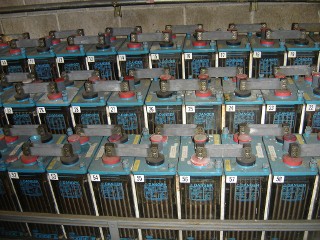
In our last segment we discussed power inverters in the context of medical equipment. That was the main part of this series that was primarily targetted at medical equipment.
For the rest of the series, we’ll cover it from a more general perspective.
Today we’re talking about power storage, specifically storing them in battery banks. Sounds complicated, but it’s really not.
There’s a couple things you need to know and/or decide.
First, you need to know what voltage your inverter needs. This is usually going to be 12V or 24V … we’ll assume for this exercise that it’s 12V.
Second, you need to know what voltage your batteries are. A common battery for these types of systems are 6V Deep Cycle batteries from golf carts. So we’ll use those.
Finally, you need to know how much power you want to store. I’m actually going to be super arbitrary here and skip this. If you want more information about this, there will be more at the end of the post.
Without going all Electrical Engineer on you, the key concept you need to know about is Ohm’s Law. Using Ohm’s Law as a basis, if you wire batteries in Series, you increase the voltage of your system. If you wire them in parallel, then you increase the storage capacity.
Knowing those two design concepts is all you need.
Since we know that we want a 12 Volt system, we know that we need to have two of our 6 volt batteries wired in series. For a larger system we’d actually have two distinct battery banks wired in series instead. This increases our capacity as well as our voltage.
Without belaboring the point for a large system you could have two banks of six batteries, wired together in parallel, that provide essentially six times the storage capacity as a single battery. By wiring these two banks in series, we then increase the overall voltage to 12 volts.
For a more in depth discussion of the topic, I wrote an article a while ago on how to build an emergency power system … if this is something that interests you, definitely check it out. The article also discusses power generation in depth, so I’m not going to go over it again.
This will wrap up our series on emergency power for medical devices. Hope you enjoyed it, and if you have any suggestions for a how to or series post, send me a note!
Sunday, November 20, 2011
Alternative Energy Battery Type 101
Original Article

Practically all batteries used in alternative energy solar power backup systems are Lead-Acid type batteries. Even after over a century of use, they still offer the best price to power ratio.
ALL of the batteries commonly used in deep cycle applications are Lead-Acid. This includes the standard flooded (wet) batteries, gelled, and AGM (Absorbed Glass Mat). They all use the same chemistry, although the actual construction of the plates etc varies.
The lifespan of a deep cycle battery will vary considerably with how it is used, how it is maintained and charged, temperature, and other factors.
These are some typical expectations for batteries if used in deep cycle service.
Type of battery: Expected battery life in ‘deep-cycle’ mode
Starting: 3-12 months
Marine: 1-6 years
Golf cart: 2-7 years
Gelled deep cycle: 2-5 years
AGM deep cycle: 4-7 years
Starting batteries are commonly used to start and run engines. Engine starters need a very large starting current for a very short time. Starting batteries have a large number of thin plates for maximum surface area. The plates are composed of a Lead “sponge”, similar in appearance to a very fine foam sponge. This gives a very large surface area, but if deep cycled, this sponge will quickly be consumed and fall to the bottom of the cells. Automotive batteries will generally fail after 30-150 deep cycles if deep cycled, while they may last for thousands of cycles in normal starting use (2-5% discharge).
Deep cycle batteries are designed to be discharged down as much as 80% time after time, and have much thicker plates. The major difference between a true deep cycle battery and others is that the plates are SOLID Lead plates – not sponge. This gives less surface area, thus less “instant” power like starting batteries need. Although these an be cycled down to 20% charge, the best lifespan vs cost method is to keep the average cycle at about 50% discharge.
Golf cart batteries are quite popular for small systems and RV’s. The problem is that “golf cart” refers to a size of battery (commonly called GC-2, or T-105), not the type or construction – so the quality and construction of a golf car battery can vary considerably – ranging from the cheap off brand with thin plates up the true deep cycle brands, such as Crown, Deka, Trojan, etc. In general, you get what you pay for.
Marine batteries are usually a “hybrid”, and fall between the starting and deep-cycle batteries. In the hybrid, the plates may be composed of Lead sponge, but it is coarser and heavier than that used in starting batteries. It is often hard to tell what you are getting in a “marine” battery, but most are a hybrid.
Gelled deep cycle batteries, or “Gel Cells” contain acid that has been “gelled” by the addition of Silica Gel, turning the acid into a solid mass that looks like gooey Jell-O. The advantage of these batteries is that it is impossible to spill acid even if they are broken. However, there are several disadvantages (must be charged at a slower rate and lower voltage to prevent permanent damage, In hot climates, water loss can be enough over 2-4 years to cause premature battery failure).
AGM, or Absorbed Glass Mat deep cycle batteries have all the advantages (and then some) of gelled, with none of the disadvantages, and they can take much more abuse. Since all the acid is contained in the glass mats, they cannot spill, even if broken. This also means that since they are non-hazardous, the shipping costs are lower. In addition, since there is no liquid to freeze and expand, they are practically immune from freezing damage. Nearly all AGM batteries are “recombinant” – what that means is that the Oxygen and Hydrogen recombine INSIDE the battery. AGM’s will cost 2 to 3 times as much as flooded batteries of the same capacity. In many installations, where the batteries are set in an area where you don’t have to worry about fumes or leakage, a standard or industrial deep cycle is a better economic choice.
If you enjoyed this, or Dachshund topics,
click here to check out our current homepage articles…
Similar Articles You Might Enjoy:
Tuesday, November 1, 2011
How Does Solar Power Work?
Original Article

Solar Energy: Keeping it simple
The Earth constantly basks in the Sun and is absorbing enough energy to satisfy the world’s power needs many times over.
So how do we turn the Sun’s energy into electricity? Well, the light from the sun contains energy. These particles of energy are called ‘photons’. These photons are created deep in the Sun by the fusion of atoms, and once they reach the sun’s surface, they shoot out in all directions into space. They take about 8 minutes to reach us here on Earth. You can feel them as they warm you when you stand in the sunlight.
When sunlight hits an object, that energy generally turns into heat. However, when sunlight hits certain materials, the energy turns into a flow of electricity instead. It’s kind of like turning on a water hose – imagine that the water in the hose is the flow of electricity.
Crystals made out of silicon will produce an electrical current (like the water flow in a hose) when exposed to sunlight. What happens is, the electrons that are in the silicon begin to ‘move’ when struck by light (instead of just staying mostly in place). Since the electrons move, we can harness that flow and direct it to useful things such as being converted to the energy we use in our homes, or perhaps to charge a bank of batteries.
In slightly more detail, a silicon atom contains electrons spinning around it’s nucleus. In a silicon crystal (of many silicon atoms), the bonds between the silicon atoms are made of electrons that are shared between all of the atoms of the crystal itself. When the light gets absorbed, one of the electrons that is in one of the bonds gets ‘excited’ up to a higher energy level and can move around more freely than when it was bound. That electron can then move around the crystal freely, and we can get a current. This is multiplied many times over since the crystals are made up of many atoms.
The Silicon Atom

The silicon atom has three shells (the three ellipses around the nucleus). As silicon atoms come close to one another they connect, latching onto the electrons in the outer shell of other atoms to form a silicon crystal.
Newer materials than silicon use smaller and cheaper crystals, such as copper-indium-gallium-selenide, that can be shaped into flexible films. One drawback though is this ‘thin-film’ solar technology is not as good as silicon at turning light into electricity.
Solar panels are made from these silicon semiconductor materials (and the newer thin-film materials). Solar panels come in a variety of sizes and electrical capabilities. This aids in the design of a wide variety of purposes and provides the flexibility to customize most any energy system.
Here is an example of a small solar panel
Instapark® 5W Mono-crystalline Solar Panel with 12V Solar Charge Controller

Here is an example of a large solar panel
Grape Solar CS-P-270-DJ 270 Watt Polycrystalline PV Solar Panel

If you enjoyed this, or topics of current events risk awareness or survival preparedness,
click here to check out our current homepage articles…
Similar Articles You Might Enjoy:
Friday, October 28, 2011
Wind Power for your House, Home, Retreat
Original Article

Wind power may be a good choice for some, when considering alternative energy sources for house and home, for either emergency preparedness or part-time power.
Some parts of the country (world) are much windier than others, with steady breezes just waiting to be harnessed. Geographical location is important while attempting to harness wind power, the best places being those with often steady breezes. For example, those who live along the ocean, breezy conditions are often part of daily life. Much of the open plains, or locations where winds are funneled through valleys are also often windy.
The following map of the United States shows favorable locations for wind power generation.

This next map of the US shows average wind speeds at a height of 80 meters, which is the common hub height of the ginormous wind generators (turbines) of wind farms that you may have seen along the landscape.

Global Wind Power Map
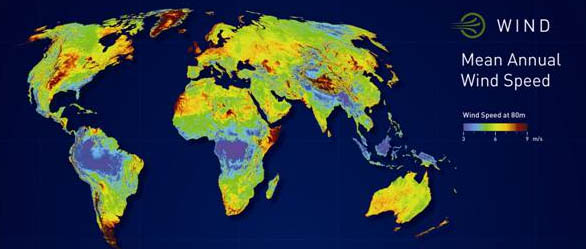
Looks like it’s pretty windy for you folks in the UK region! (lots of ‘red’, more than I thought)
Much of Australia is in the ‘yellow’ too.
The following 1,000 Watt wind generator (turbine) appears to be ideal for the home, and is much less costly per watt when compared to solar panels. Of course, the wind has to be blowing for it to generate electricity…
Windmax 1,000-Watt 24-Volt 5-Blade Residential Wind Generator Kit

1,000 watts could keep a bank of specialized batteries (heavy duty deep-cell for alternative energy storage) charged up for usage during periods when the breeze diminishes. Two of these wind generators (turbines) (2x $1K) would be equivalent to having ten 200-watt solar panels which themselves would probably cost you between $7K and $10K !
I currently enjoy the benefit of solar panels but do hope to add on a wind generator (turbine) at the new Retreat one day, and report back on the result.
The more you can do to become LESS dependent upon the grid, the better for you and your ‘risk insurance’.
How does a wind turbine work?
Incoming winds brush past the curved edges of the propeller, turning it as they go. The turning propeller rod connected to a gearbox translates a slow but high-torque turning motion into a very fast but low-torque motion which is connected to a generator, generating a continuous electrical charge.
If you enjoyed this, or topics of current events risk awareness or survival preparedness,
click here to check out our current homepage articles…
Similar Articles You Might Enjoy:
- Best Selling Portable Generators
- After the EMP comes Nuclear Meltdown
- US Power Grid
- Chain Reaction Transformer Failure
- Solar Event Risk to Power Grid
- U.S. Nuclear Power Plants, safe distance?
- Magnetically Charged Spots Suddenly Dot the Sun
- Solar SuperStorm 1859 – It could happen again
- Cyber Terrorism – Nuclear Power Plants – Grid
- Bug Out of Toronto