Most people look at local crime only after something happens close to home. A car gets broken into down the street. A neighbor posts about a prowler. The police are called to the gas station on the corner. Someone hears about a burglary two blocks away. Then, for a few days, everybody pays attention. A […]
from Survivopedia
Tuesday, July 28, 2026
Monday, July 27, 2026
17 Things You Should Always Buy In Bulk
Estimated reading time: 8 minutes
Prepping has a reputation for being expensive, and if you've spent any time browsing tactical gear websites or survival food catalogs, you know why. It's easy to blow your entire budget on gadgets and MREs while completely neglecting the basics that actually keep a household running in a long-term disaster.
Real preparedness isn't about buying one of everything. It's about being strategic, setting a budget, saving up, and buying the right items in bulk so your money goes further and your supplies actually last.
That's exactly the philosophy behind this list, which we found on the YouTube channel Zach Of All Trades. Zach has been prepping since 2012, and after years of trial and error (including some expensive mistakes), he's narrowed it down to 17 items that deliver the best combination of savings, shelf life, and everyday usefulness.
You can watch his video and read the list below.
1. Heavy-Duty Contractor Trash Bags
Thick, 55-gallon contractor bags are one of the most overlooked prepping items out there. Beyond basic trash duty, they can double as emergency ponchos, temporary window patches, water collection tools, sleeping bag liners, and vapor barriers in cold weather.
A box of 100 runs about $30, and because they're so compact, you can stack a dozen boxes in a closet and still barely notice them.
2. Batteries (By the Case, Not the Pack)
Grabbing a four-pack of AAs at the checkout counter is one of the worst ways to buy batteries. Bought by the case instead, you'll pay a fraction of the per-unit price. Batteries stored in a cool, dry place can last 5 to 10 years, so stock up on AA, AAA, 9V, and coin cell sizes.
It's also worth investing in some lithium batteries alongside standard alkaline ones. They cost more upfront but last roughly three times longer and hold up better in extreme temperatures.
3. Plain Washcloths
Skip the fancy department store washcloths and buy the basic white ones in bulk packs. Unlike paper towels, which are single-use and take up huge amounts of storage space, washcloths are reusable indefinitely.
They can be used for cleaning, first aid, hygiene, makeshift water filtration, or even as fire starters once they're worn out and oily. A stash of a couple hundred takes up less room than a month's worth of paper towels.
4 & 5. Pasta and White Rice
These two staples go hand in hand, and how you store them matters just as much as how much you buy. Transferring rice and pasta into airtight containers, adding bay leaves to deter pests, and using Mylar bags with oxygen absorbers can be the difference between food that lasts a couple of years and food that lasts decades.
Rice bought in bulk 50-pound bags is dramatically cheaper per pound than smaller packaging, and when stored properly, it can last up to 30 years. For pasta, stick to basic shapes like spaghetti and penne, buy heavily during sales cycles, and consider whole wheat varieties, which tend to store better thanks to their natural oils.
6. Dried Beans
Dried beans are one of the best value-per-calorie preps available. A large bag of pinto beans costs a fraction of what you'd pay for the equivalent in canned beans, and a single pound of dried beans equals roughly six cans' worth of food, meaning far less storage space is needed.
Stock a variety, black beans, navy beans, kidney beans, chickpeas, and lentils, and store them properly in Mylar bags or food-grade buckets for a shelf life that can stretch 25 to 30 years.
7. Whole Coffee Beans
Coffee might not seem like a survival essential, but it could become one of the most valuable barter items in a long-term crisis. It's habitual, comforting, and one of the first luxury goods to vanish when supply chains break down.
Buying whole beans instead of ground coffee extends shelf life significantly, especially when vacuum-sealed. Pair your stockpile with a manual, hand-crank coffee grinder so you're not dependent on electricity to enjoy a cup.
8. Wheat Berries
Wheat berries are whole wheat kernels before they've been milled into flour, and they last dramatically longer than flour does. While flour can go rancid within six months to a year, properly stored wheat berries can last 30 years or more.
A 50-pound bag can be ground into a substantial amount of fresh flour as needed, and wheat berries themselves can be cooked whole like rice, sprouted for fresh greens, or even popped like popcorn for a snack. A grain mill, ideally both a manual and an electric one, makes this option far more versatile.
9. Meat Bought in Bulk
For bigger savings, consider buying a quarter, half, or whole cow directly from a rancher rather than relying solely on grocery store packs. Buying in this way can bring the price per pound of high-quality, grass-fed beef down dramatically compared to retail prices.
This approach does require investment in proper storage, ideally a dedicated deep freezer, and vacuum sealing your own cuts extends freezer life to two or three years without freezer burn.
10. Cleaning Supplies
Bleach, dish soap, laundry detergent, and all-purpose cleaners carry a steep markup when bought in small containers. Buying gallon-sized containers, or concentrated versions you dilute yourself, cuts the cost per ounce significantly.
For laundry, commercial-grade powder detergent (the kind used by hotels and laundromats) is far cheaper than name-brand liquid detergent and stores indefinitely without the risk of separating.
11. Toilet Paper
If 2020 taught the world anything, it's that toilet paper disappears fast in a crisis. Buying commercial-grade bulk rolls rather than premium name brands stretches your budget considerably, and keeping a several-month supply on hand means you're never caught scrambling, or paying inflated prices, when shelves go bare.
12. Number 10 Canned Goods
Skip the regular-sized cans from the grocery store aisle and look into restaurant-sized No. 10 cans instead. These giant cans hold significantly more food per dollar spent compared to standard retail cans, and consolidating your pantry into fewer, larger containers cuts down on storage clutter.
Restaurant supply stores and bulk retailers are good sources, stock up on vegetables, fruits, sauces, and proteins like canned chicken and tuna.
13. Whole Rolled or Steel-Cut Oats
Skip the instant packets and buy whole rolled or steel-cut oats in bulk instead. Oats are inexpensive per pound, incredibly versatile (breakfast, flour, a meat extender, homemade granola, even skin care for irritations like poison ivy), and when stored in airtight containers, they can last up to 30 years while delivering solid protein and fiber.
14. Vitamins and Supplements
This is the item most preppers overlook entirely. Long-term food storage solves the calorie problem, but nutritional deficiencies can cause serious health issues if your diet lacks variety.
Stocking vitamin C, vitamin D, a multivitamin, and zinc, bought in bulk from warehouse stores, is cheap insurance against these risks. Stored in a cool, dark place, most supplements maintain their potency for a couple of years past their printed expiration date.
15. Cooking Oil
Not all oils store equally well. Coconut oil is considered the gold standard for preppers: it can last up to five years without going rancid, stays solid at room temperature (making storage easier), and has natural antimicrobial properties.
Olive oil is also a solid choice, but only in dark containers stored in a cool, dark space. Vegetable and canola oils, on the other hand, go rancid quickly and generally aren't worth the storage space for long-term prepping.
16. Salt
Plain table salt and canning salt bought in bulk are remarkably cheap, and unlike most food items, salt simply doesn't go bad. It's essential for food preservation, electrolyte balance, wound care, and countless other uses. Historically, salt has held enough value to be traded ounce-for-ounce with gold, which is where the word “salary” actually comes from.
17. Vinegar
White vinegar, apple cider vinegar, and cleaning vinegar are all inexpensive by the gallon and remarkably versatile: they preserve food, clean everything from windows to minor wounds, deodorize, and even kill weeds.
Apple cider vinegar with “the mother” is also popular for digestive and blood sugar support. Buying by the gallon instead of small bottles brings the cost down dramatically.
The Bottom Line
Buying in bulk strategically is essentially a way of converting cash into tangible, appreciating assets at a time when food prices continue to climb. The goal isn't to prepare for a single catastrophic event, it's to build resilience against the far more common disruptions: job loss, medical bills, local disasters, or temporary shortages. When you already have months of supplies bought at reasonable prices, those situations become inconveniences instead of emergencies.
The path to real preparedness isn't paved with expensive tactical gear. It's built on boring basics, rice, beans, salt, and soap, bought in bulk, stored properly, and rotated consistently. Pick two or three items from this list, look into your local pricing, figure out your storage solution, and make your first purchase this week. Small, consistent steps add up to real security over time.
You May Also Like:
The post 17 Things You Should Always Buy In Bulk appeared first on Homestead Survival Site.
from Homestead Survival Site https://ift.tt/bnFUKSp
Easy-Baked Cheesy Zucchini Bites

Today, I want to share my recipe for easy-baked cheesy zucchini bites. If you’re like me, your garden is overflowing with zucchini. Updated in 2026.
Isn’t it wonderful to have a full garden and to harvest your own food items? Remember, you can freeze your grated or shredded zucchini and use it throughout the year. I measure out 2 cups per bag and store them in freezer bags.
When my girls were growing up, this recipe was a staple in our home. We had a large garden and froze bags and bags of grated zucchini.

Of course, we also made Zucchini Muffins, zucchini bread, and zucchini cookies. But sometimes, I would include these bites in the kids’ lunch boxes when they took their lunch to school.
You can make these smaller bites and serve them with ranch dressing as an appetizer. It’s great that it makes a small batch- not too many, but just enough to freeze some if we want to save them for later.
Or, what neighbor wouldn’t love a homemade healthy snack like this? The original recipe was from a neighbor our girls babysat for.
I’d never heard of zucchini bites until we met her. I’ve modified the recipe over the years, but it still brings back great memories of that neighborhood. In case you missed this post, Quick & Easy Salad Dressing Recipes From Scratch
Easy Baked Cheesy Zucchini Bites
Items You Need In Your Kitchen
- Large Mixing Bowl
- Danish Whisk or Mixing Spoon
- Measuring Cups
- Measuring Spoons
- Cookie Sheet
- Parchment Paper
- Cookie Scoop
- Cheese Grater
Ingredients
- Zucchini
- Egg
- Shredded Cheese
- Bread Crumbs
- Salt and Pepper
- Dried Sweet Basil
- Garlic Powder
- Onion Powder
Zucchini bites come together with a handful of simple ingredients that most families already keep on hand, which is part of what makes this recipe so appealing for busy home cooks. Fresh zucchini is the star of the show and should be grated and then squeezed dry with a clean towel to remove excess moisture, since a soggy mixture will keep the bites from holding together and crisping up in the oven. Shredded cheddar cheese or a blend of mozzarella and parmesan adds richness and that classic cheesy pull, while also helping bind the mixture together and adding a rich flavor.
Breadcrumbs or panko give the bites structure and a bit of texture, soaking up moisture from the zucchini while helping the outside turn golden as they bake. Eggs act as the binder that holds everything together, so the bites keep their shape instead of falling apart in the pan. A bit of chopped onion or garlic brings savory depth, while fresh herbs such as parsley or basil add color and a garden-fresh flavor that pairs so well with summer squash. A pinch of salt and pepper rounds out the seasoning, though many home cooks like to add a dash of paprika or Italian seasoning for extra flavor. Together, these ingredients turn an overflowing zucchini harvest into a wholesome, cheesy snack that the whole family will enjoy.
Easy Baked Cheesy Zucchini Bites
Step One
Gather your ingredients. Drain the shredded zucchini until it’s almost dry. If needed, use a towel to wring out the liquid.

Step Two
Preheat your oven to 425°F (218°C). Place some parchment paper on a cookie sheet, spray with vegetable spray, and set aside. Combine the zucchini, slightly beaten egg, cheese, breadcrumbs, and seasonings, as stated in the recipe below.

Step Three
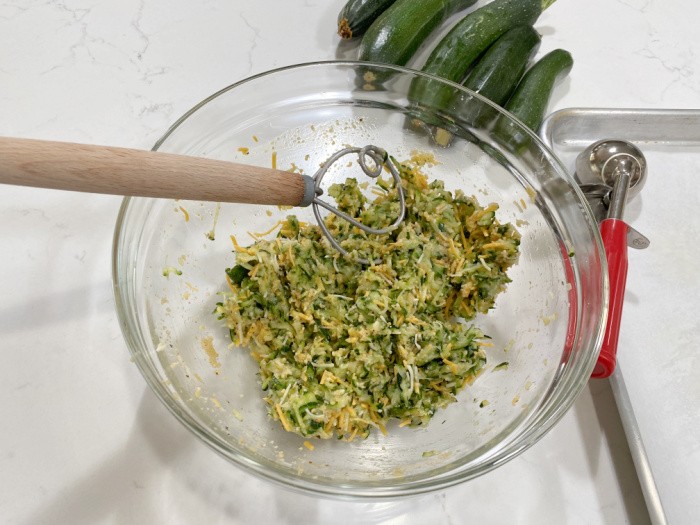
Mix thoroughly. I love using my Danish whisk for this recipe!
Step Four
I use a cookie scoop for the zucchini bites, but you can use a tablespoon if desired. I use my hands to mound them and flatten them a bit. The thicker you make the mounds, the longer they take to bake.
Bake for 20-30 minutes, depending on how large you make your zucchini bites. Bake until the edges are golden brown.

End Product
Cheesy Zucchini Bites Recipe

Cheesy Zucchini Bites Recipe
Servings 4
Ingredients
- 1-1/2 cups Shredded zucchini with skins, drained with a strainer or towel (it must be dry)
- 1 Egg, slightly beaten
- 1/2 cup Grated cheese (I used a Cheddar/Monterey Jack combo). Please note: I've also used Mozzarella cheese in the recipe. Just about any cheese should work.
- 1/4 cup Breadcrumbs (I used plain)
- 1/4 teaspoon Dried sweet basil
- 1/4 teaspoon Garlic powder or onion powder
- 1/4 teaspoon Salt
- 1/8 teaspoon Pepper
Instructions
- Preheat your oven to 425°F (218°C).
- Place some parchment paper on a cookie sheet, spray with vegetable spray, and set aside.
- Combine the zucchini, slightly beaten egg, cheese, breadcrumbs, and seasonings, as stated above.
- Mix thoroughly. I use a cookie scoop for the zucchini bites, but you can use a tablespoon if desired.
- I use my hands to mound them and flatten them a bit.
- Bake for 20-30 minutes, depending on how large you make your zucchini bites.
- Bake until the edges are golden brown. Drain on a rack.
How do I store these?
After cooking, I store them in a quart-size freezer bag in the refrigerator. They’ll be suitable for 3 – 4 days.
Can I serve them hot or cold?
You can serve them hot from the oven or eat them cold after storing them in the refrigerator.
Can I freeze these?
Absolutely. When you want a healthy snack for later, please freeze them in freezer bags and thaw them in your refrigerator when you’re ready to serve them.
Can I make these Gluten-Free?
Yes, I have family members who have gluten issues, and they use the Gluten-Free Bread Crumbs.
Are these the same as zucchini fritters?
They’re similar, but they’re different at the same time. I grew up eating fried zucchini patties; you may have eaten them too. My mom would grate some zucchini, add eggs, and some breadcrumbs.
She would fry the patties in a large cast-iron pan filled with oil. We would eat them for breakfast, lunch, or dinner. We always had a large garden and several fruit trees.
History Behind These Gems
Zucchini bites have roots that stretch back to the humble zucchini itself, a summer squash first cultivated by Italian growers in the late 1800s after squash seeds brought over from the Americas were bred into the slender green vegetable we know today. Italian immigrants carried zucchini recipes with them to the United States, where home cooks began grating and frying the squash into fritters as a way to use up the abundant harvest that summer gardens produce every single year.
Over time, American kitchens took that same idea of a fried squash fritter and gave it a cozy makeover by baking it instead of frying it and folding in cheese, breadcrumbs, and herbs, turning a simple vegetable side into the bite-sized snack so many families enjoy today. Baked cheesy zucchini bites became especially popular as home cooks looked for healthier ways to prepare classic fritter recipes without a skillet full of oil, and as more families started growing their own zucchini in backyard gardens as part of a self-reliant lifestyle. Today, these little bites are loved for being a simple way to stretch a garden harvest, sneak vegetables into a family meal, and create a snack that freezes and reheats beautifully, which makes them a natural fit for anyone who values scratch cooking and making the most of what the garden provides.
Final Word
I hope you try making these zucchini bites. It’s one more recipe we can teach our family to cook from scratch. How is your garden doing?
You may be able to get fresh zucchini at a Farmer’s Market if you don’t have room to grow them in your garden. May God bless this world, Linda
The post Easy-Baked Cheesy Zucchini Bites appeared first on Food Storage Moms.
from Food Storage Moms
Diagnosing Whether a Water Heater Problem Is Actually Fixable
Not every water heater malfunction warrants an immediate call for water heater repair, and not every repairable issue is worth fixing depending on the unit’s age and overall condition. A pilot light that won’t stay lit on a gas unit often traces back to a faulty thermocouple, a relatively inexpensive part that’s straightforward to replace and restores full function without addressing anything else about the unit. A tank actively leaking from its body, by contrast, usually indicates internal corrosion that no repair can reverse, since once the tank’s structural integrity fails, no patch addresses the underlying material breakdown causing it.
This distinction matters because homeowners sometimes request repairs for problems that repair can’t actually solve, based on the assumption that any water heater issue has some fix available. Sediment-related noise, inconsistent temperature, and slow recovery times are typically repairable issues addressing symptoms with identifiable, fixable causes. Rust-colored water combined with a tank showing external rust, however, usually signals deterioration that repair only delays temporarily before the same failure returns or worsens, making the repair investment a poor use of money compared to planning replacement instead.
Common Repairs and What Actually Causes Them
Heating element failure ranks among the most frequent repairs for electric water heaters, typically caused by mineral buildup insulating the element from water, forcing it to work harder until it eventually burns out. Replacing a failed element restores heating function, but if sediment caused the original failure, an unaddressed tank flush means the replacement element faces the same conditions that killed its predecessor, shortening its own expected lifespan unless the underlying sediment issue gets resolved alongside the element replacement itself.
Gas unit issues frequently center around thermocouples, pilot assemblies, or gas valve malfunctions, each requiring different diagnostic approaches despite producing similar symptoms like a pilot that won’t stay lit or inconsistent heating. A thermocouple failure and a gas valve malfunction can present nearly identically from a homeowner’s perspective, both resulting in a pilot that won’t hold or a unit that won’t heat consistently, but they require entirely different parts and labor to resolve. Accurate diagnosis before repair prevents the frustrating scenario where a homeowner pays for a thermocouple replacement that doesn’t resolve the actual problem, only to discover the real issue was a failing gas valve that the initial repair never addressed.
When Repair Costs Approach Replacement, the Math Changes
Every water heater repair decision should weigh repair cost against the unit’s remaining expected lifespan, a calculation many homeowners skip in the moment when they simply want the immediate problem resolved. A repair costing a third or more of what a full replacement would cost, on a unit already past the midpoint of its expected lifespan, often represents poor value compared to putting that money toward a new unit that comes with a fresh warranty and years of expected reliable service ahead of it. This calculation shifts for younger units still well within their expected lifespan, where even a moderately expensive repair still makes sense given the years of remaining service the fix would restore.
Repeated repairs on the same unit within a short period signal a system reaching the end of viable repair economics, even when each individual repair seems reasonable in isolation. A water heater that’s needed three separate service calls within a year, even for seemingly unrelated issues, often indicates broader systemic decline that will keep generating new problems regardless of how many individual components get replaced along the way. Recognizing this pattern, rather than treating each repair as an isolated decision disconnected from the unit’s overall trajectory, helps homeowners avoid the trap of spending repair money incrementally on a system that ultimately needs full replacement anyway.
You may also like:
 DIY Solar Water Heaters To Cut Down On Energy Bills
This Homemade Device Can Power Up Your Entire House 7 Days In A Row (VIDEO)
Survival Water From Your Water Heater
The Water Supply Already Sitting in Your House (And Why Most Preppers Ignore It)
Living Off the Grid: The Complete Guide to Energy, Water, Food, and Independence
The post Diagnosing Whether a Water Heater Problem Is Actually Fixable appeared first on Ask a Prepper.
from Ask a Prepper https://ift.tt/BRrO5NM
10 Prepper Items You Can Get for Under $5
Estimated reading time: 7 minutes

When people think about prepping, their minds usually jump to expensive gear like generators, tactical bags, and water filter systems with price tags in the hundreds. But some of the most useful items for riding out a disaster are already in your house. These everyday household items are cheap, easy to find, and usually overlooked, which is exactly what makes them so valuable.
This list of inexpensive prepper items comes from the YouTube channel The Provident Prepper, and it's packed with practical uses you may not have considered before. You can watch the video and see the list below.
1. Baking Soda
Baking soda earns its spot on almost every prepper list because it does so much more than leaven bread. It works as a homemade toothpaste, a fire suppressant, and a powerful deodorizer. Sprinkle it on smelly carpet, let it sit, then vacuum it up. It also works as a dry shampoo in a pinch, and adding a bit to a pot of beans while they soak helps soften them before cooking (just be sure to drain and rinse before cooking in fresh water).
Baking soda is also an excellent natural cleaner. A simple combination of Dawn dish soap and vinegar sprayed on a shower, followed by a sprinkle of baking soda and some scrubbing, cuts through grime without harsh chemicals. The good news for long-term storage: baking soda has an indefinite shelf life. It may lose some leavening power over time, but its other uses remain just as effective.
Here are some more uses for baking soda.
2. White Vinegar
Like baking soda, white vinegar is a jack-of-all-trades. It softens hard water in the dishwasher and washing machine, cuts down on the amount of detergent needed, and removes rust and scale from tools when they are soaked in a vinegar-water solution. Wrapping a vinegar-soaked paper towel around a faucet plagued by hard water buildup and leaving it for an hour will dissolve the mineral deposits almost like magic.
In the kitchen, a diluted vinegar rinse can help remove residues from produce. Outdoors, straight vinegar sprayed directly on weeds acts as an effective, chemical-free weed killer, even on stubborn plants like bindweed, without harming the surrounding garden. Because it gets used so often, buying vinegar in bulk (jugs or stackable boxed containers) makes sense for anyone serious about self-sufficiency.
Here are some more uses for white vinegar.
3. Borax
Borax is a century-old preparedness staple with a surprising range of uses. A simple trail of borax will kill ants that carry it back to their nest, and it works similarly on roaches. It boosts laundry detergent, treats mold, and works as a strong deodorizer.
One catch: borax is often sold in cardboard boxes, and if stored in a humid area, moisture can cause the box to swell and create a mess. For long-term storage, transfer borax into a sealed Mylar bag and label it clearly.
Here are some more uses for borax.
4. Unscented Bleach, Pool Shock, and Safer Water Disinfection Alternatives
Calcium hypochlorite (pool shock) can purify thousands of gallons of water and it has a long shelf life, making it great for your long-term water purification plan. However, it's also a dangerous chemical. It can release gas, corrode metal containers, and even ignite under the wrong conditions. Long-term storage tests have shown that bottles sealed inside Mylar bags can bulge from built-up gas, and calcium hypochlorite should never be stored in large quantities or near metal.
Unscented regular chlorine bleach (with no thickeners or fragrances) is another good option, but it degrades within about six months of manufacture, becoming unreliable for water treatment well before its printed date suggests, and it can be surprisingly expensive to find in its truly unscented form.
Because of these downsides, it is worth knowing the free and low-cost alternatives:
- Boiling is the gold standard. Water at 212°F kills essentially all pathogens, though boiling alone will not remove protozoa cysts, so filtering beforehand still matters.
- Pasteurization using a solar oven can disinfect water without using any fuel.
- Solar water disinfection (SODIS) uses nothing but sunlight. Fill a clear glass or plastic container (no more than about 4 inches in diameter) about two-thirds of the way, shake it to oxygenate the water, then fill it the rest of the way and lay it on its side in direct sunlight. In sunny conditions, 4 to 6 hours of exposure is enough to kill harmful organisms in the water; cloudy weather may require a day or two. Even an old, empty soda or water bottle (with the label removed) works for this method.
The takeaway: transparent, narrow containers and a basic understanding of solar disinfection can provide reliable, free water treatment without the risks that come with storing dangerous chemicals.
5. Cardboard Boxes
Cardboard boxes are everywhere, especially with how much of daily life now arrives via home delivery, and they are essentially a free resource. Beyond organizing and storing supplies, cardboard makes an effective insulator for windows or as a barrier between a sleeping bag and cold ground. It is also a reliable fire starter.
In the garden, flattened cardboard works as a weed barrier when layered under wood chips, preventing weeds from pushing through. Torn into smaller pieces, it also breaks down well in a compost pile, enriching the soil over time.
6. Petroleum Jelly
Petroleum jelly is best known for soothing diaper rash, but it has a long list of other practical uses. It works as a skin protectant, a waterproofing barrier, and a remedy for chapped lips. Rubbed onto metal tools, it helps prevent rust.
It also makes an excellent fire starter. Cotton balls coated in petroleum jelly catch quickly and burn long enough to get a fire going, even in damp or cold conditions.
Here are some more uses for petroleum jelly.
7. Epsom Salt
Epsom salt is loaded with magnesium, which makes it useful well beyond a relaxing soak in the tub. It helps soothe sore, overworked muscles and can be part of a recovery routine after an injury.
A warm water soak with Epsom salt also makes stubborn splinters much easier to remove after about 15 minutes, and it softens cracked, rough feet with regular soaking. In the garden, Epsom salt acts as a fertilizer for certain vegetables, and soaking seeds in an Epsom salt solution before planting can help with germination while giving seedlings an early magnesium boost.
Here are some more uses for epsom salt.
8. Unscented Clay Kitty Litter
You don't need an indoor cat to benefit from kitty litter. It provides traction on icy surfaces, works as an emergency toilet solution, and controls moisture and odor. Spilled oil in the garage is easily cleaned by sprinkling kitty litter over it, letting it soak in, then sweeping it up. The same trick works for cleaning up other unpleasant messes, since it absorbs liquid and helps neutralize odor at the same time.
9. Coffee Filters
Even households that do not drink coffee can put coffee filters to good use. They are inexpensive, and one of their most important preparedness roles is clarifying water (removing debris and particulates) before it is disinfected, whether by boiling, chemical treatment, or solar disinfection.
In the kitchen, coffee filters work well for straining fats and oils, filtering teas, or straining homemade nut milk for a smoother texture. Secured over the top of a fermentation jar with a rubber band, a coffee filter lets air in and out while keeping dust and flies out. They are also great at absorbing moisture, making them useful for drying a freshly washed cast iron pan and helping prevent rust.
Here are some more uses for coffee filters.
10. Dryer Lint
Dryer lint comes free with every load of laundry, and while it can turn into a stringy mess if not managed, storing it in a labeled can or container solves that problem easily. Kept near a wood pile or fire-starting supplies, lint becomes an excellent fire starter on its own, and its performance improves even further when combined with melted wax, using something like an egg carton mold to create long-burning fire-starter pucks.
Bonus: A Cheap Plastic Shower Liner
A basic, inexpensive shower curtain liner is lightweight, waterproof, and surprisingly versatile. It can cover and insulate a window using painter's tape, serve as an improvised poncho, act as a barrier to protect a mattress from moisture, or double as a ground tarp. A non-clear version can even provide a privacy screen for an outdoor bathroom setup.
You May Also Like:
The post 10 Prepper Items You Can Get for Under $5 appeared first on Urban Survival Site.
from Urban Survival Site
Subscribe to:
Posts (Atom)