Submissions     Contact     Advertise     Donate     BlogRoll     Subscribe                         
Showing posts with label Bugging in/out. Show all posts

Tuesday, July 18, 2023

Bugging In: The #1 Ultimate Preppers Guide On How to Bug In

 Original Article


By Linda Loosli


Bugging In: The #1 Ultimate Preppers Guide On How to Bug In


What is Bugging In?

Saturday, May 20, 2023

Simple Tips to Prepare Your Vehicle for Bugging Out

 Original Article


By Bob Rodgers


As preppers, we know that when the brown stuff hits the fan, we need to get away from trouble fast. We made our vehicles bug-out ready, and with the simple tips from this article, any like-minded person out there can turn their family car into a bug-out vehicle. 

In our country, there are plenty of natural disasters occurring each year, and people will have to deal with forest fires, hurricanes, floods, and blinding blizzards. All these disasters have one thing in common, they are causing mass evictions, and ordinary people will leave their homes in a hurry, searching for safety elsewhere.  

If you want to get your family out of harm’s way, you need to have a reliable vehicle. A vehicle that’s always prepared and ready to move at a moment’s notice. Let’s discuss what items I keep in my vehicle and the steps I would follow if something were to happen. 

The circumstances you may face in your state may be different, and you have to keep in mind that you will need to bring along items suited to your area. Also, you may have time to load your vehicle(s) with other items as well. This is a general guide, and the suggestions can be adapted based on your own personal situation.  

Saturday, July 23, 2022

Should I Stay or Should I Go? How to Decide Whether to Bug Out or Bug In During an Emergency

Original Article


By Daisy Luther


If you're new here, you may want to subscribe to my RSS feed. Thanks for visiting!
(Psst: The FTC wants me to remind you that this website contains affiliate links. That means if you make a purchase from a link you click on, I might receive a small commission. This does not increase the price you'll pay for that item nor does it decrease the awesomeness of the item. ~ Daisy)


Author of The Bug Out Book and The NEW Interactive Prepper’s Book of Lists


When disaster seems imminent, there’s one vital decision that preppers have to make: grab your bag and bug out or hunker down and bug in? The lyrics from the chorus of a song by The Clash sums it up – you’ve got trouble either way, but one way will be worse than the other.

Because this song is now stuck in my head, I thought it should be stuck in your head, too.

Should I stay or should I go now?

Should I stay or should I go now?

If I go, there will be trouble

And if I stay it will be double

So come on and let me know

~ The Clash

If you are looking for far more detail on bugging out, check out The Bug Out Book, available instantly in PDF format.
Bug in or bug out?

Bugging In: This is when you shut the gate, lock the doors, and hunker down to weather the disaster at home with your supplies.

Bugging Out: This is when you grab your bug-out bag, and you hit the road to go somewhere else because your home is not safe.

In all but the most desperate circumstances, my personal plan is bugging in. Being out on the road amid a disaster means you’re a refugee. It means your supplies are minimal and that the things you’ve carefully stored over the years are very possibly going to be lost to you. The personal sustainability you’ve been cultivating at your home is also lost, including your garden, livestock, and water plan.

That being said, after the past few years we’ve seen in the United States, it seems to me that the possibility of having to evacuate has become more and more likely. What with the wildfires (and not just in California – we’ve seen them in Colorado, Tennessee, and North Carolina, to name a few), the industrial accidents, the hurricanes, the floods, and even volcanos, it seems that disaster can strike anywhere. And it can strike in a way that makes it impossible for you to hunker down safely at home.
This is not a decision engraved in stone

A while back, I wrote about the 3 steps to surviving any crisis.

1.) Accept

2.) Plan

2.) Act

If you are completely married to only one course of action, it limits your ability to perform the first step. That first step is accepting that whatever horrible event is out there has actually occurred. You have to be adaptable if you want to be able to survive extraordinary circumstances. Disasters rarely go by a script, and your plan can’t either.
The variables to consider

The answer to this question is hard to come by. There are so many different variables. There can never be a one-size-fits-all response. Here are the major factors you have to look at.
Will you be safe if you remain at home?

Bugging in is my first choice, but there are some situations in which evacuation is a necessity. Last year, during the King Fire, we were only a few miles from the evacuation line. Had the fire leaped that line, it would have been suicidal to stay home.

If you live near an erupting volcano, same thing. Storms like Hurricane Katrina also indicate that evacuation is a wiser course of action. Chemical spills, fires, biological contaminants, and extreme civil unrest can all be good causes to get-the-heck-out. You have to be willing to accept that no matter how fantastic your survival set-up is at your home, some circumstances beyond your control would absolutely require a bug out.
Do you have a place to go

Bugging out to the woods to live off the land is not a good idea for most people. While some folks would be just fine, most of us would not. Are you going to go live in the woods with your children, your elderly mother-in-law, and your diabetic spouse? Even though it’s a stretch, it might work briefly in good weather. But what about when the snow flies? What about when your food runs out?

Also, what about the fact that every third prepper has the same idea and will be out there shooting at deer, rendering your ability to bag one nearly impossible. If you do get one, do you know how to preserve it with only what you carried out to the woods on your back? That list could go on and on.

The point is, do you have a reliable retreat that is stocked with supplies? Do you have a friend in the boondocks to whom you can go? Is that friend actually expecting you, and have you ponied up with some supplies before the event to ensure that you are welcome? If you have your own retreat set up somewhere, what will you do if someone hostile got there first? If it has really, truly hit the fan, your best bet for bugging out is a well-stocked retreat location where someone in your group resides full time.
Do you have a way to get there?

Suppose you have a retreat, an awesome little compound up the mountain, over the stream, and around the bend. That is a beautiful thing to have. But in a worst-case scenario, how will you get to it? How long would it take you to hike there, should the roads be clogged by fellow evacuees, or in the event of an EMP event that takes out the power, including that of most vehicles? Is it possible to get there on foot with the family members who will be accompanying you? How far away is your secondary location? If it takes you more than a week to get there on foot, your chances of making it to your destination with a family in tow are pretty slim.

If you expect to get there in a crisis, your secondary location should be less than 100 miles from your primary location. A 25-mile range is optimal because it’s far enough not to be affected by localized disasters, but not so far you couldn’t make it on foot in a couple of strenuous days.
Can all of your family members make the trip?

It’s important to have a plan, a backup plan, and a backup to your backup. Often, in a bug-out scenario, that plan includes a difficult hike over rough terrain. Have you thought about who you’ll be taking with you?

Are there children old enough to walk on their own for long distances, or will you be carrying them? A 25-pound child piggy-backing on you will drain your energy very quickly, especially if you are going up and down steep trails. What about elderly family members? If you have a frail parent with a heart condition or age-related dementia, bugging out on foot is simply not an option for you. (Unless you can rig up a sturdy cart with knobby, off-road tires and pull it.) If you have family members that can’t make it, you must plan for your on-foot-bug-out to take far longer than normal. That doesn’t make it impossible. It just means that you MUST consider these things in advance and make modifications to your travel arrangements.

When to go is every bit as important as whether to go

If you live in the heart of the city, civil unrest is going down, and the homes around you are getting burned to the ground by rioters, you may have missed your window of opportunity for easy evacuation.

If there are only two roads out and everyone else has decided it’s time to go, you may be too late to get out quickly. For example, places like New York City and San Francisco are accessible by only a couple of bridges. Getting out of those cities would be nearly impossible with the huge populations there if you wait too long to leave.
This all goes back to the three steps to survival: Accept, Plan, Act

If the situation has shown signs of going south in a hurry, you need to get a move on. If you are going to go, go early. You don’t want to be stuck in traffic, sitting in your car, when the hurricane hits. If the local government gives an evacuation order, that means that everyone else in your area is getting that order at the same time. The roads will quickly become impassable, as traffic becomes gridlocked and unprepared people run out of fuel.


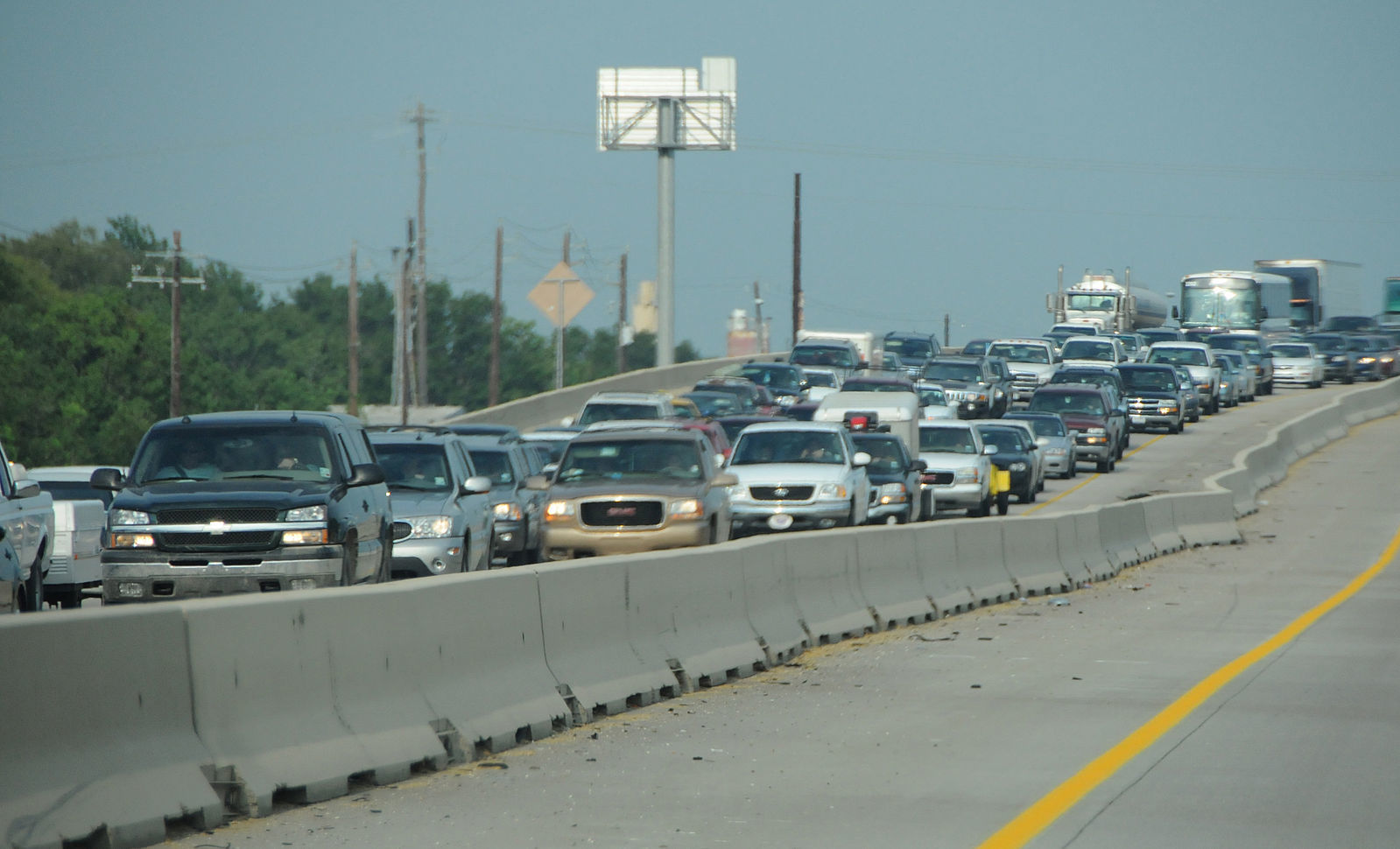
Hundreds of vehicles line the interstate outside of Beaumont, Tx. Mandatory evacuation orders were made in east Texas near the Gulf Coast in advance of Hurricane Gustav’s landfall in San Antonio. FEMA is working with State, local, and other Federal agencies in a joint operation in preparation for Hurricane Gustav’s landfall. Photo by Patsy Lynch/FEM


Learn why you might need to evacuate, decide what to bring with you, figure out where you’ll go, and make a plan for every member of your family. The Bug Out Book will help you create an evacuation plan for any disaster.

Grab yours here: The Bug Out Book
If you decide to stay…

If you decide that staying home and hunkering down is the best decision, then it’s time to commit to that decision.

You should, at the minimum (hopefully) have these supplies and more:

Water
Necessary prescription medications
A well-stocked pantry – you need at least a one-month supply of food for the entire family, including pets
An off-grid cooking method like an outdoor burner, a barbecue, a fire pit, or a woodstove)
Or food that requires no cooking
A tactical quality first aid kit
Lighting in the event of a power outage
Sanitation supplies (if the municipal water system is unusable, this would include cleaning supplies and toilet supplies)
A way to stay warm in harsh winter weather
Over-the-counter medications or herbal remedies to treat illnesses at home
A diverse survival guide, a comprehensive preparedness book, and a first aid manual (hard copies in case the internet and power grid are down)
Alternative communications devices (such as a hand-crank radio) so that you can get updates about the outside world
Off-grid entertainment: arts and craft supplies, puzzles, games, books, crossword or word search puzzles, needlework, journals (here are some more ideas to keep the kids entertained.)
Keep yourself and your home under the radar

Regardless of the reason you’ve hunkered down, vandals, looters, and thugs come out to play when disaster strikes.

Defense is two-fold. You want to stay under the radar and not draw attention to yourself. Some of the following recommendations are unnecessary during an ordinary grid-down scenario. Still, they could save your life in a more extreme civil unrest scenario or a situation that has gone long-term. It’s always better to be over-prepared than under-prepared. The best way to win a fight is to avoid getting into that fight in the first place. Secure your home and lay low but be prepared if trouble comes to visit.
Here are some tips to make your home less of a target:Keep all the doors and windows locked. Secure sliding doors with a metal bar. Consider installing decorative grid-work over a door with a large window so that it becomes difficult for someone to smash the glass and reach in to unlock the door. Install a door bar on your front and back doors.

Keep the curtains closed. There’s no need for people walking past to see what you have or to reconnaissance on how many people are present. If the power is out, put dark plastic over the windows. (Heavy duty garbage bags work well.) If it’s safe to do so, go outside and check to see if any light escapes from the windows. If your home is the only one on the well-lit block, it is a beacon to others.
Keep cooking smells to a minimum. Especially if there is a food shortage or everyone in the neighborhood is hungry, the meat on your grill will draw people like moths to a flame.
Don’t answer the door. Many home invasions start with an innocent-seeming knock at the door to gain access to your house.

Keep pets indoors. Sometimes criminals use an animal in distress to get a homeowner to open the door for them. Sometimes people are mean and hurt animals for “fun.” Either way, it’s safer for your furry friends to be inside with you.

Be ready for the potential of fire. Have fire extinguishers mounted throughout your home. You can buy them in 6 packs from Amazon. Be sure to test them frequently and maintain them properly. (Allstate has a page about fire extinguisher maintenance.) Have fire escape ladders that can be attached to a windowsill in all upper story rooms. Drill with them so that your kids know how to use them if necessary.
Do what it takes to defend your home

If your property draws the attention of people with ill intent despite your best efforts, firearms are an equalizer. A small woman can defend herself from multiple large intruders with a firearm if she’s had some training and knows how to use it properly. But put a kitchen knife in her hand against those same intruders, and her odds decrease exponentially.Don’t rely on 911. 

If the disorder is widespread, don’t depend on a call to 911 to save you – you must be prepared to protect yourself. First responders may be tied up, and the cops are not always your friends in some cases. In the aftermath of Hurricane Katrina, some officers joined in the crime sprees, and others stomped all over the 2nd Amendment and confiscated people’s legal firearms at a time when they needed them the most.

Be armed and keep your firearm on your person. When the door of your home is breached, you can be pretty sure the people coming in are not there to make friendly conversation over a nice cup of tea.

Make a plan to greet them with a deterring amount of force. Be sure to keep your firearm on your person during this type of situation because there won’t be time to get it from your gun safe. Don’t even go to the kitchen to get a snack without it. Home invasions go down in seconds, and you have to be constantly ready.

Know how to use your firearm. Whatever your choice of weapon, practice, practice, practice. A weapon you don’t know how to use is more dangerous than having no weapon at all. Here’s some advice from someone who knows a lot more about weapons than I do.
Make sure your children are familiar with the rules of gun safety

It should go without saying that you will have pre-emptively taught your children the rules of gun safety, so no horrifying accidents occur. In fact, it’s my fervent hope that any child old enough to do so has been taught to use a firearm safely and effectively themselves. Knowledge is safety.

Also, have a safe room established for children or other vulnerable family members. If the worst happens and your home is breached, you need to have a room where family members can escape. This room needs to have a heavy exterior door instead of a regular hollow core interior door. There should be communications devices in the room so the person can call for help. Also, there should be a reliable weapon to be used in the unlikely event that the safe room is breached. The family members should be instructed not to come out of that room FOR ANY REASON until you give them the all-clear or help has arrived.

You can learn more about building a safe room HERE. Focus on the tips for creating a safe room in an apartment to put it together quickly.
Always be ready for Plan B

Even if you plan to bug in, you must be ready to change that plan in the blink of an eye. Plan an escape route.

If the odds are against you, your house catches on fire, or floodwaters rise, devise a way to get your family to safety. Your property is not worth your life. Be wise enough to accept that the situation has changed and move rapidly to Plan B.
If you decide to go…

Nearly everything to do with bugging out needs to be done ahead of time. When the time comes to evacuate, you want to be able to put your plans into motion quickly and flawlessly. This reduces stress tremendously.

These actions are not last-minute actions. No matter what Plan A is, you need to have all of the above components in place long before any potential disaster occurs.
So….all of this and I didn’t answer your question

That’s because there is no single “right” answer. Hopefully, the information provided here has pointed out the important variables that will allow you to make good decisions.

The most significant part of preparedness is being able to adapt to the situation at hand. For us, bugging in is our Plan A. That doesn’t mean we have disregarded Plans B and C. (Bugging out to a friend’s place by car, followed by bugging out to the same friend’s place on foot.) We also have a second location should the first one be unavailable, which I suppose would be Plan D.

Don’t just make one plan. Make at least 3. Try to figure out the shortcomings of all of your plans and solve those issues ahead of time. Whatever your plan is, strict adherence to one course of action is extremely dangerous and short-sighted.

You may get through life never needing to evacuate or hunker down, but if you do, the speed at which you make your decisions could be pivotal in saving the lives of your loved ones.


Saturday, May 21, 2022

The Uncensored, Real-Deal Guide to Bugging Out of the City

 Original Article

The Uncensored, Real-Deal Guide to Bugging Out of the City


by Fabian Ommar


The concept of bugging out is one of the most discussed and controversial topics in preparedness and survivalism. The term “bug out” comes from the military. It means retreating, fleeing in a hurry, abandoning position in panic. This definition applies to the act of bugging out in survivalism as well. For the sake of objectiveness, let’s consider bugging out as fleeing the urban context because this is the current situation for most people. 

Given the tense situation building around the world, we’re about to see more and more people fleeing from the cities. Many of them have no idea what they’re doing so the definition above fits perfectly. As situations escalate, these relocations will be less planned and they won’t just be moving – they’ll be fleeing.

You can find entire chapters in numerous books, endless videos, articles, and treaties dedicated to the whys and hows of bugging out. The debates continue whether it’s the best or the worst idea ever for when the SHTF. 

This dilemma stem perhaps mostly from two conflicting factors:

Saturday, December 25, 2021

After the Bug Out

Original Article:


By Bill White


We all know that bugging out and being ready to bug out, is an important part of prepping.

I’ve seen countless articles about building a bug out bag through the years, along with countless lists about what to put in them. Most of those are pretty similar, but they all seem to have an item or tow that the author of that list thinks is important to have, and which others have ignored.

Which of us doesn’t want to have that proverbial cabin the woods, someplace we can take our family to, when everything else falls apart? For that matter, it would be nice to have that cabin, even with everything going good. Who doesn’t need a place to get away to? But having it set up to be a survival retreat, when everything else goes south, definitely makes owning that cabin more than worthwhile, even if we don’t get to get away every weekend.

The tricky part about that isn’t so much the cabin, that’s just expensive. It’s stockpiling the cabin, making sure it’s ready to use as a survival retreat. It’s hard to stockpile supplies in a remote place and even harder to make sure that those supplies are secure. So even while bugging out, our minds would be filled with questions of how we’ll find the retreat, once we get there.

Saturday, December 11, 2021

The Ultimate Guide to Bugging Out

by Tom Marlowe

Even if you are a complete newbie to prepping in general you have doubtlessly already heard the term BOB, meaning “bug-out bag”, referenced countless times in various articles, books and discussions on the matter.

The bug-out bag is the backpack you’ll carry containing all of your supplies you’ll need for the bug out itself that the pack is named for, the self-starting evacuation that will hopefully see you and your loved ones escape from trouble.


So that’s great. Now what do you do? Seriously, it is time to grab your pack, grab your family, and flee your home with the hope that you’ll reach someplace safe. Where do you go? How do you get there? What do you do?

Monday, October 11, 2021

SHTF Survival in the Mountains: What You Need to Know

by Tim Makay

Bugging out is a core tenant of prepping, and integral to the concept of bugging out is having in mind one or more bug out locations, places where you and your loved ones can head to in times of trouble so that you can better ride out whatever the problem is in safety, or at least relative safety compared to where you are.

Throughout history, threatened people and populations have fled into the mountains seeking a bastion against dangers big and small.

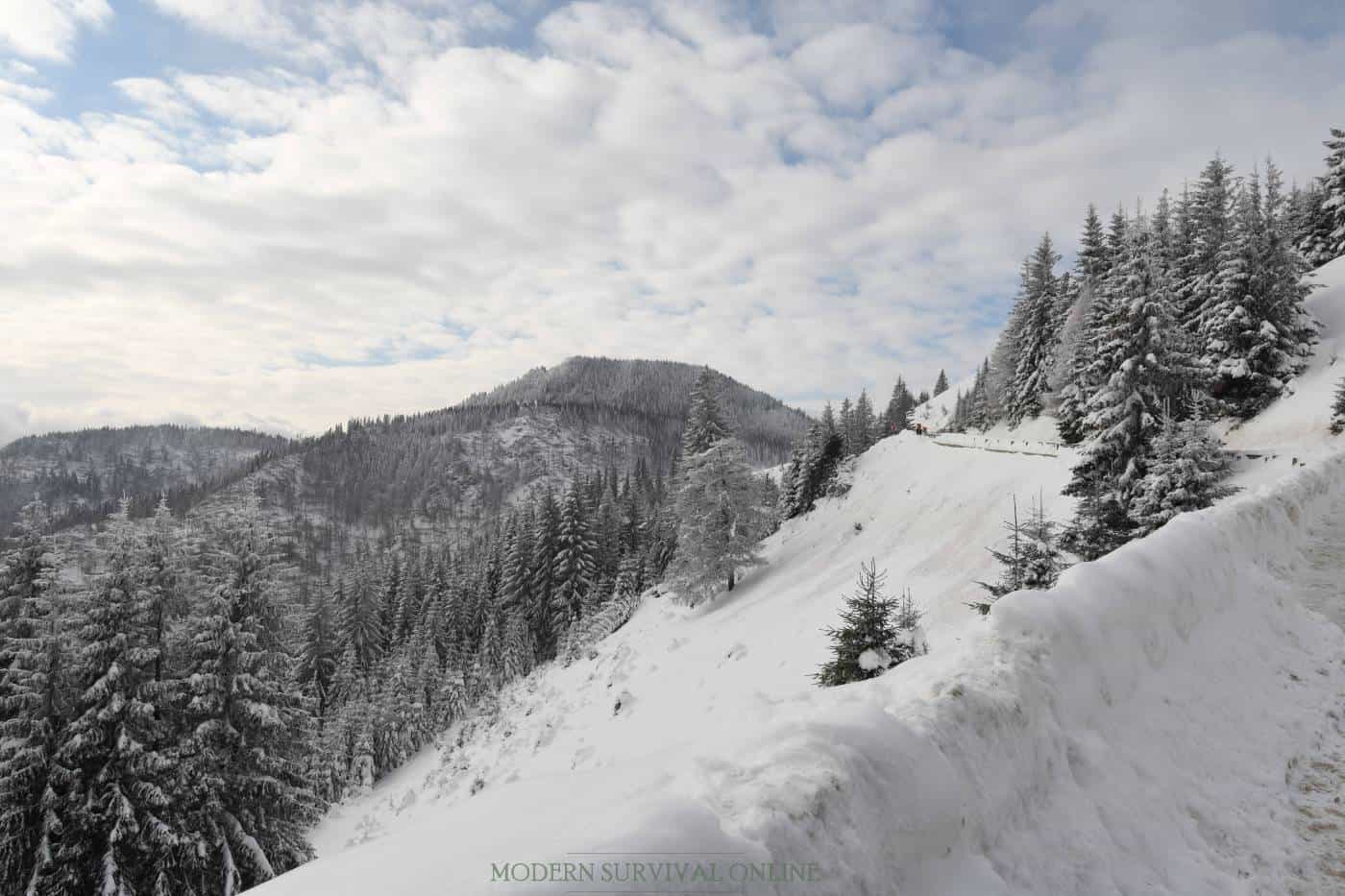
mountain during winter covered in snow

Sometimes, the mountains served as the backdrop of a valiant last stand and other times it served as a sanctuary, proof against all harm. More often, it turns out that the mountains themselves are an even bigger danger than what the refugees were originally fleeing from.

Friday, October 8, 2021

9 Group Bug-Out Ideas that Worked in the 1800s


By By Bill White


The idea of bugging out in the case of a disaster isn’t new. There have been many times when people left their homes throughout human history due to one disaster or another.

While some disasters came on so quickly that people couldn’t run, there were also those which gave people some opportunity to escape. For example, wars, volcanoes erupting, and droughts might offer a chance to escape for those who chose to take the risk and do so.

Bugging out from a disaster wasn’t the only reason people left their homes and migrated to some distant land unless you call lack of economic opportunity a disaster. Just like today, history is filled with examples of people who “bugged out” from their homes in search of a better life. This country exists because of that. The westward expansion of the United States in the 1800s also happened because of it.

Wednesday, January 27, 2016

Bug In Contingencies


Original Article:
Bug In Contingencies

Though Katrina hit more than a decade ago, I remember it like yesterday.  Forty-eight hours before the pundits at the National Weather Service finally decided on a landfall location, the local grocery stores were already picked clean like vultures working a road kill.  I only wish I had taken pictures of the mayhem.  I walked the aisles just to see what a premier national disaster does to a localized population of scared people.

By Dr. John J. Woods, a contributing author to Survival Cache & SHTFBlog

The hurricane itself would hit land some 150 miles away from our town, but the impact would be felt locally for days, months and years.  Anything fresh was gone, all the fruits and vegetables gone.  Fresh milk, cold juices, bottled water, soft drinks, and most of the beer were gone.  A lot of the meat was gone unless you wanted calves liver or some other weird cuts.  Cold cuts, cheeses, and all that were emptied out.  There was nothing on the shelves that remotely resembled bread, rolls, bagels, crackers, English muffins or anything else you could spread peanut butter or jelly on.  Oh, all that was gone, too.  Virtually everything else in the store food and drink wise had been bought out.  It was a ghost land.  If you had not been in the first wave of panic shoppers 72 hours before the storm hit, then you were flat out of luck.  The question is now and have we learned our lesson that if we plan a Bug In during a SHTF are we any more ready today, than we were ten years ago?

Societal Woes Arrive

Before I get into the meat of prepping your Bug In location for a SHTF, let me relay what also developed in the area where I live as a result of the evacuation of thousands of people from the Gulf Coast in advance of Katrina.  As fast as they could get north on the interstate highways, we had hundreds if not thousands of people descend upon our city.  Every motel room booked quickly.  Local restaurants were overwhelmed.  Even their food stores ran short.  A fair ground building was set up as a help center to house and feed people.  That situation ended up lasting for weeks.  I visited the site after it was finally closed and it was a virtual trash pile.  You might remember what people did to the Super Dome in New Orleans.  We had the same thing only on a smaller scale.

You Might Also Like: SHTF Firearm Choices

To abbreviate the details, for several months, many of these refugees remained in the regional area.  Crime shot up 200%.  Construction, roofing, and clean up crews flocked into the area from all over the country.  Some literally preyed upon the citizens taking money, promising services, and then disappearing.  It took law enforcement and other authorities too long to get a handle on controlling all of this activity.  It left a really sour taste in the mouths of many, even those poised to help the honestly needy.

My point is, besides preparing your own property to withstand and survive any kind of a SHTF, you also have to prepare for the aftermath.  In fact, in our case the aftermath was actually worse than how the SHTF impacted the region.  At my own house and neighborhood we were lucky.  Sure we went five days without power in August, when temperatures went over 100 degrees but we unofficially bonded together as neighbors to watch things and maintain control over our residential area.  For days, I sat on the front porch eying trucks with out-of-state, out-of-county license plates file down the streets looking for opportunities.  Perhaps it was the AR lying across my lap in the rocking chair that deterred them from stopping at my place.  I hope so.

Home Assessment

You need to conduct a firsthand, thorough evaluation of your Bug In house and property.  If you live in a housing residential area, then look around your house and your immediate neighbor’s houses to get a complete understanding of access points, how outsiders might get to your back door, easy access windows, garage doors, or other points of entry.  You may elect not to harden these against oppressive entry because of the expense and hassle, but at least you will know your home’s weak points.  Today, they make all kinds of secure window and door entry covers to keep out everyone but the most ardent determined thug.  If those jacks want in, about all you can do is shoot them out a porthole.

Also Read: Do You Need An AR15?

Most garage doors you can lock down in a variety of ways.  However, like I mentioned above the really talented thieves will have a gas powered disk saw that will slice through an aluminum garage door or some steel home doors in a matter of seconds.  They can also cut through the roof, around window frames, through non-brick sidewalls and other suspect points of entry.  If you do not or cannot protect all of these points, then you have to devise a planning and train to defend yourself from inside.

Hey, Nobody is Home Here!

I’d love to hear from everyone in the comments below if you think posting a sign like that outside would have an impact on deterring any unwanted entry.  I have seen metal signs at gun shows that say things like “There is nothing in this house worth your life for breaking in” or whatever.  I am just doubtful such postings would deter anyone.  Perhaps a painted marking on the outside of the house as in post-Katrina that identifies the house as searched and secured as nobody being home?

Related: SHTF vs. TEOTWAWKI

Having said that, I think during any kind of a SHTF either natural or unnatural that you want to maintain a low profile around your Bug In residence, unless you and a survival team or neighbors actively conduct armed patrols outside in full view.  During the day, stay in the house as much as possible.  Use only one exit and entry, one that is more out of public view from the street.  At night, blacken a room you can stay in or keep all windows in the main living area securely covered permitting no light to be seen.  Go outside yourself to double check this. This approach of course is a point of debate.  Is it better to show a presence (armed) or maintain a discrete lack of visibility?  What do you think?

Bug In SHTF Supply Up

This becomes the hard and fast of the survival part.  You have to stock up enoughwater and food to sustain yourself for the long haul, while not even knowing what that means.  I think maybe we all hope whatever kind of a SHTF occurs, that at some point, hopefully sooner than later, that calm and public resolve will be returned to normal.  If you are optimistic, then I say plan on sustaining you and your family for a minimum of a month.  If you lack faith in the “system” then you might want to think in terms of six months.  I cannot imagine the efficiency, manageability, affordability, and space to keep enough supplies to hold out at a Bug In (or Out for that matter) for that long.  Perhaps I am self-deluding here?  What say you?

Related: Breaking The Law When The SHTF

I recall when attending the University of Missouri back in the late 60s and 70s that the library in the center of campus was a storage site for supplies in the event of aNBC (nuclear, biological, or chemical)attack.  Big drums of supplies, food, and water lined the basement halls and book stacks.  As I look back today, no way would all those supplies have lasted hardly any time at all for a campus population of say 25,000 students, not counting everybody else.  See my point?

So, anyway, initially think in terms of holding out for a month.  That alone will be taxing enough.  You may decide to go with plastic tubs, cardboard cases, or canisters of commercially available survival foods,MREs or other foods.  I can see that as a good option, expensive, but not a bad plan.

You other options made easier by Bugging In at your own residence is to supply up with tons of canned goods of all kinds to weather the SHTF.  I will not detail here nutritional requirements, quantities, calories, food prep, or such.  There are much better resources out there to study for this information, but do keep these ideas in mind especially how you will “cook” food on what and such.

Just keep everything in perspective in terms of how many people you have to feed, and what their general likes and dislikes are.  If you buy ten cases of potted meat, but nobody will touch it with a ten food pole, then you made a bad choice.  Water supplies could be a real issue.  It would be nice to hope that the sink tap water will continue to flow, but what if it does not or it is not drinkable?  Storing large quantities of drinking water is problematic.  I recommend filling milk jugs or other large gallon water containers to keep in the garage or basement.  Maybe this could be done at the Nth hour before a storm of any kind hits, like they recommend filling bathtubs for extra water.  I would plan on maintaining some water supplies though.  It will always take more than what you planned on.

Also Read: Networking After TSHTF

A survivalist friend of mine maintains a stock of 50 cases of 24-bottles each of plastic bottled water.  He rotates it by purchase dates.  He only has 2-3 people at home to worry about, so I would think this much water would last a while, but who really knows how long?  At least that is a start.

Now, make a list of all the other supplies you might need besides food and water.  A starting list might include medicines, OTC items, paper products, candles, cell batteries, solar panel re-chargers, clothing, cleaning supplies, personal hygiene items, extra eyeglasses, medical/first aid kit(s), back up heater(s), fuels, propane, charcoal,AM-FM radio(s)CB radioscanner, water filter, fire extinguisher(s), so on and so forth.

Bug In Defense

I hope at a future date to develop another article dedicated in more depth to this subject.  For now, just know and realize that you may not be WEVISIply huddle up in your Bug In home and hope to be left alone.  I suspect or fear for some preppers that are not inclined as many of us are to be aptly prepared to defend ourselves against unwanted intrusions to our domicile.  This can be a very scary situation even for those that think they are prepared.  It is just another reality of the SHTF aftermath.  Let’s be honest, few of us are really prepared to shoot or kill another human being, but it might come to that in defense of our family.  Scavengers are very likely to be about their business of robbing homes and businesses of anything of what they deem is valuable.

Remember the thugs pushing shopping carts down the streets of New Orleans in three feet of water loaded with electronics and other merchandise?  This could and likely will happen even in your quiet little neighborhood, too, depending on how out of control everything gets after the SHTF resides.  Expect it, prepare for it, and hope it never happens.  So, there is a very thin thumbnail sketch of some Bug In contingencies that you may have to deal with and prepare for.  We can sometimes see natural SHTFs like storms and severe weather coming somewhat in advance.  Societal collapses are more difficult to predict.  Some get out of hand so quickly it is hard to react, aka Ferguson, MO.  Of course, planning and preparation is the key to survival.

Photos By:
Apocalypse 101
Dan Davis

Friday, May 2, 2014

10 Bug Out Options

Original Article

by Code Name Insight
Bugging out is a pretty hot topic.  There are BOBs (bug out bags), BOVs (bug out vehicles), BOLs (bug out locations), BOCs (bug out cabins), et al.  Many people think that "bugging out" doesn't happen until TS hits TF and society crumbles into a flaming heap but the necessity to bug out, and the various bug out equipment/supplies/etc will actually come into play much sooner than TEOTWAWKI.

It may be something small (like a wild fire heading your way), medium (like a chemical spill that empties your town) or bigger (like Hurricane Katrina bearing down on your city) but these are all occasions when bugging out is a good idea (or better than a good idea, legally mandated).  Where will you go if you need to clear out of your home and possibly your city on a moment's notice?  Here's ten options:

  1. A community shelter.  These are set up when there is a disaster in your area that displaces more than a few home's worth of people.  A fire, for example, might displace a few families at which time the Red Cross usually shelters them in hotels but when there is displacement of A LOT of people, shelters that can house up to a hundred or more people are generally set up.  Community shelters are also set up when people can not shelter themselves due to the severity of the problem (ie: a tornado shelter for folks living in mobile homes, a warming shelter when the power is out for a whole community, etc).  On a scale of "wonderful places to bug out to" these rate pretty low.  But they are better than nothing.
  2. Nearby neighbors, friends, and family.  If the problem that sent you fleeing from your home is limited in area (a small wild fire or flooding in low lying areas for example), one of your better bug out options may be with nearby neighbors, friends, or family.  This is generally good for the short term and leaves you close enough to your home so you can do/help with your own recovery, make further arrangements, etc.  Not a bad place to bug out to depending on the situation (you need to get along well with these people and the fewer people bugging out the better as bringing a family of two to stay is usually easier than bringing in a family of eight).
  3. Hotels and motels.  Whenever there is a disaster, a common place for people to bug out to is either nearby or further away hotels or motels.  This gives you more autonomy and privacy than staying with friends or family but can also get expensive quickly.  Some of these places will give you better rates if you intend to stay for a longer period of time or if they know you have been in a disaster.
  4. Family and friends further afield.  If the disaster is big enough, you may not be able to stay near to your home and may be forced to travel further away to seek shelter.  Staying with family or friends who live further away from you is a good option.  This is often a cheaper option (they may allow you to stay for free for at least a certain period of time) but the issue may be how to get there if roads and other transportation options are down.
  5. Boat or RV.  Nothing like sheltering in your own "home away from home".  If you have a boat or RV, along with a full gas tank, and the roads aren't too badly damaged, traffic isn't massively backed up, and/or access to useful waterways is available, this may be one of your best options.  You will be mobile so you can relocate at a moment's notice and you will have privacy plus many of the comforts of home.  Obviously this is higher up on the scale of expensive bug out options.
  6. Camping.  For a short-term bug out, camping may be an option.  Obviously you need the gear/food/fore planning to do this.  Some of the negatives to bugging out in this manner are that, depending on the disaster, many other people may have the same idea so crowding at your intended camp spot may be an issue, security may be an issue (people may not be so nice is extreme situations), the weather can be an issue, and overall, camping due to circumstances instead of by choice can be downright unpleasant (plus you will need to source/create your own food, water, shelter, latrine, etc).
  7. Squat.  Living in a squat can be either better or less better than camping but not by much.  If your area is demolished but there are still buildings standing, these places look like good enough places to shelter for many.  Again, safety and security will be issues (either with law enforcement or other residents), as will basic living resources (water, food, hygiene) but if the choice comes down to sleeping in a cardboard box or in a perfectly useful vacant building I'd probably pick the vacant building.
  8. Bug out cabin or second home.  The image is ideal...you need to leave your home in a hurry due to disaster or other reasons and you have a perfectly good second home or cabin waiting for you.  The three problems you may have with this set up are #1 the expense (it is expensive to pay for two complete houses, utilities, etc), #2 security when you aren't there (your second home may look like a good target for others either to squat in or to loot with or without you there), and #3 getting there (how will you get there during a disaster?). 
  9. Another country.  In an extreme bug out situation, high-tailing it to another country may be an option.  Note that this would make you a REFUGEE which is an overall unpleasant experience by all accounts.  But extreme times require extreme measures so if this is one of your bug out options, you need to be ready by having a passport, the means to get there and set yourself up for your stay, and a plan for what to do next.
  10. On the move.  Slightly better or slightly worse than being a refugee--depending on the situation--would be a roaming refugee.  Sure it is possible to grab your BOB or your bike and just keep on moving from place to place camping one night, couchsurfing another etc. until you come up with a better plan but this is yet another situation where your safety and security could be at risk not to mention the fact that you will still need to be able to provide the basics like food and water for yourself.
Enhanced by Zemanta

Thursday, August 2, 2012

Bugging Out – Will You Make It There?

Original Article

bugging-out

When disaster happens, will you stay or will you go? How will you decide which to do or when it’s time to do it? If you decide to bug-out, where will you go and how will you get there? There are lots of questions and they require lots of thought, BEFORE ‘it’ happens.

Okay, for the sake of this article, the S has hit the fan and you’ve decided to run, to get out, to bug-out, to ‘get out of Dodge’.

Maybe you were at work when ‘it’ happened and you are about to make your way home. When you think about it, two-thirds (or more) of a 24-hour day we spend at work, away from home. The odds are fairly high that the SHTF could happen while we are at work.

Maybe you were at home when ‘it’ happened and you have decided to bug-out to a place where you believe it will be safer, because you live in a fairly high population density region and you fear the troubles which may come your way because of it. You may be fortunate enough to have a secondary rural retreat, or you may have friends or family that live out in a more rural (less population dense) region who are willing to have you in during the crisis.

In either scenario, how will you get to your chosen place? Answer: You may walk, or more likely you will drive. If you are to drive, hopefully you have thought ahead of time about the following considerations for your vehicle and immediate bug-out plan…

Car in good shape
The last thing you need in an emergency is an unreliable vehicle. Do not put off that maintenance or new tires, etc.

Spare gas
Assume that no gas will be available. You will only get as far as the quantity of gas will allow you to, so always keep your gas tank as full as possible. Try a self imposed rule of filling it when it hits 3/4 tank. Keep spare gas in safe storage or safely in your trunk or the back of the truck. Fuel Stabilizer for long term storage.
Excellent maps

Topo maps of your region are a much better aid than just plain old road maps, although road maps are better than nothing at all. Keep a compass with your map, and know how to use it. Maybe GPS… but don’t count on it working in every disaster scenario.

Off-road capability (4WD)
Surmounting obstacles or navigating off the beaten path may prove to be your only way out of some situations. Having a four-wheel-drive vehicle will help drastically in this area.

Emergency equipment in car
Things like flat tire repair kit, duck tape (hose repair), spare belts, oil, water for radiator, tools, tire jack, and other things related to keeping your vehicle running.

72-hour kit in car
This kit is designed to keep ‘you’ running and includes food, drinking water, and supplies to sustain you for 72-hours. A three day supply has been commonly accepted as adequate for a vehicle, assuming that you will either get to your supplied destination by then, or you will be rescued or found by then.

How will you get around any potential obstacles?
If the disaster is weather related, trees or debris may be blocking some roads. Know ways around, or have a chainsaw and winch with you.

Traffic jams
During a major disaster ‘event’, most or all roads will be hopelessly jammed. During a bug-out, this will likely be your primary obstacle to getting where you want to go, and will require some forethought so that you stand a chance to avoid this very large obstacle. People are like sheep. They will all flock to the same routes home (or the same routes out of town). Few will have the brains to purposely travel on back roads. Here is a HUGE tip… avoid traveling the segment of a road that comes upon and intersects with an on-ramp or off-ramp of a highway or other ‘major’ road. These will become clog zones – even though you simply intended to cross over or under the highway on your way down that road, you may become ‘stuck’. Look for a way across a highway where there is no highway ‘exit’ there.

Above all, what’s the backup plan if you can’t get through to your destination? Survival preparedness is all about backup plans. For example, do you have a secondary bug-out destination as part of your plan? Do you know how to get there? Have you thought about other means to acquire more gas during your journey? Do you have enough cash to buy what you need during the outset of the disaster while people are still accepting it? Again, there are always lots of questions, and all of them are good ones because they make you think about it. Survival starts with thinking and using that noodle between your ears.

Appreciate topics of survival, emergency preparedness – or planning for disaster?
Read our current articles on Modern Survival Blog
twitter: MSurvivalBlog
Facebook
Similar Articles You Might Enjoy:


Friday, June 8, 2012

Frugal Prepping - Bug Out Bag Alternatives

Corrugated shipping container, one type of &qu...Corrugated shipping container, one type of "cardboard box" (Photo credit: Wikipedia)

Original Article


The most common Bug Out Bag is generally in the form of a backpack. This is mainly to afford you with an easy method of carry that leaves your hands free for other tasks and offer quick and afford easy access for the transport of the basic necessities that may be required. Thankfully, they aren’t your only option.
Bug Out Bags have some drawbacks that can create problems that can be solved by using other options. These other options are inexpensive but are still effective in serving your needs. Here are just a few of the alternatives that can be used for a Bug Out Bag.
Bug Out Bag Alternatives
1. Bug Out Bucket - Buckets are very versatile items that can be found rather easily for free or at an inexpensive price. They can hold a significant amount of items but also work to limit the weight factor and generally can offer extended protection for your bug out gear items. One of the major drawbacks of a backpack is that people generally tend to over pack their BOB’s until they are almost too heavy to carry any distance and if they sit around for an extended period of time don’t offer significant protection from pests or moisture. A bucket is not going to give much, no matter how hard you try to stuff items into it. Yet it still offers significant protection for your gear and generally will have a handle as well. It can also serve a number of secondary purposes such as a means to carry water from a remote source. 
2. Bug Out Box - A simple cardboard box can also be used instead of a Bug Out Bag. They are extremely tough, inexpensive and come in a large variety of sizes. While it may not offer a comparable level of protection as a bucket, it is a very frugal alternative. A small to medium size box will put some limitations on what you can carry but this only helps you to keep the weight factor down. They are also easily stored and stacked. If your budget allows, you could even use plastic storage bins as a cheap alternative.
3. Bug Out Blanket - Even a simple blanket when made into a swag will offer you a cheap alternative for use as a Bug Out Bag. In fact, you could use just about any type of material you have available. If you’re looking for a little protection from moisture for your gear, you could easily use an old shower curtain tied off with some paracord to make a bindle, especially if you needed to bug out in a hurry.
In a survival situation, it’s important not to place arbitrary limits on how you seek to accomplish things. It’s important to focus on your immediate goals and use whatever means and resources that are available to your advantage.
You will need every advantage you can get in a survival situation.
Staying above the water line!
Riverwalker
Enhanced by Zemanta


Tuesday, February 21, 2012

Know Multiple Routes ‘Out’

Original Article

multiple-evacuation-routes

How many driving routes do you know from your place of work to home? How many driving routes do you know should you have to evacuate from your city or town or workplace? How many roads along these routes are major roads traveled by the majority of others?

Why is this important?

Because during a time of disaster, emergency or evacuation, you, along with most others will be sharing the same roads together, and they very well may be clogged or impassible.

Face it, we are all creatures of habit, including the routes and roads that we travel on a regular basis. During ‘normal’ times, commuting to and from work can be busy enough as it is – but imagine it magnified by a disaster situation where nearly everyone is scrambling to get out at once.

Nearly everyone will instinctively head out to the same roads that they normally travel. You however may have the opportunity to outsmart them all, having previously planned several routes out of your location, roads that are less traveled and are off the beaten trail, so to speak.

What should you look for or focus on while planning out alternative routes?
  • Roads that are not traveled by the main stream.
  • Don’t be too concerned if your alternative route is longer than your normally traveled route.
  • Neighborhood streets that zig-zag their way alongside main roads may serve you better.
  • Avoid routes with bottlenecks of roads which come together at major traveled intersections.
  • Roads with fewer traffic signals may be better.
  • There are often lesser known ‘shortcuts’ through the countryside, older roads which once were main routes and have mostly become forgotten.
  • GPS can be great, but be sure to keep street-level maps of your region.

You should discover these alternative routes, and then drive them once in a while. Not only will it be a nice change of scenery, but you will be assured of multiple ways out if you have to evacuate.

Be Prepared. If you enjoyed this, or topics of current events risk awareness and survival preparedness, click here to check out our current homepage articles…

Similar Articles You Might Enjoy:

Tuesday, November 29, 2011

The 3rd Wave, Evacuation From A Disaster Location

Original Article

determine evacuation clearance times 800x800 The 3rd Wave, Evacuation From A Disaster LocationLet me preface this article by acknowledging the source for the idea of this article comes from another peppers’ video. Unfortunately, it’s been a long time I’ve mulled over this topic and I don’t recall who exactly it was.
With that out of the way, let’s get started.
The subject of evacuation from a disaster location, or evacuation in advance of a potential disaster (such as a storm), has been written about here and on other sites ad nauseum. But the timing of an evacuation isn’t usually discussed in detail. That is the topic of this article.
In general, during an SHTF event there is likely going to be 3 waves of evacuations.
1st Wave
These are mostly going to be the people who already live their lives on a hair-pin trigger just waiting for any small sign that a disaster is brewing. “Neurotic” is certainly an accurate if not flattering description. It also includes a small number of people, either by gifted insight or blind luck, connect the dots early and come to the conclusion that a major SHTF event is approaching.
The number of people evacuating probably will be very low. Most people will either refuse to believe anything bad is going to happen (“normalcy bias”) or fail to see the early warning signs and connect the dots.
Supplies like food, water, fuel etc will be at normal levels of availability and you should make every effort to top-off with fresh supplies before leaving. Similarly, currency will still be readily available and accepted. Retailers should have little problem resupplying at normal schedules (if you choose to risk waiting a bit longer for additional supplies).
Traffic will be light to normal with little or no additional law enforcement/government control issues. People in surrounding communities will likely not even notice you as you pass through, perhaps pausing for more supplies, refueling etc.
2nd Wave
By this stage the danger (or at least the signs of the danger) is becoming far more apparent and harder to ignore, though many more will still refuse to accept what events seem to be leading up to (footnote: Some argue we are already in this stage). This wave will be characterized by a much wider swath of people taking their leave of the affected area(s). Not just preppers but “average” (non-preppers) too will be getting nervous and start leaving. Early signs of panic may be setting in too.
Supplies, especially of food, water, and fuel will start becoming noticeably harder to find (and likely more expensive) with less products on the shelves, even some empty shelves, and longer lines. Resupply to retailers will be slower. ATMs will start running out of cash. Bank branches themselves will run low or out of cash as branches only keep a small amount of actual currency on hand every day (for security and liquidity reasons).
Services too may become harder to obtain as “the [pick a color] flu” mysteriously falls upon employees in all manner of government and private business (i.e. people choose not to come into work to either stay home with their families or evacuate – a topic for another article soon).
A much larger number of people will be on the roads and other transportation methods. Traffic will be much greater and nerves tenser (more road rage). Also, the availability of other means of transport (train tickets, bus tickets etc) will be in greater demand and less available. There may be an increased law enforcement presence on the roads especially at bridges and tunnels, probably more for traffic control.
Surrounding communities and even further out from the affected area will see a rapidly growing influx of out of area people. Initially there may be some welcome as they bring a fast economic boost to the community, buying supplies etc. But that will likely switch over to resentment and possibly forceful rejection as smaller community supplies dwindle and people just keep coming and demanding more.
3rd Wave
In this wave all your neighbors, preppers or not, have reached the same conclusion: Time to get out of Dodge!
At this point the danger is upon you. The SHTF event has happened or is on the cusp of happening. It is acknowledged (perhaps begrudgingly but still acknowledged) by all but the most intransigent people who still refuse to accept the reality of the situation and cling to hopeless ideas everything will be fine and/or someone (i.e. government) will do something to make it all better. At this point these people are likely never going to be convinced and, cruel as it may sound, don’t waste any more time trying to. They may already be beyond helping.
Supplies will be very hard if not impossible to get. Store shelves will be wiped clean. Fuel may be unavailable as retailers have drained their tanks and resupply unlikely. There may even be fuel rationing as whatever local supplies are ordered saved for “official use only”. Bank branches will likely be closed and ATMs long since emptied of cash.
The roads will likely be packed and tempers will be high. Fear and panic will set otherwise calm people off at any little provocation. Some level of civil unrest may ensue especially if it is perceived there is an official policy to slow or prevent people from leaving (such as some kind of check point or vehicle searches).
The masses of evacuees will spread throughout the surrounding geography and likely overrun smaller surrounding communities thereby overwhelming their own stocks of retail supplies and services. Tempers will be high, violence likely. Don’t be surprised if small communities even try to block the main roads into their areas.
By the time the 3rd wave of evacuees comes if you still haven’t left most likely it’s too late to even try. For all the reasons above and more it will be impossible, or at the very least highly risky, to even attempt to leave. You are probably better off digging in and trying to wait out the event (depending what the event is).
I believe the key to success in this is to determine your “trigger event”. Determine clearly and precisely what actions or events prior to an SHTF event will prompt you to implement your evacuation plan. You have to be reasonable and specific. Life is full of daily unexpected events and you can’t be “bugging out” every time there’s a news flash.
Above all, I believe it comes down to trusting your gut instincts. Don’t be ruled by what others are doing, or more likely not doing. Don’t be afraid to make the decision to leave. You may get ribbed for it later if nothing bad happens. But I assure you deep down a lot of those people jabbing you wish they had thought to leave too and had the strength of character to actually do it themselves.


Sunday, October 30, 2011

Guest Post: About Laying Low (bugging in), By Northern Raider


© 2011Northern Raider


In general in the UK many members of our community are now focusing their efforts on bugging in, IE living full time in the locality of their Bug Out Location, such as (wisely) moving out of the cities, bypassing the burbs and moving lock stock and barrel to a small rural community. They normally still maintain the capability of bugging out if forced to by retaining BOBS, Caches, BOVs etc but they focus primarily on prepping their normal home to be their retreat.

The British preppers are now assessing the growing problems of (A) being able to bug out successfully and (B) finding a secure and safe BO Location when they do bug out.

Gross overcrowding and overpopulation in many areas combined with a road system that is even on a normal day close to gridlock for at least 6 hours each day. They note that even a single vehicle accident such as a car and caravan overturning can lead to massive tailbacks and localised gridlock for hours, especially as the police of today appear to thrive on closing roads often for 24 hours to investigate every possible fact of the accident. Indeed we all know of cases where entire regions have become gridlocked because of a small accident, or road works, or bank holiday traffic, or ½ inch of snow or sporting event or the dreaded farmer accidentally tipping an overloaded trailer full of hay bales onto the road. Heck up here the three main north south roads became gridlocked one day recently because  of a herd of horses got onto one of the roads.

Consider also our unpredictable climate, there is a 3 in 4 chance it will be bad weather to content with as well.(Cold, Wet, Windy or even all three)

We also consider the problem of bugging out during a crisis if 20 million unprepared and panic stricken people decide to flee the towns and head to the hills.

Consider for one moment if the riots of August 2011 spread to every city and large town and the violent unrest continued for a week, Our police and military could never hope to contain it, this could see millions trying to escape the fires and looting.

Consider the implications also that as well as you trying to cope with 20 million evacuees but also perhaps the public transport systems are not working either because the train, tube and bus drivers are among the 20 million heading out of town as fast as they can.

Consider also the fact that if mass panic did occur and the 20 plus millions did decide to flee how many of them are equipped to do so?   How many of them will have enough food and fuel and more importantly how many out of say 20 million refugees have a destination to go to where they will be welcome.

Consider also the government, regional and local authorities along with the military will not want 20 million souls plus a few hundred preppers clogging the roads and paths and exhausting the immediate fuel stocks within hours.

Those considerations among other are making many preppers choose to relocate now and attempt to adopt “The Good Life”.

(Yes I know there is equally as many preppers with the most wonderful and varied reasons why they just cannot move right now, I’ve given up trying to reason with them and now just encourage them to become very capable Urban Preppers)

So where does this leave us folks who have relocated to the boonies and perhaps what issues do we need to consider?
In the short term if rural preppers are to survive the initial crisis and the immediate aftermath I think we are all in agreement that not being disovered by the authorities or by packs of feral sheeple will feature highly for the first few weeks. This in itself will give us some interesting issues to overcome.

We are living and surviving in our rural retreat, we need to stay warm, stay clean, stay healthy, stay motivated, stay alert, stay secure and stay fed.  That is a lot to deal with if the world around us is unravelling.

I see problems with running central heating because boilers (furnaces in Americanese) need power as well as gas, and nearly all modern CH systems have noisy vent systems which on a quiet day or night can be heard from hundreds of yards.

I see problems with wood burning and multi fuel stoves if we use them during the day because even bone dry wood and supposedly smokeless fuel  both smoke until they are up to operating temperature, not to mention the smell of burning wood and coal can be detected for over a mile.

I can see problems with lighting if very strong blackout protocols are not in place, I don’t think lined curtains will be sufficient, shutters and boards probably will need to be in place at least before dusk.

I see problems with concealing larger livestock and keeping all livestock both quiet and secure in the initial post collapse period

I see noise from firearms may persuade SOME more cautious types to avoid your area of operations, but equally I foresee other bolder and possibly better armed people being attracted by the gunshot.

I see people noticing wind turbines more if they are actually turning and are more likely to investigate them, I feel turbines may need to only be turned on after dark, and ideally lowered out of sight during the day.

Water wheels and water turbines are noisy, they can be more easily concealed than wind turbines but they will need very good noise suppression measures.

If you are using motor vehicles and animals for transport or patrolling you are going to have to be very careful you don’t leave a trail of hoof prints or tyre marked mud heading back to your retreat. Indeed you don’t really want the sound of a 4x4 engine heading repeatedly back to the place you live in.  Once the societal collapse has settled down engine noise will become far more apparent.

Folks even the good lady wife boiling up cabbage could be the cause of your discovery as the smells of many cooked meats and veg travel long distances, and the hungrier the sheeple the most sensitive their noses are.

Your stockpile of firewood or coal will need to be well hidden at all times as will the parking arrangements for your BOV. Aerials for radios will need to be lowered during the day or well hidden.

In the short term at least noise reduction protocols will need to be very strongly kept in place, especially at night. In time after the die offs and rage has subsided you will gradually be able to relax and start rebuilding and hopefully enjoy a long and fruitful life.